Use the 2026 Benchmark
Evaluate execution maturity across seven dimensions, distinguish activity from impact, and identify the evidence needed to scale.
Explore the BenchmarkAI Execution Gap
Most organizations have AI ideas, tools, and pilots. The harder problem is turning that activity into governed workflows, clear ownership, prioritized use cases, adoption, and measurable results.
Most organizations do not have an AI idea problem. They have an AI execution gap.
Book a Private BriefingWhat It Is
The AI Execution Gap is the disconnect between AI activity and AI outcomes. It appears when an organization has experiments, tools, pilots, or executive pressure, but lacks the operating conditions required to turn AI into measurable workflow impact.
The gap is the distance between AI activity and measurable, governed workflow adoption.
AI Execution Gap
Choose Your Path
Whether you are exploring the issue, diagnosing your organization, or ready for a deeper advisory assessment, the AI Execution Gap campaign gives you a path.
Evaluate execution maturity across seven dimensions, distinguish activity from impact, and identify the evidence needed to scale.
Explore the BenchmarkSee why AI efforts stall between strategy, experimentation, governance, workflows, and adoption.
Read the ReportGet a quick signal across six execution dimensions and identify your top blocker.
Get Your Gap ScoreUse the 10-business-day diagnostic to identify what to fund, fix, stop, or pilot next.
Start the AssessmentUse a focused executive conversation to brief your team on the AI Execution Gap and the practical path forward.
Book a BriefingEstimate the business value that may be trapped behind weak workflow integration, unclear ownership, poor prioritization, or limited adoption.
Estimate AI ROISix Dimensions
Execution breaks down when one or more of these operating conditions is missing.
Score these dimensionsAI priorities connect to business outcomes, sponsorship, ownership, and funding logic.
Opportunities are ranked by value, feasibility, risk, and workflow impact.
Required data is accessible, trusted, governed, and connected to the systems where work happens.
Privacy, security, compliance, vendor review, human oversight, and acceptable-use practices are clear.
AI is embedded into real processes, decisions, handoffs, and operating behaviors.
Teams have the training, communication, incentives, and iteration loops needed to make AI stick.
AI Decision Rights
AI execution slows down when everyone supports the initiative but no one is clear about who has the right to decide what happens next.
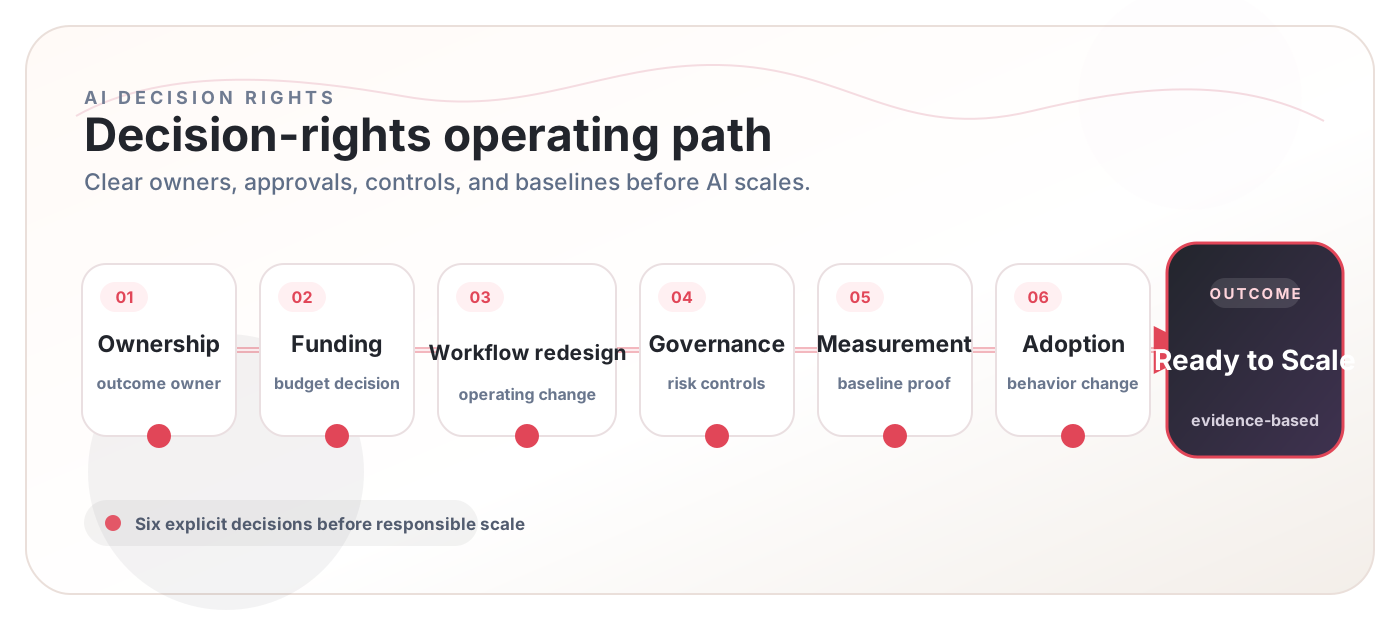
AI pilots can look promising and still stall if decision rights are unclear across AI funding decisions, workflow redesign, data access, AI governance, baseline metrics, AI measurement, AI adoption, and AI scale decisions. Teams need to know who owns the outcome, who can approve changes, who can stop or revise a pilot, and who decides whether AI becomes part of the operating rhythm.
Clear decision rights turn AI from an experiment into an operating discipline. They help leadership teams decide what to fund, what to fix, what to pause, and what to scale.
If those decisions are unclear, the issue is usually not the model. It is the AI Execution Gap.
Use the AI Execution Gap Scorecard to identify your strongest and weakest execution dimensions, read the Executive Field Report for the broader framework, browse the AI Templates & Toolkits library, or start the AI Execution Gap Assessment if your team needs a decision-ready roadmap.
Read the Executive Field ReportWho owns the business outcome, not just the tool? Every AI initiative needs a clear operating owner accountable for workflow impact, adoption, and measurable business impact.
Who decides whether the use case deserves budget, more time, or a stop decision? Funding should be tied to expected value, baseline metrics, readiness, and pilot evidence.
Who can change the workflow? AI often requires new handoffs, exception paths, review steps, and operating behaviors so the tool becomes part of workflow automation.
Who approves acceptable use, data boundaries, vendor risk, human oversight, and escalation paths? Governance should be part of execution, not an afterthought.
Who defines the baseline and determines whether the pilot worked? AI teams need agreed metrics before launch, not after the demo.
Who owns training, communication, trust, and ongoing behavior change? Adoption should be planned before rollout, not treated as a post-launch activity.
Diagnostic Signals
These symptoms show up when AI activity is increasing but the operating layer for value capture is not yet in place.
Diagnose your top blockerAI Adoption Debt
InitializeAI defines AI adoption debt as the accumulated execution work left behind when AI tools launch without corresponding workflow redesign, ownership, training, governance, integration, and business measurement. The organization may appear to be adopting AI, while unresolved operating work quietly makes future value harder to capture.
Like other forms of organizational debt, the cost is rarely visible at launch. It appears later as duplicate work, inconsistent usage, added review, unmanaged risk, tool sprawl, and slower decisions about what should scale.
The hidden liability
Activity can grow faster than execution readiness.
How the backlog compounds
What begins as a launch gap can become an operating dependency carried into more teams, tools, and workflows.
Access expands before the operating use case is fully defined.
AI is added beside the process rather than designed into it.
Employees use AI and still complete the original manual steps.
Usage expands without consistent guidance, review, or adoption support.
Teams rely on AI without clear ownership, fallback, or monitoring.
The organization cannot isolate gains in cost, capacity, quality, speed, or risk.
Execution debt ledger
These accounts connect deployment activity to the operating work still required. They are diagnostic categories, not a debt score.
AI usage expands without a named business owner accountable for the workflow outcome, user behavior, operating support, and measurable result.
Visible symptomThe tool has an administrator or technical sponsor, but no one owns whether it changes the business process.
AI is layered onto an existing process without redesigning handoffs, exceptions, review steps, approvals, or downstream actions through deliberate AI workflow automation.
Visible symptomEmployees use AI and still complete most of the original manual workflow.
AI use cases rely on fragmented data, manual transfers, inconsistent sources, or temporary integrations that become harder to maintain as usage grows.
Visible symptomTeams repeatedly copy, export, reconcile, or verify information across systems.
Usage expands faster than AI governance for acceptable use, data boundaries, vendor review, human oversight, escalation, documentation, and monitoring.
Visible symptomDifferent teams apply different rules to similar AI use cases.
Organizations provide access without sufficiently redesigning roles, training users, reinforcing behavior, supporting managers, or measuring correct workflow use.
Visible symptomLicense usage may rise while consistent operating adoption remains low.
AI launches without a documented baseline, target metric, data source, accountable metric owner, or review cadence.
Visible symptomLeadership can describe activity but cannot demonstrate business impact.
Executive FAQ
Use these questions to separate visible AI activity from reliable enterprise AI adoption.
AI adoption debt is the accumulated execution backlog created when AI usage expands faster than the organization redesigns workflows, assigns ownership, prepares data and systems, establishes governance, trains users, and measures business outcomes. It is the work that still must be completed before AI activity can become a reliable operating capability.
AI adoption debt does not mean that experimenting with AI is inherently harmful. It means unresolved implementation work should be made visible and managed before temporary workarounds become permanent operating dependencies.
Tool access is not the same as workflow adoption.
AI adoption debt often appears through operating friction rather than a single technical failure. Teams may have many tools and pilots while still relying on manual work, inconsistent review, scattered guidance, duplicate vendor capabilities, and unclear success measures.
A growing number of AI users can coexist with growing adoption debt.
The cost of AI adoption debt is broader than software spend. It can appear as duplicate effort, rework, inconsistent decisions, added review, integration maintenance, fragmented vendor management, slower employee adoption, delayed risk resolution, and missed business value.
The debt compounds when unresolved work is carried into additional teams, use cases, vendors, and workflows.
Organizations can reduce adoption debt by treating AI deployment as an operating-model change rather than a software rollout. Each material use case should have a workflow owner, documented baseline, redesigned process, approved data boundary, human-review model, adoption plan, success measures, and explicit scale or retirement decision.
Prevention does not require slowing every experiment. It requires distinguishing bounded learning from unmanaged production dependency.
Executives should trace each meaningful AI initiative from the tool to the workflow, owner, users, data, controls, baseline, outcome metric, and next decision. Missing links reveal where adoption debt is accumulating.
The AI Execution Gap Scorecard can help leadership identify whether the strongest debt is accumulating in alignment, use-case quality, data readiness, governance, workflow integration, or adoption.
Portfolio decision output
A useful review should turn scattered AI activity into an actionable portfolio view: which tools and workflows are creating value, which need operating redesign, which require governance or adoption support, which overlap, and which should be paused or retired.
Explore the AI Execution Gap
Use the AI Execution Gap Scorecard to identify whether leadership alignment, use-case quality, data readiness, governance, workflow integration, or adoption is preventing AI activity from becoming measurable business value.
Execution Path
InitializeAI helps leadership teams turn AI uncertainty into a practical execution path: diagnose the gap, assess AI readiness, prioritize the right use cases, address governance and workflow blockers, and move toward measurable AI pilots.
Use the scorecard or assessment to locate the weakest execution dimensions.
Separate fundable opportunities from expensive distractions.
Address ownership, data, risk, workflow, and adoption issues before scaling.
Move forward with pilots that have owners, metrics, workflows, controls, and a scale/revise/stop decision path.
Proof of Focus
InitializeAI focuses on operational outcomes, governed adoption, and workflows that can be measured.
AI-powered logistics routing and workflow optimization.
Predictive audience targeting and dynamic personalization.
Forecasting support for budgeting and service planning.
Readmission-risk and operational efficiency support.
Who It Is For
Clarify what AI efforts deserve funding and which risks need attention.
Identify workflows where AI can improve speed, quality, or capacity.
Connect AI ambition to data, systems, integration, security, and governance realities.
Create practical guardrails without blocking responsible adoption.
Prioritize AI opportunities and move teams from experimentation to execution.
Identify AI value creation opportunities and readiness gaps across operating companies.
Next Step
Start with the free scorecard, read the field report, or move directly into the 10-business-day assessment if your leadership team needs a decision-ready roadmap.
Book a Private Briefing