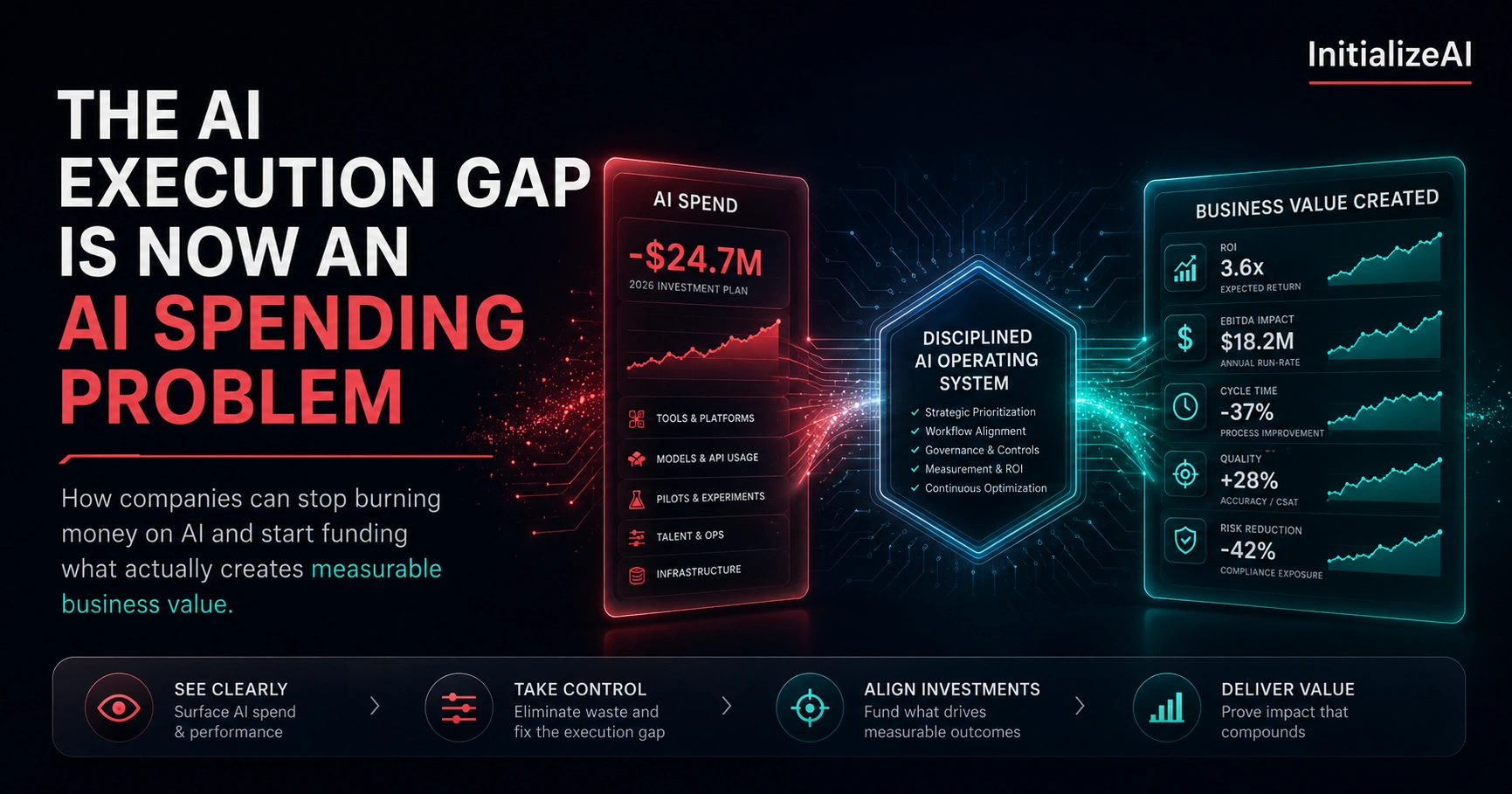
How companies can stop burning money on AI and start investing in the workflows, pilots, and operating systems that actually create measurable business value
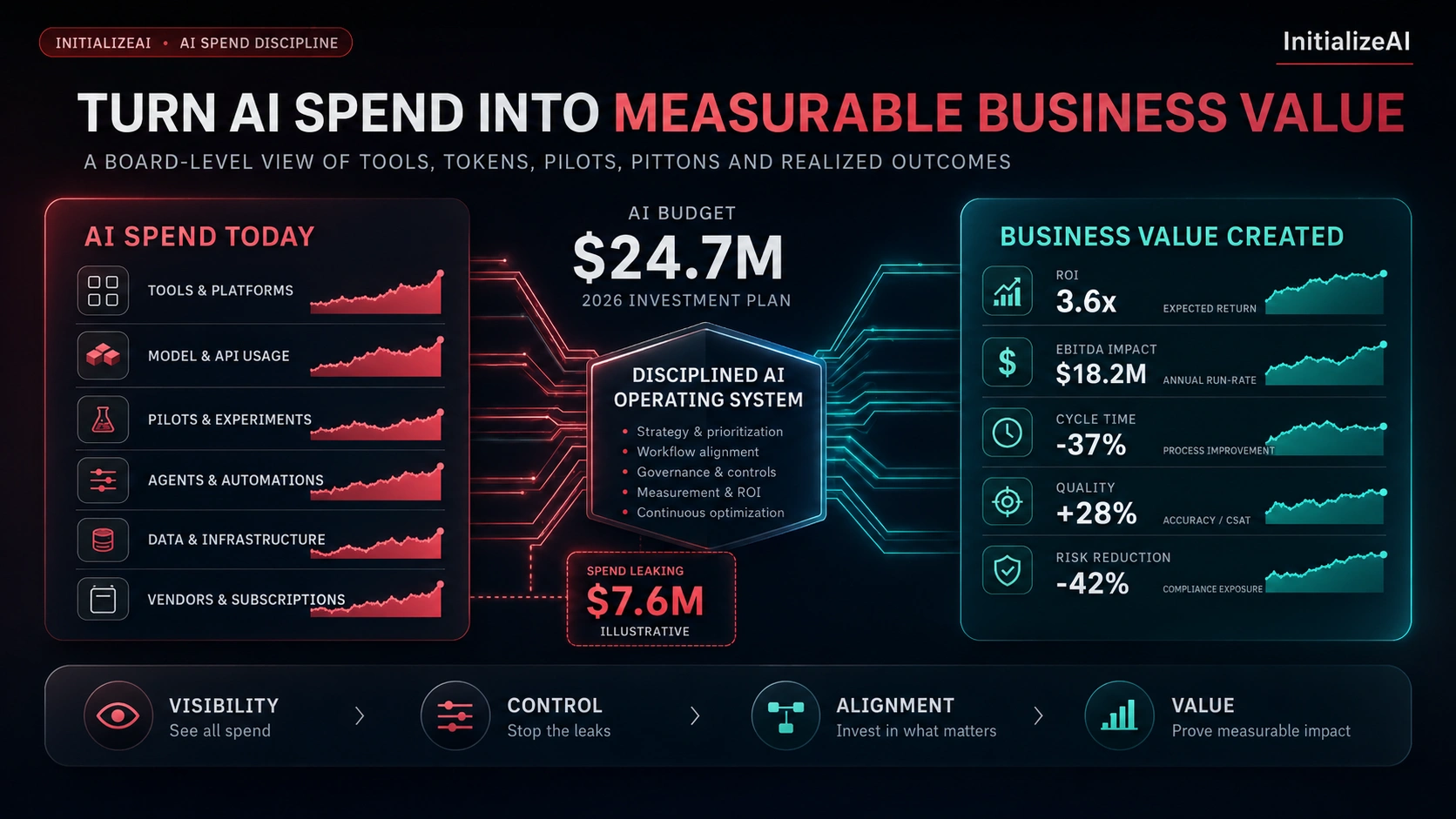
Media note: InitializeAI is available to comment on AI spending, AI ROI, token waste, tool sprawl, pilot debt, and AI governance. See the For media and analysts section below for quotable perspectives and suggested attribution.
AI has entered a new phase.
The first wave was about access.
Who has ChatGPT? Who has Copilot? Who is experimenting with agents? Who is testing AI coding assistants? Who has a generative AI roadmap? Who has a vendor demo impressive enough to get leadership excited?
That phase is ending.
The next phase is about accountability.
AI is no longer just an innovation-budget experiment. It is becoming a material operating expense, a board-level priority, and, increasingly, a CEO-level performance issue.
Gartner has forecast that worldwide AI spending will reach $2.52 trillion in 2026, a 44% year-over-year increase, while noting that AI will not truly scale across the enterprise until ROI becomes more predictable. Gartner
BCG has also reported that companies expect to roughly double AI investment in 2026, from about 0.8% of revenue to 1.7% of revenue, while nearly three-quarters of CEOs now say they are the primary AI decision maker in their organization. BCG
That is a remarkable shift.
AI is no longer merely something the innovation team explores. It is becoming a major budget category, a strategic investment area, and a source of increasing scrutiny.
But there is a problem.
Spending is scaling faster than value realization.
Axios recently described the current moment as “AI sticker shock” hitting corporate America, with business leaders questioning whether ballooning AI costs are producing meaningful returns. Axios
Reuters reported that Commonwealth Bank of Australia’s CEO warned AI costs can rise in unpredictable ways as companies move from simple tasks to more complex reasoning, tool use, and larger context windows. Reuters
Business Insider also reported that Amazon shut down an internal AI usage leaderboard after it encouraged employees to chase token usage rather than solve meaningful business problems. Business Insider
This is the moment every executive team should pause and ask a harder question:
Are we investing in AI — or are we just funding AI activity?
Because those are not the same thing.

The new AI cost problem is not simply that AI is expensive
It is tempting to reduce the current conversation to a simple headline:
AI costs too much.
But that is not quite right.
AI can be expensive. The real problem, however, is not the cost of AI in isolation.
The real problem is unmanaged AI spend without a clear execution system behind it.
Some AI spend is strategic. It creates leverage. It improves cycle time. It reduces rework. It increases throughput. It helps employees make better decisions. It improves customer experience. It unlocks new revenue. It turns fragmented knowledge into operational intelligence.
Other AI spend is just noise.
It shows up as unused licenses, overlapping tools, shadow AI subscriptions, experimental pilots that never reach production, agents that consume tokens without changing business outcomes, custom prototypes that are never integrated into workflows, and vendor contracts signed before the organization knows what it actually needs.
That is why the AI spending problem is really an AI Execution Gap problem.
At InitializeAI, we define the AI Execution Gap as the distance between an organization’s AI ambition and its ability to turn that ambition into measurable, governed, scalable business impact.
When that gap is small, AI investment becomes disciplined.
When that gap is large, AI spend leaks value.
The AI Spend Leak
The AI Spend Leak is the difference between what a company spends on AI and the measurable business value that spend actually produces.
It is not always obvious at first.
The dashboards may show adoption. Employees may be using AI tools. Vendors may be running pilots. Innovation teams may be producing impressive demos. Leadership may feel the organization is “doing AI.”
But underneath that activity, value can disappear in small, compounding ways.
A pilot is launched without a business owner.
A tool is purchased before the workflow is understood.
An AI assistant is deployed without baseline metrics.
A team celebrates time saved, but no one verifies whether that time becomes revenue, margin improvement, faster delivery, lower risk, or better customer experience.
An agent is given too much autonomy before cost controls, quality checks, and approval paths are defined.
A vendor is selected before data access, security, governance, and integration requirements are clear.
A model is used because it is powerful, not because it is the right economic choice for the task.
That is the AI Spend Leak.
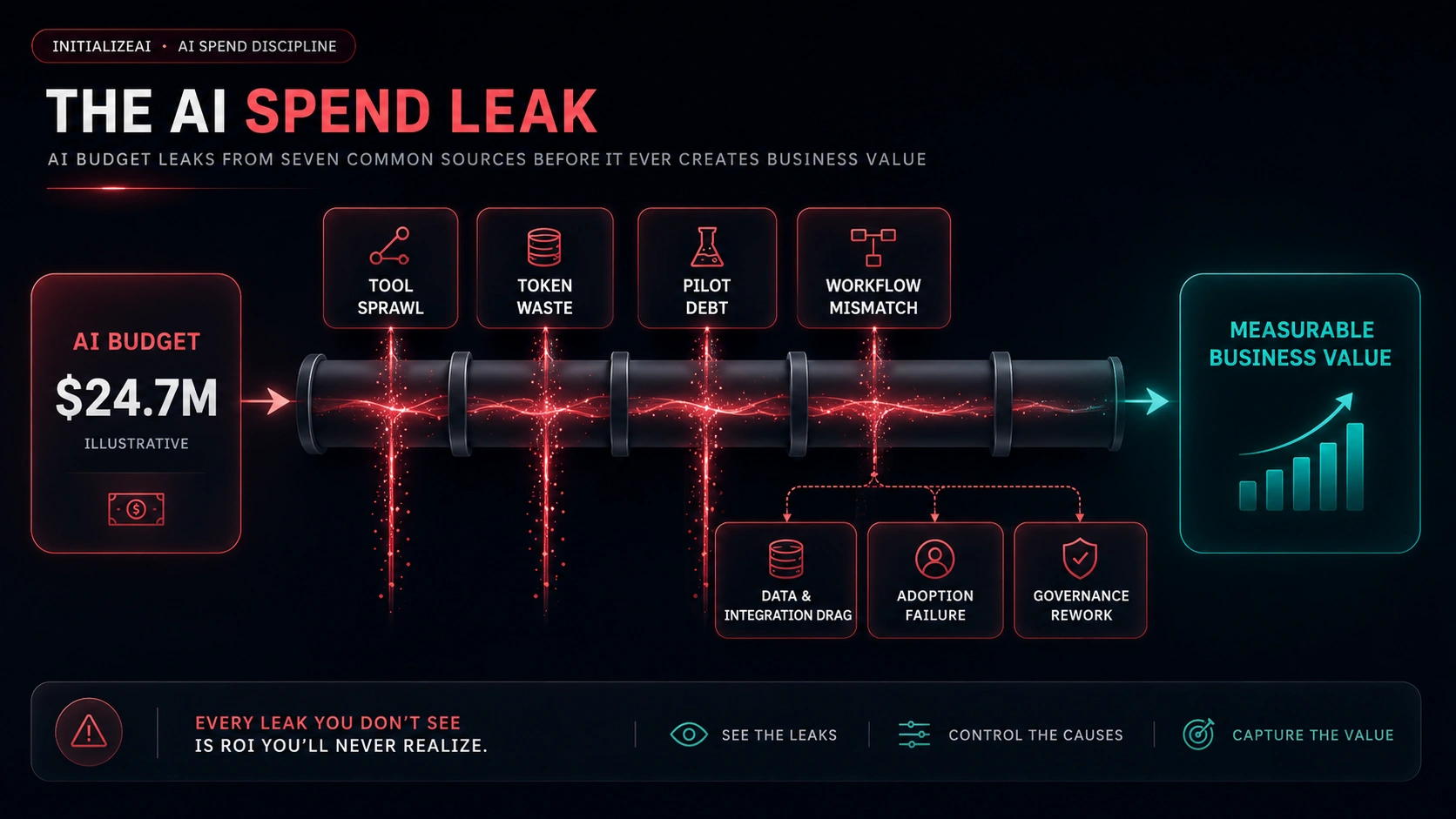
And it is becoming more visible because AI is shifting from fixed software subscriptions to variable consumption-based economics.
With traditional SaaS, a company might overspend on licenses.
With AI, a company can overspend on licenses, tokens, compute, workflow disruption, data preparation, integration work, vendor services, governance rework, change management, and failed pilots — all at the same time.
That is why AI spending discipline is becoming a leadership issue, not merely an IT issue.
The dangerous illusion: “More AI usage means more AI value”
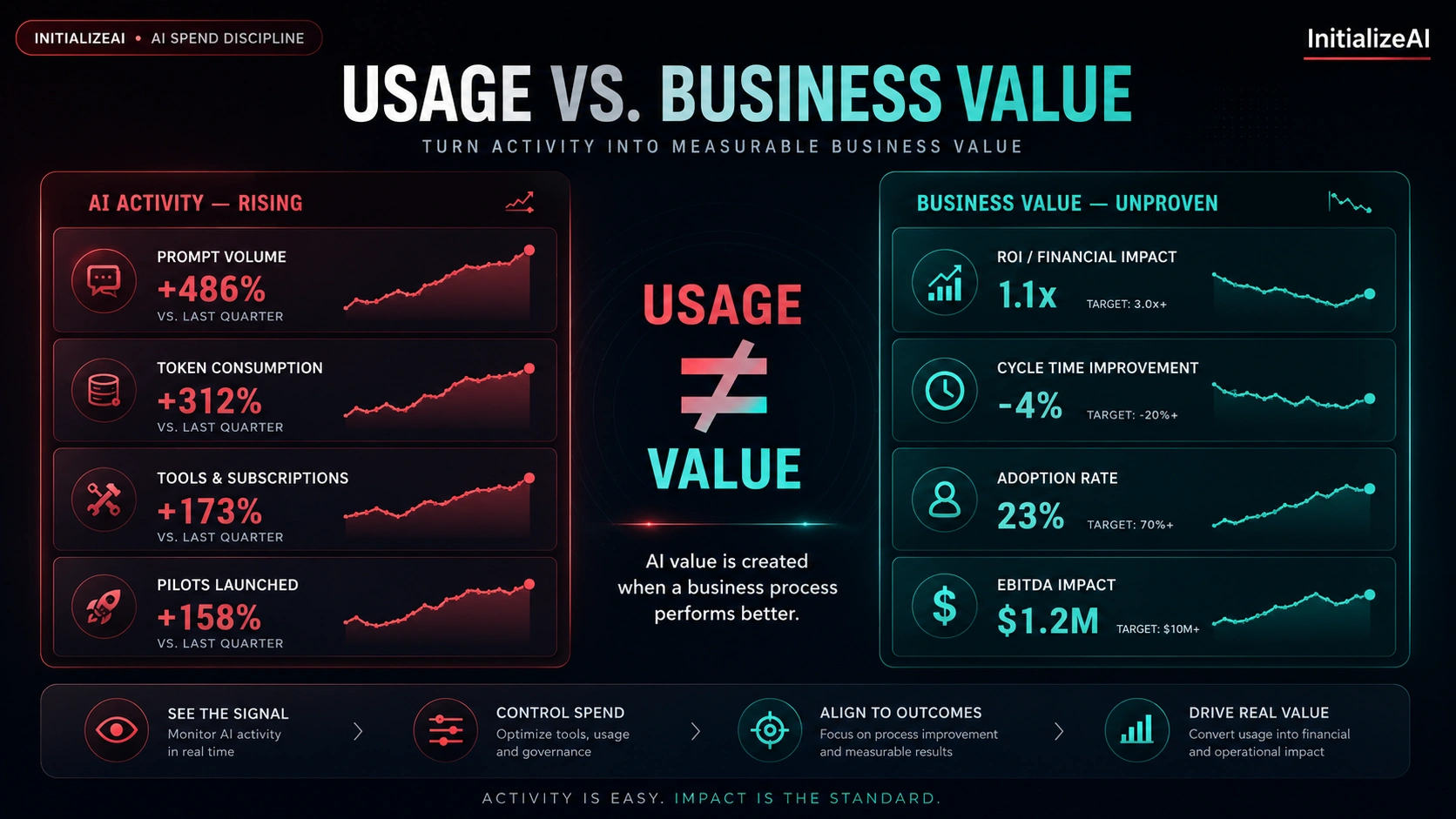
One of the most important lessons from the recent AI cost backlash is that usage is not the same as value.
A company can increase token usage and still fail to improve productivity.
A company can deploy AI copilots and still fail to reduce operating costs.
A company can launch agents and still fail to improve customer outcomes.
A company can run dozens of pilots and still fail to scale one meaningful use case.
This is why the Amazon “tokenmaxxing” story matters. According to Business Insider, Amazon deprecated an internal leaderboard that tracked AI token usage because it encouraged some employees to perform tasks that did not necessarily solve business problems. Amazon’s message was straightforward: do not use AI merely for the sake of using AI; use it to solve customer and business problems. Business Insider
That distinction is critical.
The goal is not more prompts.
The goal is not more AI-generated documents.
The goal is not more pilots.
The goal is not more agents.
The goal is measurable business improvement.
That may mean faster quote generation, fewer support escalations, shorter close cycles, better field-service documentation, lower compliance review costs, faster month-end close, improved forecast accuracy, reduced customer churn, fewer warranty claims, higher first-time fix rates, or better executive decision-making.
AI value is not created when a model produces output.
AI value is created when a business process performs better.
The ROI gap is now impossible to ignore
The current AI cost conversation is not happening in a vacuum.
IBM has reported that only about 25% of AI initiatives deliver expected ROI, and only 16% have scaled enterprise-wide. IBM also found that many CEOs expect AI investment growth to more than double, even while half of surveyed CEOs say rapid investment has left their organizations with disconnected, piecemeal technology. IBM IBM Newsroom
MIT NANDA’s 2025 State of AI in Business report found a similarly stark divide: despite tens of billions of dollars in enterprise GenAI investment, the vast majority of organizations were not yet seeing meaningful return, while a small minority of integrated pilots were extracting significant value. MIT NANDA Report
BCG has also framed the current moment directly: AI has entered the “prove it” stage, with investment enthusiasm outpacing measurable returns. BCG reports that many companies still see minimal or no value from AI despite significant effort. BCG
These numbers should not lead executives to conclude that AI does not work.
They should lead executives to a better conclusion:
AI does not create value merely because it is deployed. AI creates value when it is attached to the right workflows, measured against the right baselines, governed with the right controls, and scaled through the right operating model.
That is the difference between AI experimentation and AI execution.
Why companies burn money on AI
Most companies do not waste AI budget because they are careless.
They waste AI budget because they are moving fast without the right decision system.
The pressure is understandable. Boards are asking about AI. Competitors are announcing AI initiatives. Employees are experimenting with tools. Vendors are promising transformation. CEOs do not want to be late.
BCG’s 2026 survey shows that CEOs and boards may agree that AI matters, but still diverge on strategy, pace, understanding, and ROI expectations. BCG
That misalignment creates exactly the kind of environment where companies spend quickly but unevenly.
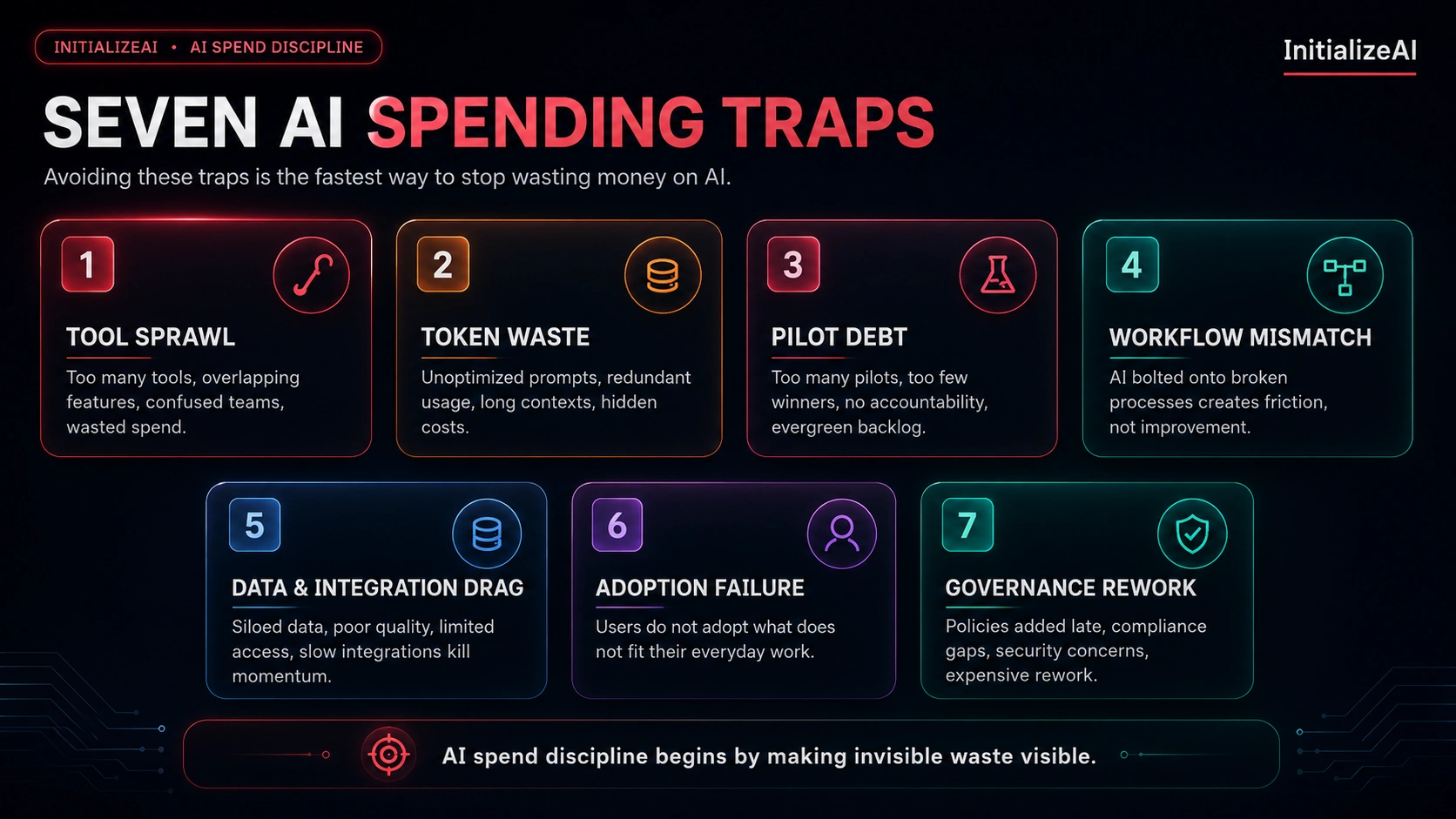
The result is a predictable set of AI spending traps.
1. Tool sprawl
Tool sprawl happens when every function buys its own AI solution without a shared enterprise view.
Marketing buys an AI content platform.
Sales buys an AI prospecting platform.
Customer support buys an AI chatbot.
Engineering buys AI coding tools.
HR buys an AI recruiting assistant.
Finance pilots AI forecasting.
Legal tests AI contract review.
Operations experiments with AI workflow automation.
Each purchase may be reasonable on its own. But together, they create overlapping capabilities, inconsistent data access, duplicated vendor spend, fragmented governance, and weak visibility into what is actually working.
Tool sprawl is not just a cost issue.
It is an operating-model issue.
A company that does not know which AI tools are in use cannot govern them. A company that cannot govern them cannot manage risk. A company that cannot manage risk cannot scale confidently.
The fix: Build an AI spend inventory and map every tool to a business workflow, owner, cost center, data source, risk category, and measurable outcome.
2. Token waste
Token waste happens when AI usage grows without cost routing, model selection discipline, usage monitoring, or business-value thresholds.
This is becoming more serious as companies move from simple prompting to agents, coding assistants, retrieval-augmented generation, tool calls, long-context workflows, and autonomous systems.
Business Insider recently reported that Mercor’s CEO said the company now spends more on AI tokens for internal agents than on employee salaries, a striking example of how AI can become a major operating cost when agents are embedded across business functions. Business Insider
That may be rational for some AI-native companies.
But for most enterprises, the lesson is not “avoid AI agents.”
The lesson is that AI agents need cost architecture.
Not every task needs the most powerful model.
Not every workflow needs long context.
Not every request needs real-time generation.
Not every process needs an autonomous agent.
Not every model call needs to happen at all.
The fix: Create model-routing rules, usage tiers, token budgets, approval thresholds, prompt and context optimization, caching strategies, and cost-per-workflow reporting.
3. Pilot debt
Pilot debt is the accumulation of AI experiments that consumed time, budget, executive attention, vendor support, and internal resources — but never became production capabilities.
Pilot debt is dangerous because it can look like progress.
A demo is built.
A prototype works.
A vendor deck is impressive.
An innovation team declares early success.
But no one has answered the operational questions:
Who owns the workflow?
What system of record does this connect to?
What data is required?
What happens when the model is wrong?
Who approves the output?
What is the baseline?
What metric must improve?
What is the cost per transaction?
What is the scale plan?
What is the kill criterion?
What business case justifies production?
Without those answers, a pilot is not an investment.
It is a lottery ticket.
The fix: Require every AI pilot to have a formal pilot charter, baseline metrics, success thresholds, governance requirements, implementation owner, adoption plan, and scale-or-stop decision date.
4. Workflow mismatch
Many AI initiatives fail because they are attached to interesting tasks instead of economically important workflows.
This is one of the biggest reasons AI spending disappoints.
A company automates something visible, but not valuable.
It improves a task employees dislike, but not a process that affects revenue, margin, risk, cycle time, retention, or customer experience.
It builds a chatbot because chatbots are familiar.
It creates a document assistant because document generation is easy to demonstrate.
It launches an agent because agents are exciting.
But the workflow itself may not matter enough.
McKinsey’s 2025 State of AI research found that AI high performers are far more likely than others to fundamentally redesign workflows, and that workflow redesign is one of the strongest contributors to meaningful business impact. McKinsey
That point is essential.
The companies getting value from AI are not just adding AI to existing workflows.
They are redesigning the work.
The fix: Prioritize AI use cases by business value, feasibility, workflow readiness, data readiness, risk, and scale potential — not by novelty.
5. Data and integration drag
AI does not create enterprise value in a vacuum.
It needs access to the right data, systems, permissions, knowledge bases, workflows, and feedback loops.
When companies ignore the integration layer, AI initiatives become disconnected from the business.
Employees may use a tool, but the tool does not update the CRM, ticketing system, ERP, document repository, finance workflow, claims system, project management platform, or field-service system.
The AI produces output, but the business process still requires manual re-entry, review, reconciliation, or cleanup.
IBM’s CEO research found that 68% of surveyed CEOs view integrated enterprise-wide data architecture as critical for cross-functional collaboration, while 50% say rapid investment has left their organizations with disconnected, piecemeal technology. IBM Newsroom
That is the cost of moving fast without architecture.
The fix: Evaluate data readiness and integration requirements before funding AI pilots, not after the demo.

6. Adoption failure
AI spend is wasted when the technology is available but the organization does not change how work gets done.
This is the quietest form of AI waste.
Employees may have access to AI, but no training.
Managers may encourage usage, but no workflow redesign.
Executives may approve tools, but no adoption metrics.
Teams may experiment individually, but no standard operating procedures change.
Deloitte’s State of AI in the Enterprise research has found that worker access to AI is rising quickly, while expectations for production scaling remain high. Deloitte
But access alone does not equal transformation.
More employees using AI is not the same as more business value from AI.
The fix: Pair AI deployment with role-based training, workflow redesign, manager enablement, adoption metrics, and clear expectations for how the process should change.
7. Governance rework
Many companies treat AI governance as a late-stage compliance activity.
That is a mistake.
If governance is added only after a pilot is built, the organization may discover too late that the solution cannot be used with sensitive data, cannot satisfy security requirements, cannot support auditability, cannot explain outputs, cannot meet procurement standards, or cannot operate within acceptable risk boundaries.
Then the company pays twice: once to build the pilot, and again to redesign or abandon it.
Governance is not the enemy of AI speed.
Poor sequencing is.
The fix: Define governance early enough to accelerate safe scaling. That includes data classification, model usage rules, vendor review, human-in-the-loop requirements, audit logs, security controls, risk tiering, approval rights, and acceptable-use standards.
The right response is not “spend less on AI”
The companies that win with AI will not be the companies that simply cut AI budgets.
They will be the companies that learn how to spend wisely.
There is a major difference.
A company can reduce AI spend by canceling tools, slowing pilots, restricting model access, and forcing every AI request through procurement. That may reduce waste, but it can also suffocate the very experimentation needed to find high-value opportunities.
The better move is to shift from AI cost control to AI investment discipline.
Cost control asks:
How do we reduce the AI bill?
Investment discipline asks:
Which AI spend deserves more funding, which should be redesigned, and which should be stopped?
That is the more strategic question.
The goal is not to spend as little as possible.
The goal is to stop funding low-value AI activity so the organization can confidently fund the use cases that actually matter.
What wise AI spending looks like
Wise AI spending has a different operating rhythm.
It does not start with a vendor demo.
It starts with a business problem.
It does not start with “Where can we use AI?”
It starts with “Which workflows are expensive, slow, risky, inconsistent, knowledge-heavy, or strategically important?”
It does not measure success by usage.
It measures success by operational and financial improvement.
It does not treat AI as a technology project.
It treats AI as a business transformation capability.
In practical terms, wise AI spending means every AI initiative has:
| Requirement | Why it matters |
|---|---|
| A named business owner | Someone must be accountable for business value, not just technical delivery. |
| A workflow target | AI must attach to a process that matters. |
| A baseline metric | The company needs to know the before state. |
| A success threshold | The team must define what improvement justifies scaling. |
| A cost model | Leaders need to understand software, tokens, compute, integration, support, and change-management costs. |
| A governance tier | Higher-risk use cases require stronger controls. |
| A scale path | A pilot without a scale path is usually just a demo. |
| A stop rule | Not every AI initiative deserves to continue. |
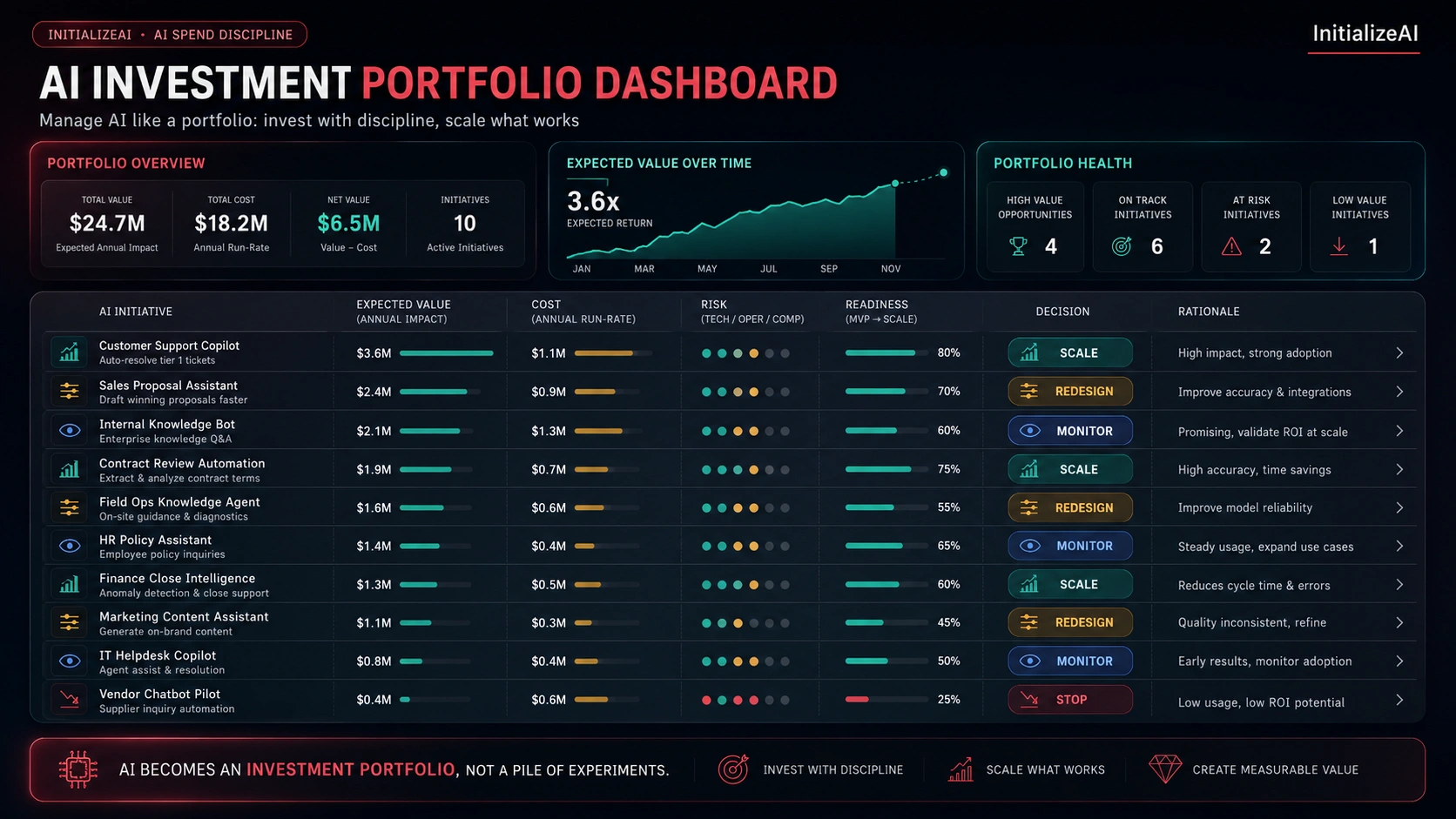
That is how AI becomes an investment portfolio rather than a pile of disconnected experiments.
The InitializeAI AI Spend Discipline Framework
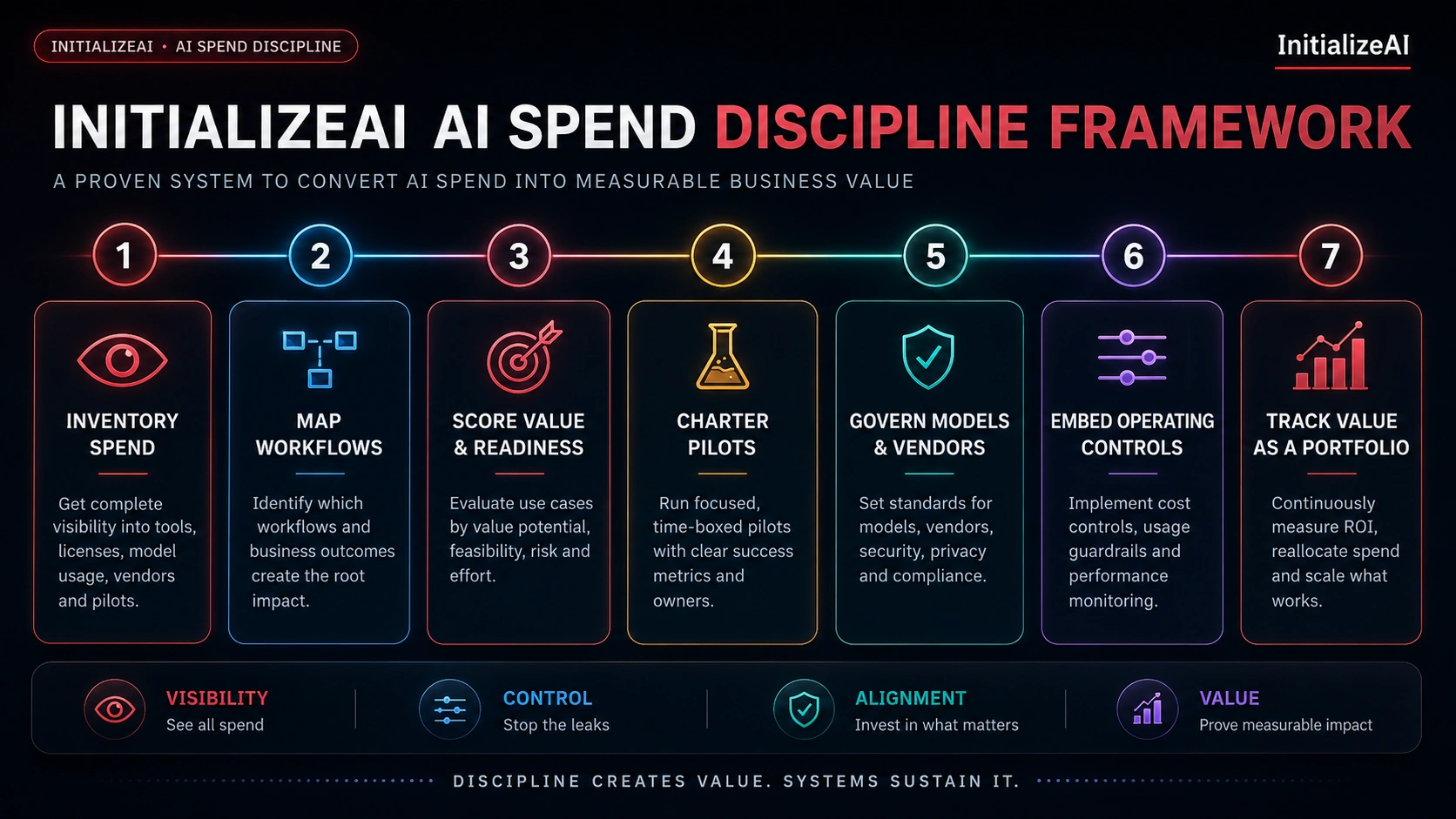
InitializeAI helps companies close the AI Execution Gap by creating a disciplined system for deciding where AI spend belongs, how success should be measured, and which initiatives deserve to scale.
The framework is simple, but powerful.
Step 1: Build the AI spend inventory
Most companies do not have a clear view of their AI spend.
They may know the major enterprise contracts, but they often miss departmental subscriptions, usage-based model costs, cloud compute, consulting spend, internal engineering time, data preparation work, pilot costs, security reviews, and shadow AI usage.
The first step is to create a complete AI spend inventory.
This should include:
- AI software subscriptions
- Model API usage
- Token consumption
- Cloud and GPU costs
- AI-enabled SaaS features
- Vendor pilots
- Internal prototypes
- Consulting and implementation spend
- Data preparation and integration work
- Security, legal, and compliance review costs
- Training and change-management spend
- Department-level AI tools purchased outside central IT
The goal is not to shame experimentation.
The goal is visibility.
You cannot manage what you cannot see.
Step 2: Map AI spend to workflows
Once the spend is visible, the next question is:
What business workflow does this spend improve?
If a tool, pilot, or model cost cannot be mapped to a real workflow, that is a warning sign.
The workflow map should connect AI spend to areas such as:
- Sales qualification
- Proposal generation
- Customer support
- Claims processing
- Compliance review
- Field-service documentation
- Finance close
- Contract review
- Employee onboarding
- Recruiting
- Knowledge management
- Product analytics
- Forecasting
- Procurement
- Operations reporting
- Executive decision support
This is where many AI initiatives either become stronger or get exposed.
A use case that sounds impressive in abstract terms may become weak when mapped to an actual workflow.
A use case that sounds boring may become highly valuable when connected to labor cost, revenue leakage, risk reduction, or cycle-time improvement.
Step 3: Score use cases by value and readiness
Not every AI idea deserves equal funding.
InitializeAI recommends scoring AI use cases across two dimensions.
Business value
- Revenue impact
- EBITDA impact
- Labor leverage
- Cycle-time reduction
- Error reduction
- Customer experience improvement
- Risk reduction
- Strategic differentiation
Execution readiness
- Data availability
- Workflow clarity
- System integration feasibility
- Stakeholder ownership
- Governance complexity
- Security requirements
- User adoption likelihood
- Time to measurable result
The highest-priority AI opportunities are not always the flashiest ones.
They are the ones with meaningful business value and enough readiness to produce measurable results within a defined time horizon.
Step 4: Require every pilot to earn the right to exist
A good AI pilot is not an open-ended experiment.
It is a structured test of a business hypothesis.
Every AI pilot should answer:
- What workflow are we improving?
- Who owns the outcome?
- What baseline are we measuring against?
- What metric must improve?
- What cost will we accept?
- What risks must be controlled?
- What data is required?
- What systems must be integrated?
- What users must adopt it?
- What would cause us to stop?
- What would justify scaling?
This turns pilots from innovation theater into evidence-generating investments.
The point is not to eliminate experimentation.
The point is to make experimentation useful.
Step 5: Create model and vendor discipline
AI cost management increasingly depends on model and vendor architecture.
Companies need to decide when to use frontier models, smaller models, open-source models, domain-specific tools, embedded SaaS AI, internal automation, retrieval systems, or non-AI workflow automation.
Axios recently reported that corporations are increasingly looking for cheaper AI models as usage pressures IT budgets and ROI remains uncertain. Axios
That trend will continue.
Enterprises will not want a single default model for every task.
They will want cost-aware routing based on task complexity, risk, speed, accuracy, and business value.
A mature AI organization asks:
- Does this task need a frontier model?
- Can a smaller model handle it?
- Can retrieval improve accuracy and reduce context cost?
- Can caching reduce repeated calls?
- Can the workflow be redesigned to reduce unnecessary generation?
- Can a deterministic automation handle part of the task?
- Should this be bought, built, or partnered?
- What is the switching cost if pricing changes?
- What is the risk of vendor lock-in?
This is where AI strategy becomes financial architecture.
Step 6: Put governance in the operating model
AI governance should not be a PDF that sits on a shelf.
It should be embedded in how AI work gets approved, built, deployed, monitored, and improved.
Governance should define:
- Acceptable use
- Data access rules
- Sensitive data restrictions
- Human review requirements
- Model approval standards
- Vendor evaluation criteria
- Security and privacy controls
- Bias and accuracy testing
- Audit logging
- Incident response
- Cost thresholds
- Escalation paths
- Ownership and accountability
The purpose of governance is not to slow the organization down.
The purpose is to prevent rework, reduce risk, build trust, and make responsible scaling possible.

Step 7: Track AI value like a portfolio
Executives need an AI value dashboard that goes beyond usage.
A useful dashboard should show:
- Current AI initiatives
- Business owner
- Workflow owner
- Spend to date
- Expected value
- Realized value
- Pilot stage
- Adoption level
- Risk tier
- Model/vendor dependencies
- Baseline metric
- Current performance
- Scale recommendation
- Next decision date
This allows leadership to manage AI like an investment portfolio.
Some initiatives should receive more funding.
Some should be redesigned.
Some should be paused.
Some should be stopped.
Some should be scaled aggressively.
Without this portfolio view, companies end up making AI decisions through anecdotes, executive enthusiasm, vendor pressure, or fear of missing out.
That is how money gets burned.
The CFO’s AI spend checklist
Before approving the next AI tool, pilot, or vendor contract, CFOs and executive teams should ask:
- What business workflow does this improve?
- Who owns the business outcome?
- What is the baseline metric?
- What financial or operational result would justify the spend?
- What is the full cost, including software, tokens, compute, integration, training, support, and governance?
- What happens if usage doubles or triples?
- Can a lower-cost model or simpler automation handle the task?
- What data does this require, and is that data ready?
- What are the security, privacy, legal, and compliance implications?
- What is the adoption plan?
- What is the scale path if it works?
- What is the stop rule if it does not?
If these questions cannot be answered, the company is probably not ready to spend.
Or, more precisely, the company is not ready to spend wisely.
The CEO’s AI execution checklist
CEOs should ask a slightly different set of questions.
Not just “How much are we spending?” but:
- Are we funding the AI initiatives most connected to strategy?
- Are our AI efforts concentrated or scattered?
- Do we know which workflows are producing measurable value?
- Are we creating new operating leverage or just new technology expense?
- Are our teams trained to use AI in the flow of work?
- Are we redesigning workflows or merely adding tools?
- Are we managing AI risk proactively?
- Are we building internal capability or vendor dependency?
- Are we measuring business outcomes or activity metrics?
- Are we prepared to scale what works?
BCG has noted that CEOs increasingly recognize AI as more than technology because it touches strategy, operations, culture, risk, and talent. BCG
That is exactly why AI spend cannot be delegated entirely to IT, procurement, innovation, or individual departments.
AI spending is now a leadership discipline.
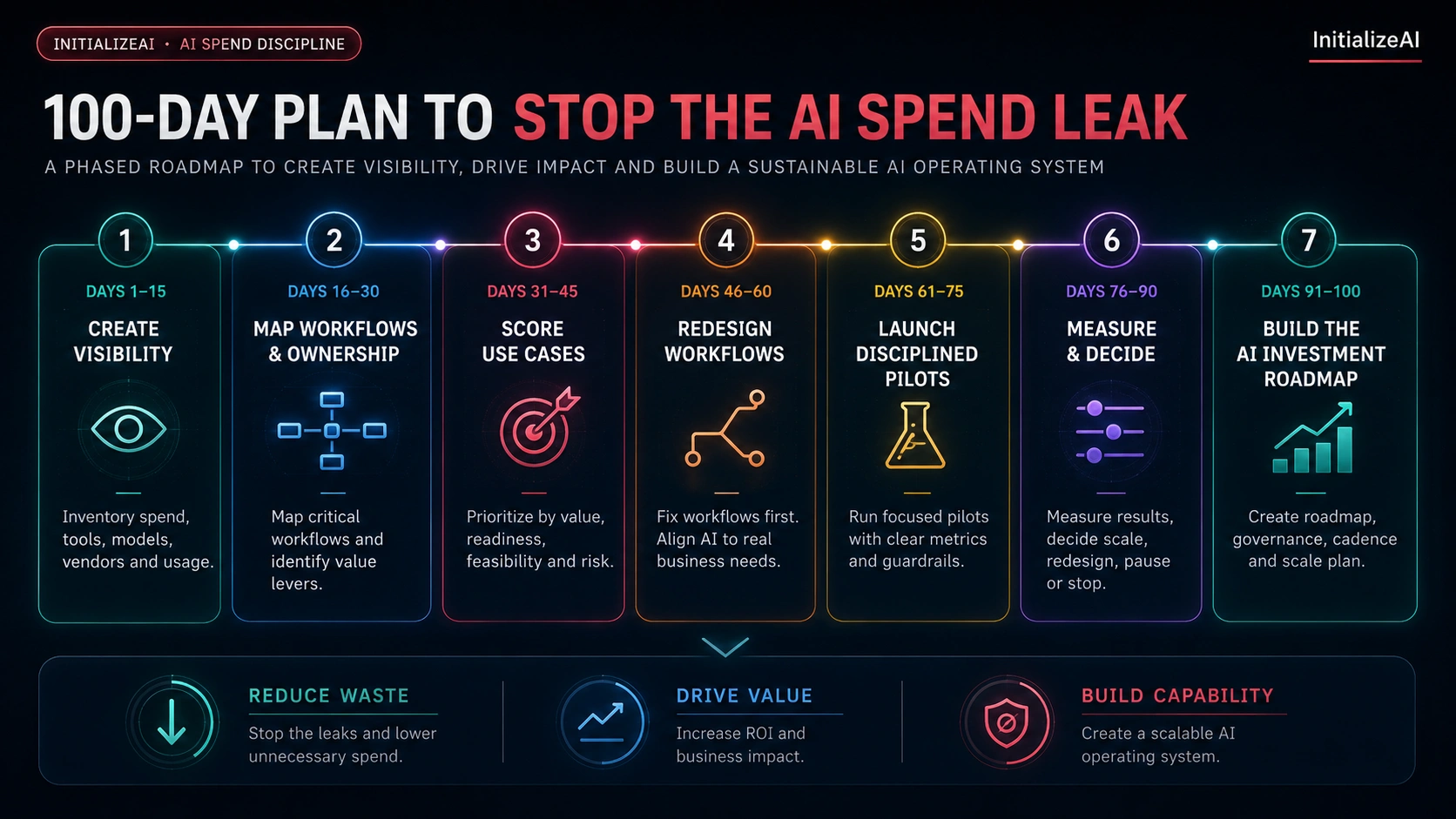
A 100-day plan to stop the AI Spend Leak
Companies do not need to freeze AI investment.
They need to structure it.
Here is a practical 100-day plan.
Days 1–15: Create visibility
Build a current-state picture of AI activity across the organization.
Deliverables
- AI tool inventory
- Vendor and contract list
- Token/API usage review
- Cloud and compute cost review
- Department-level AI survey
- Active pilot list
- Shadow AI risk scan
- Initial spend categories
Key question
Where is AI already being used, and what is it costing us?
Days 16–30: Map workflows and ownership
Connect AI activity to actual business processes.
Deliverables
- AI workflow map
- Business owner assignments
- Process pain-point analysis
- Data source mapping
- System dependency map
- User group identification
- Governance risk tiering
Key question
Which AI activities are attached to workflows that matter?
Days 31–45: Score use cases
Prioritize opportunities using a value-readiness model.
Deliverables
- Use-case prioritization matrix
- Business value scoring
- Feasibility scoring
- Data readiness scoring
- Risk scoring
- Recommended quick wins
- Recommended stop/pause list
Key question
Which AI opportunities deserve investment now, later, or not at all?
Days 46–60: Redesign the highest-value workflows
Do not simply add AI to broken processes.
Redesign the work.
Deliverables
- Future-state workflow maps
- Human-in-the-loop design
- Exception handling
- Approval paths
- System integration requirements
- KPI definitions
- Pilot success metrics
Key question
How should the workflow change if AI works?
Days 61–75: Launch disciplined pilots
Start with structured pilots that can produce evidence.
Deliverables
- Pilot charters
- Baseline measurements
- Model/vendor selection
- Governance controls
- User training
- Adoption plan
- Cost monitoring
- Pilot dashboard
Key question
What evidence will prove whether this should scale?
Days 76–90: Measure and decide
Evaluate pilots against business outcomes, not enthusiasm.
Deliverables
- Performance review
- Cost-per-workflow analysis
- User adoption review
- Risk and quality review
- Lessons learned
- Scale/pause/stop recommendations
Key question
Did this create measurable value at an acceptable cost and risk level?
Days 91–100: Build the AI investment roadmap
Turn the learning into an operating plan.
Deliverables
- 12-month AI roadmap
- AI governance cadence
- Executive dashboard
- Budget recommendations
- Vendor strategy
- Internal capability plan
- Scale roadmap
- Board-ready summary
Key question
How do we turn AI from scattered activity into a managed investment portfolio?
What companies should stop doing immediately
Companies that want to spend wisely on AI should stop doing the following:
- Stop buying tools before defining workflows.
- Stop measuring AI success by usage alone.
- Stop launching pilots without baseline metrics.
- Stop funding demos without scale paths.
- Stop allowing every team to select vendors independently.
- Stop using the most expensive model for every task.
- Stop treating governance as a post-pilot issue.
- Stop assuming employee access equals adoption.
- Stop confusing productivity anecdotes with financial impact.
- Stop approving AI budgets without cost scenarios.
The problem is not ambition.
The problem is unmanaged ambition.
What companies should start doing instead
Start treating AI as a business capability.
Start with workflows.
Start with measurable pain.
Start with operational baselines.
Start with business owners.
Start with governance.
Start with cost visibility.
Start with pilots that can be evaluated honestly.
Start with a portfolio view.
Start with the question that matters most:
Where can AI produce measurable business value at an acceptable cost, risk, and level of organizational readiness?
That question changes everything.

How InitializeAI helps
InitializeAI helps leadership teams move from AI ambition to AI execution.
For companies worried about burning unnecessary money on AI, InitializeAI can help in six practical ways.
1. AI Execution Gap Assessment
We identify where AI value is leaking across strategy, governance, data readiness, workflow design, vendor selection, measurement, adoption, and scaling.
This gives leadership a clear view of why AI activity may not be converting into measurable results.
2. AI Spend and Tool Inventory
We help companies understand what they are already spending on AI, where tools overlap, where usage is unmanaged, where vendor decisions are fragmented, and where shadow AI may create risk.
The outcome is a practical AI spend map that leadership can actually use.
3. AI Use Case Prioritization
We help teams separate exciting AI ideas from economically meaningful AI opportunities.
That means scoring use cases by business value, readiness, risk, cost, and implementation feasibility.
The goal is to fund the right opportunities in the right sequence.
4. AI Pilot Charter and ROI Design
We help companies design pilots with clear baselines, success metrics, governance controls, cost expectations, business ownership, and scale-or-stop criteria.
This prevents pilot debt and turns experimentation into a disciplined learning system.
5. AI Governance and Operating Model
We help companies create the policies, decision rights, review processes, steering committees, risk registers, and operating cadences needed to scale AI responsibly.
Governance becomes part of execution, not a barrier to execution.
6. AI Roadmap and Executive Dashboard
We help leadership teams manage AI as a portfolio.
That includes current initiatives, expected value, realized value, spend, risk, adoption, ownership, and next decisions.
The result is a clearer answer to the board-level question every company is starting to face:
What are we getting for our AI investment?
The companies that win will not be the ones that spend the most
The next chapter of enterprise AI will not reward the companies that spend blindly.
It will reward the companies that build execution discipline.
The winners will not necessarily have the largest AI budgets.
They will have the clearest AI operating model.
They will know where AI belongs.
They will know where it does not.
They will know which workflows matter.
They will know what success looks like before the pilot begins.
They will know when to scale.
They will know when to stop.
They will connect AI investment to business outcomes, not just activity.
That is the real shift happening now.
AI is no longer just a technology race.
It is an execution race.
And for many companies, the biggest risk is not falling behind because they failed to spend on AI.
The bigger risk is spending heavily on AI without building the execution system required to turn that spend into value.
That is the AI Execution Gap.
And now, it is an AI spending problem.
Final takeaway
Companies do not need to stop investing in AI.
They need to stop funding disconnected AI activity.
They need to stop mistaking usage for value.
They need to stop launching pilots without business ownership, baseline metrics, governance, cost controls, and scale paths.
They need an AI investment system.
InitializeAI helps companies build that system.
Because the goal is not to spend less on AI.
The goal is to spend smarter — and turn AI into measurable business value.
For media and analysts
InitializeAI is available to comment on enterprise AI spending, AI ROI, token waste, AI tool sprawl, pilot debt, AI governance, and practical frameworks for helping CFOs, CIOs, CEOs, and boards spend more wisely on AI.
Suggested attribution
Andrew M. Jensen, CEO of InitializeAI
Quotable perspective
“The problem is not that companies are spending too much on AI. The problem is that they are funding AI activity before they have an execution system to prove value.”
“AI value is not created when a model produces output. AI value is created when a business process performs better.”
“Token usage is not an ROI metric. It is a consumption metric. Without workflow-level measurement, AI adoption can look successful while value quietly leaks away.”
Available commentary topics
- Why AI sticker shock is becoming an enterprise operating-model problem
- How CFOs can identify AI spend leaks
- Why tokenmaxxing is not the same as productivity
- How CIOs can govern AI pilots before they become pilot debt
- Why AI should be managed as an investment portfolio
- How companies can build a 100-day AI spend discipline plan
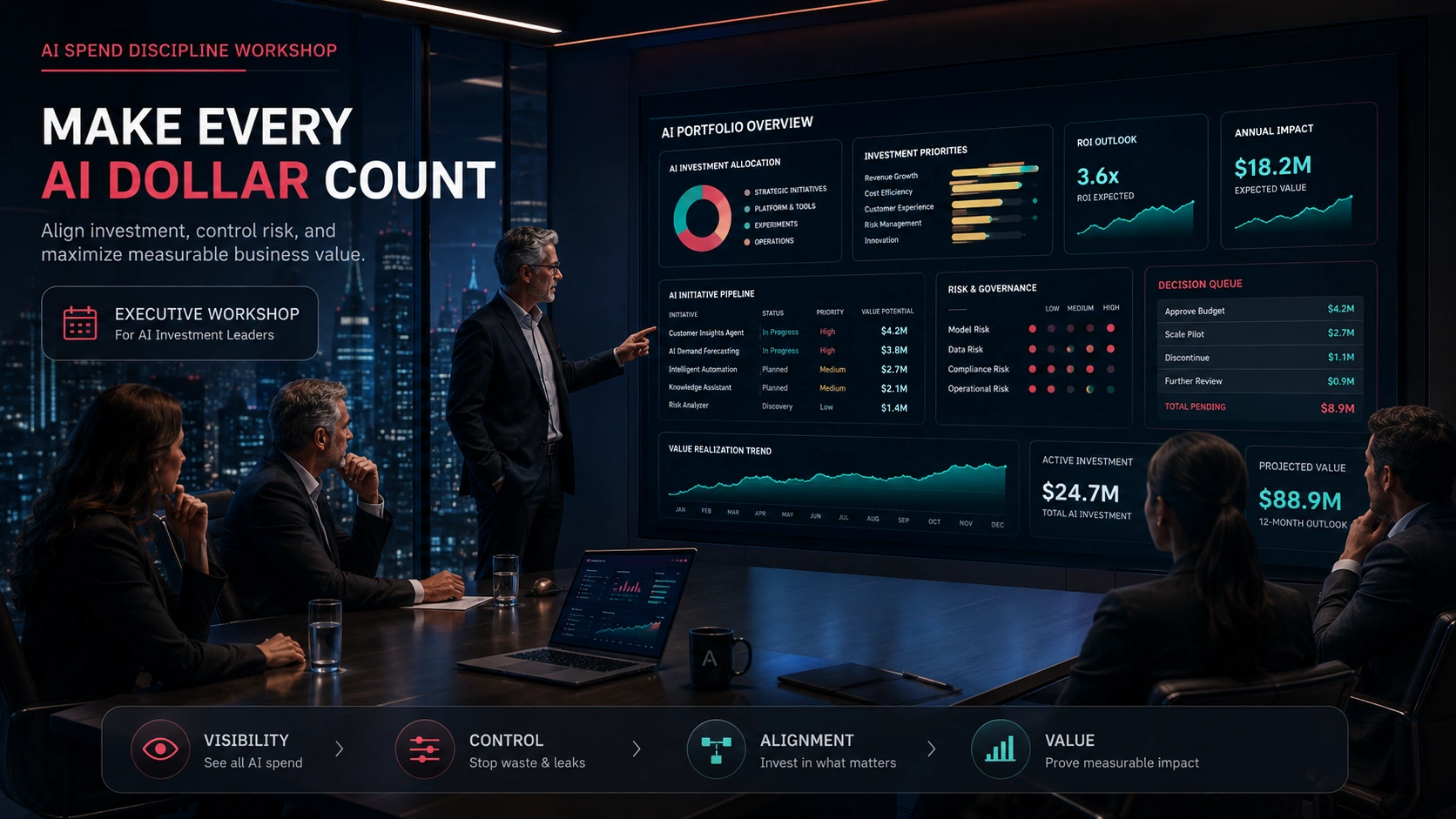
Before approving another AI tool, pilot, or vendor contract, find out where your AI budget may be leaking value.
Take the AI Execution Gap Scorecard or schedule an AI Spend Discipline Workshop with InitializeAI to identify which AI initiatives deserve funding, which need redesign, and which should be stopped before they burn more budget.