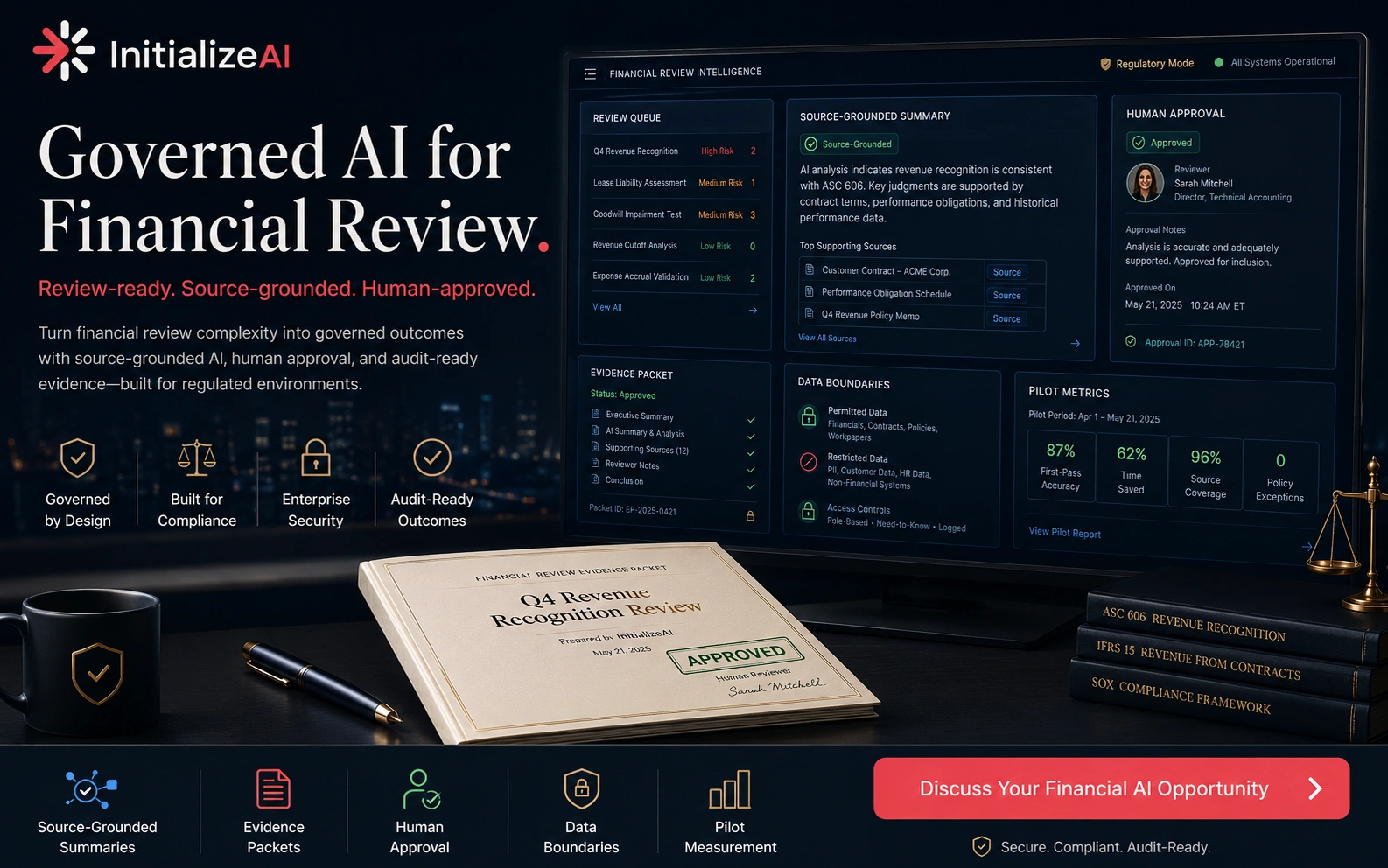
High-volume financial review work across risk, compliance, onboarding, evidence, and internal knowledge workflows.
Readiness assessment, workflow mapping, governance design, review-workbench concept, pilot scoping, and measurement model.
Assist reviewers with source-grounded summaries, evidence organization, triage, policy lookup, and human-approved next steps.
Data boundaries, reviewer approval, model/vendor questions, escalation paths, and review-ready artifacts.
Completeness, correction rate, reviewer confidence, escalation quality, adoption, and scale readiness.
THE FINANCIAL-SERVICES PROBLEM
Manual review was doing too much of the work.
The organization had promising AI opportunities, but the highest-value workflows were also trust-sensitive. Risk, compliance, onboarding, and client-service teams needed faster review support without losing human judgment, source traceability, or control.
This page uses anonymized language and does not disclose confidential client information, private metrics, or production claims.
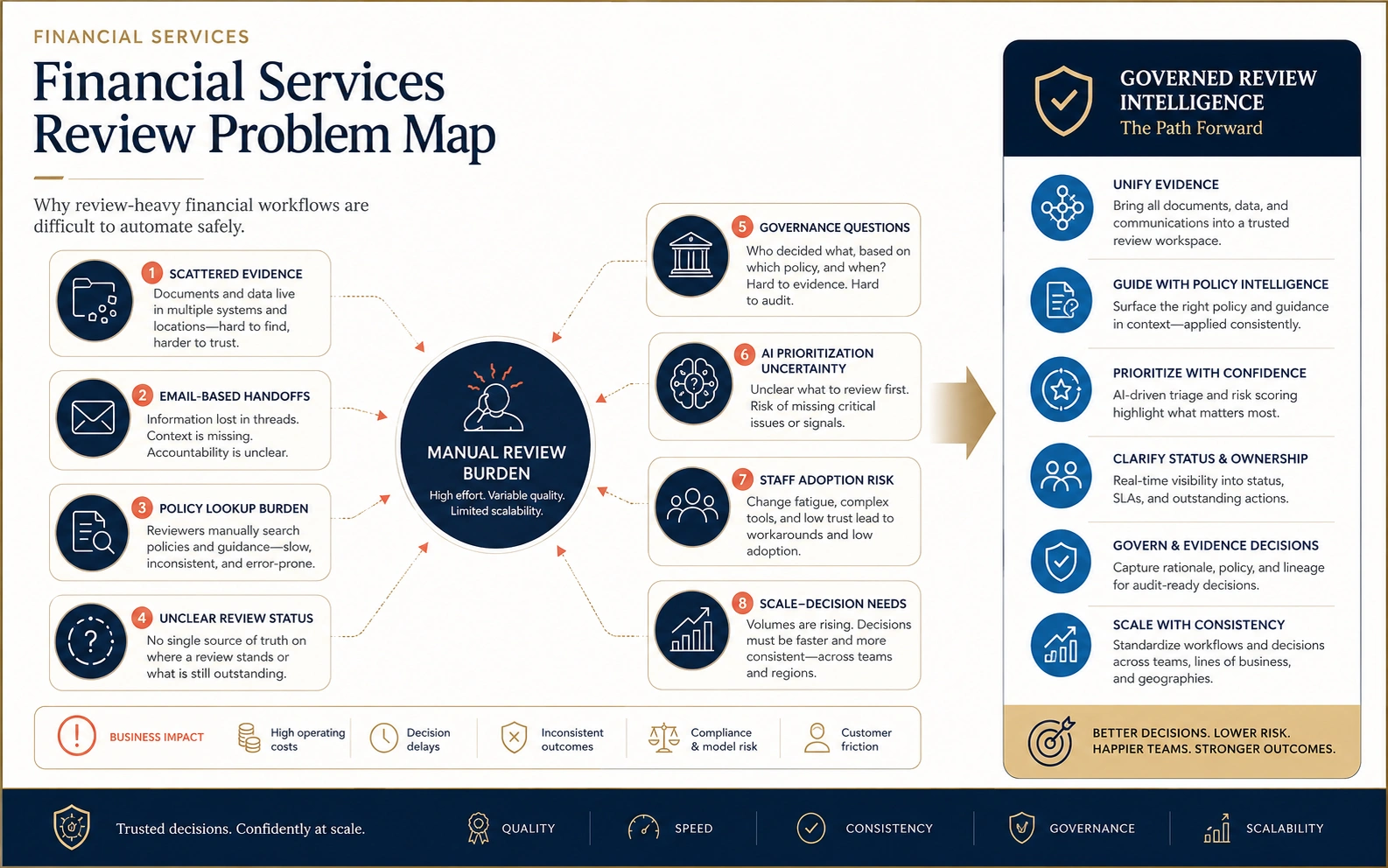
Review queues were manual
Teams spent time reading, summarizing, classifying, and routing documents, signals, requests, and evidence.
Evidence was scattered
Policies, supporting documents, review notes, source materials, and approval context were not always assembled in one review-ready packet.
Governance needed to come first
The team needed clarity on data boundaries, access, vendor/model questions, reviewer authority, and escalation.
AI ideas were not all equal
Some use cases were strong pilot candidates. Others required deeper legal, compliance, security, or model-risk review.
Staff adoption mattered
Reviewers needed a system that made their work easier to inspect, not harder to trust.
Scale needed evidence
The pilot needed metrics that could support a scale, refine, pause, or stop decision.
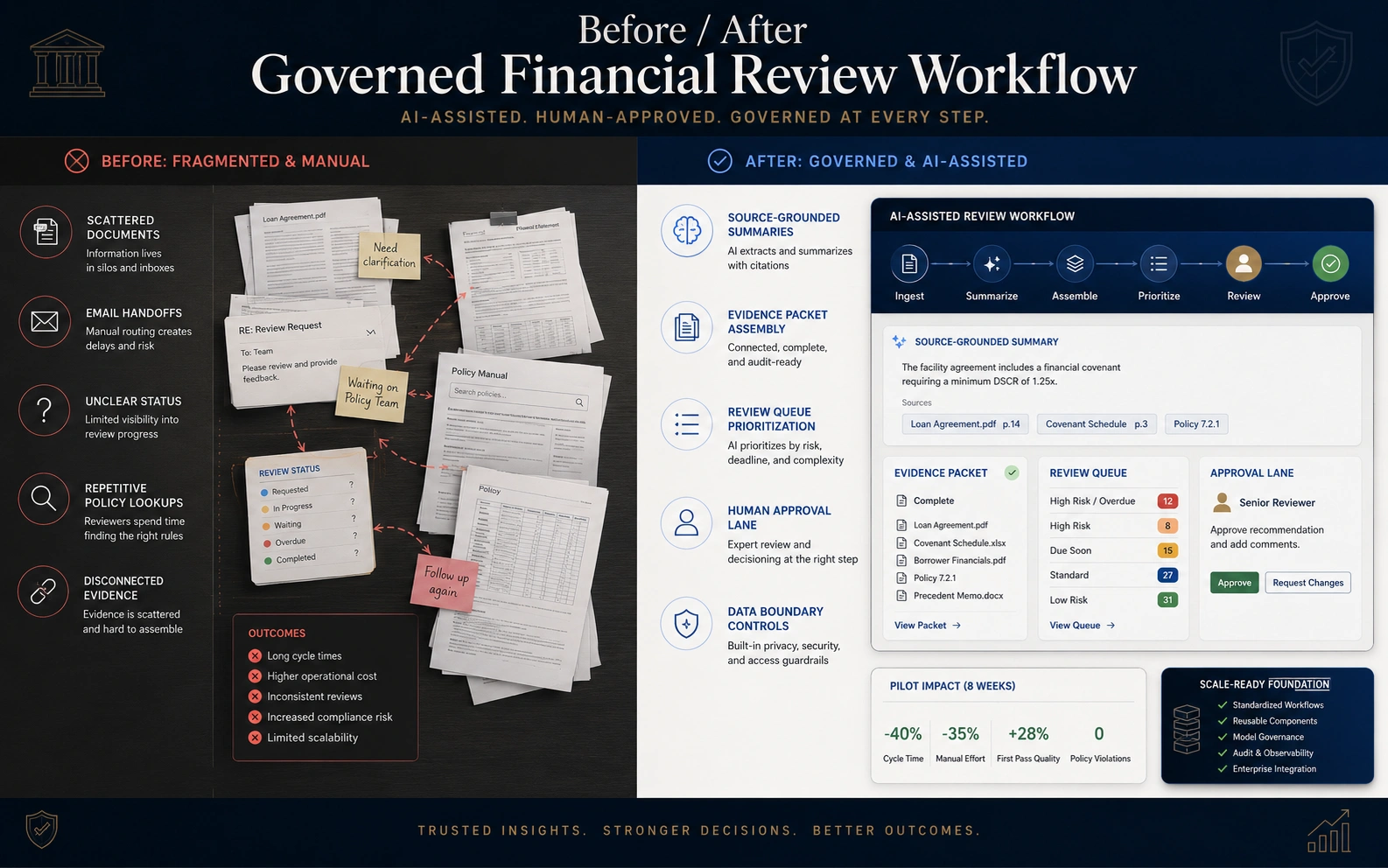
Before
- Manual document review
- Scattered evidence
- Email-based handoffs
- Unclear review status
- Repetitive policy lookup
- Hard-to-compare materials
- Unclear AI governance path
- No scale-decision evidence
After
- Source-grounded summaries
- Evidence packet assembly
- Review queue prioritization
- Human approval lane
- Policy and knowledge lookup
- Data-boundary controls
- Pilot metrics dashboard
- Scale-readiness record
SOLUTION CONCEPT
The solution: a governed financial review intelligence workbench.
The workbench was designed to help reviewers move faster through document-heavy, evidence-heavy, and policy-heavy workflows while keeping final decisions with qualified humans.
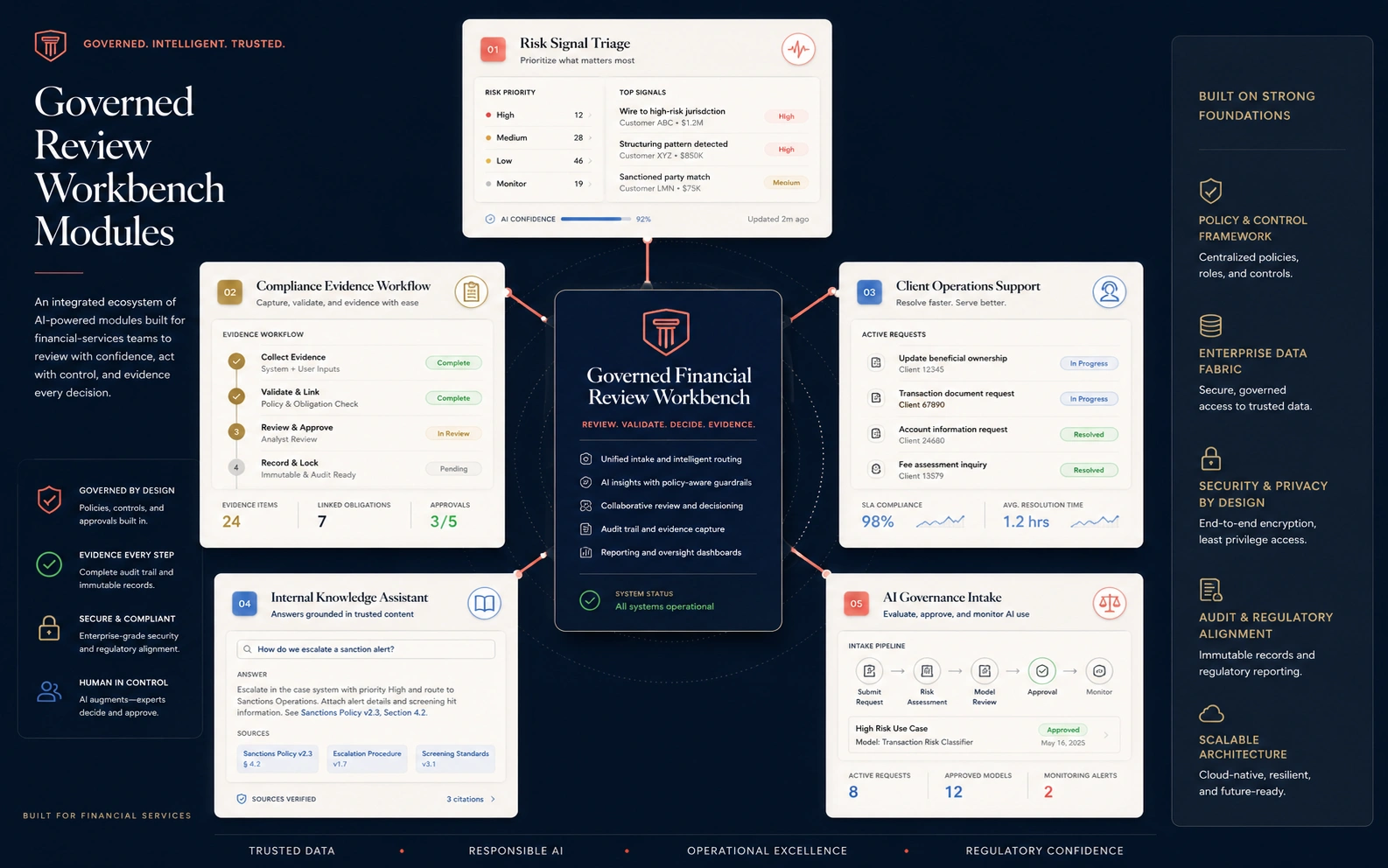
Risk signal triage
Summarize existing signals, organize review queues, surface relevant context, and support analyst prioritization.
Compliance evidence workflow
Assemble source materials, summarize evidence, map documents to policy requirements, and route for reviewer approval.
Client operations support
Summarize onboarding materials, service requests, documentation status, and client-operation workflows for human review.
Internal knowledge assistant
Retrieve policies, procedures, training materials, playbooks, and compliance guidance with source references.
AI governance intake
Route proposed AI use cases through risk, data, human oversight, model/vendor, and approval questions before pilots scale.
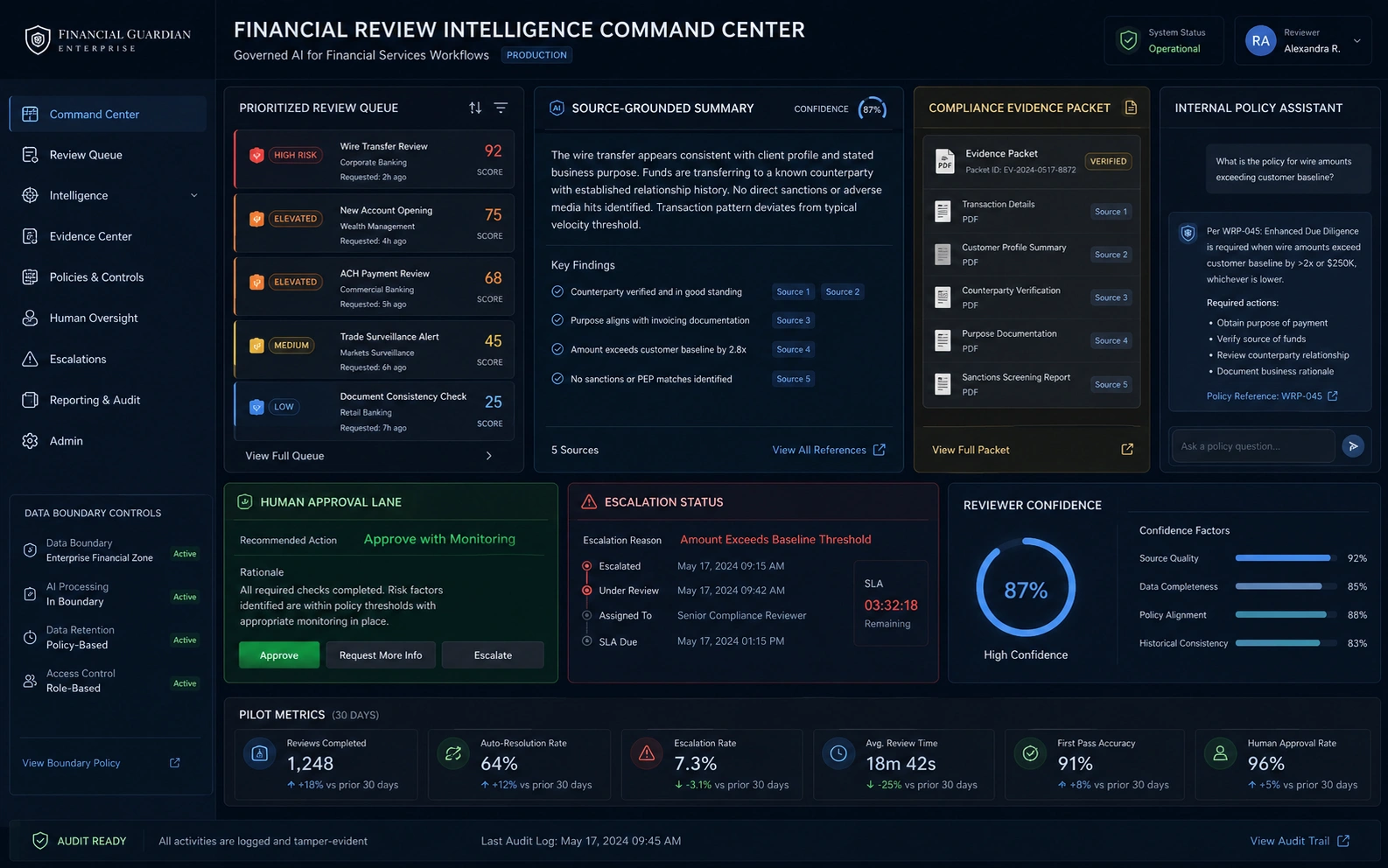
PRODUCT / WORKFLOW UI SHOWCASE
Inside the review workbench.
The UI concept organizes review queues, source-grounded summaries, evidence packets, policy answers, governance intake, and approval status without showing private customer, account, transaction, or portfolio data.
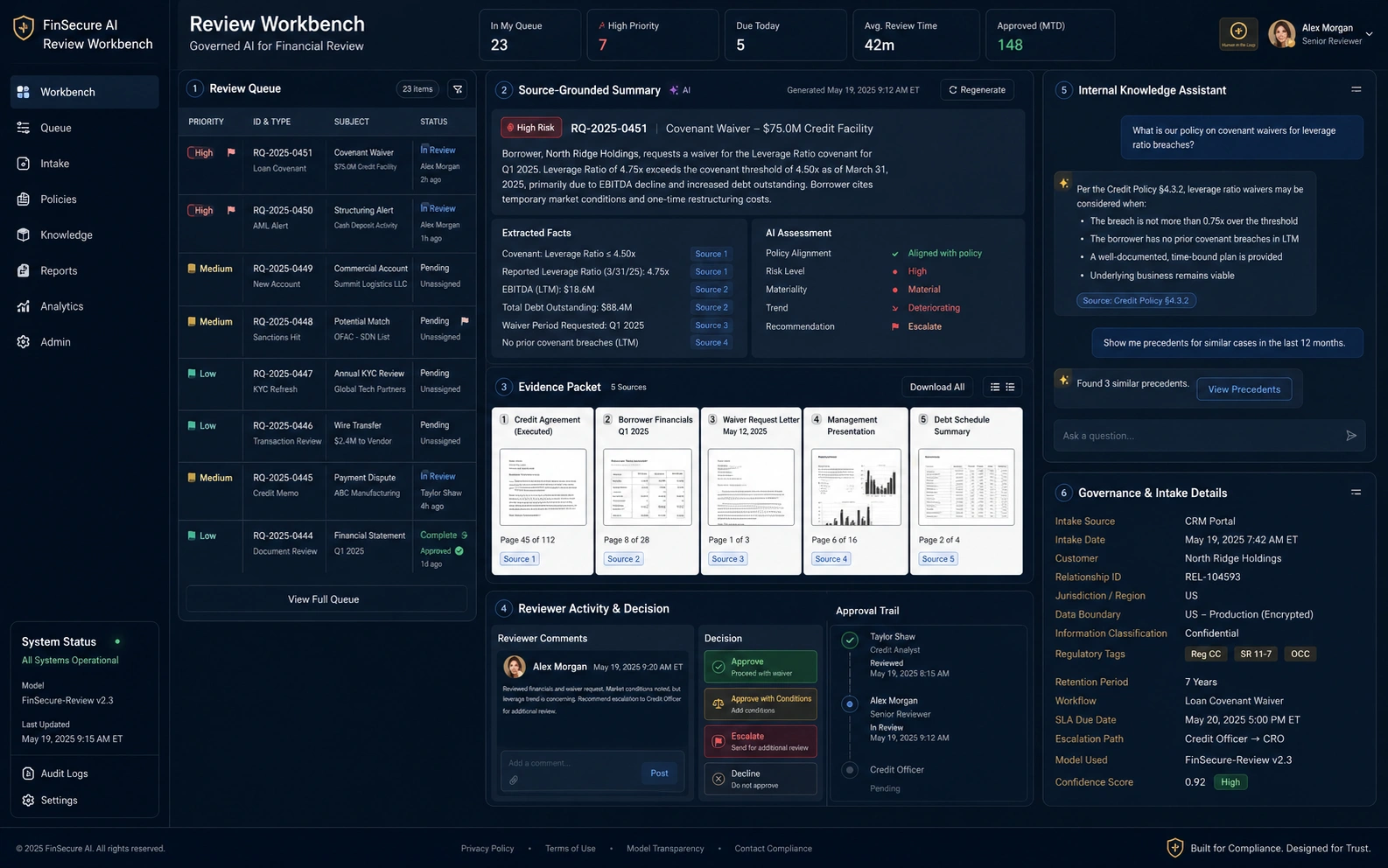
Review queue
Queue item, workflow type, risk/compliance tag, reviewer, status, and escalation flag.
Source-grounded summary
Source documents, key extracted facts, verification note, reviewer comments, and human approval badge.
Evidence packet
Policy reference, supporting document, reviewer note, escalation history, and approval status.
Knowledge assistant
Source-backed policy answer, related procedures, and reviewer feedback controls.
Governance intake
Use-case owner, data involved, model/vendor path, human oversight, risk level, and approval path.
INITIALIZEAI PROCESS
How InitializeAI approached the engagement.
The project was not treated as a model-selection exercise. It was treated as a financial-services execution problem.
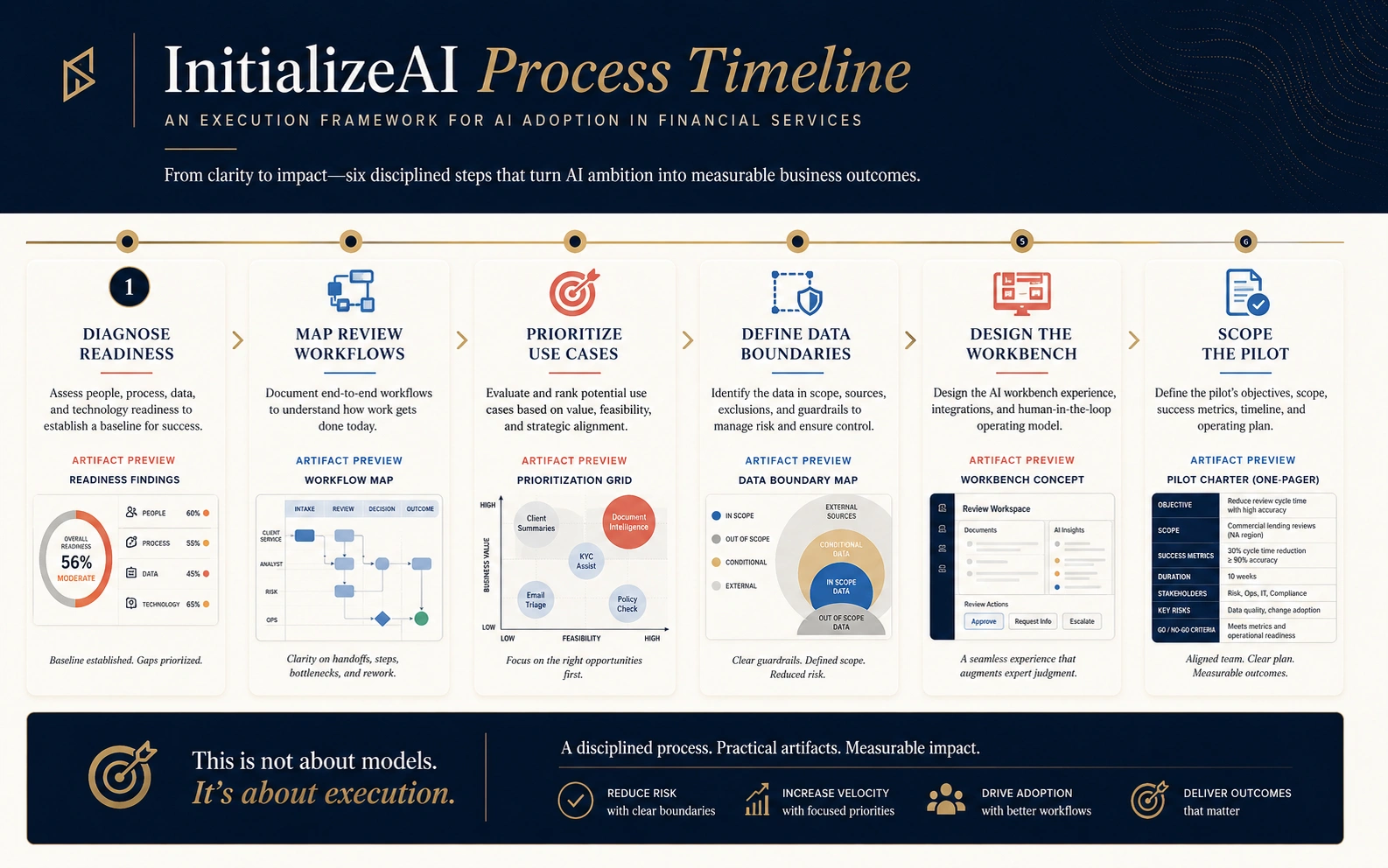
Diagnose readiness
Evaluate current AI maturity, workflow pain, data readiness, governance questions, and stakeholder alignment.
Map review workflows
Identify handoffs, review queues, source documents, approval points, escalations, and ownership.
Prioritize use cases
Separate strong first-pilot candidates from high-review use cases that required deeper risk review.
Define data boundaries
Clarify what data could be used, what needed review, what stayed out of scope, and who could access outputs.
Design the workbench
Create the review-workbench concept, evidence packet model, human approval lane, and governance intake flow.
Scope the pilot
Define pilot scope, reviewer group, metrics, artifacts, feedback loop, and scale/refine/stop decision criteria.
FINANCIAL AI EXECUTION GAP
How the case study closes the Financial AI Execution Gap.
This case study shows the operating layer required to turn AI interest into reviewable, governed, measurable financial-services workflows.
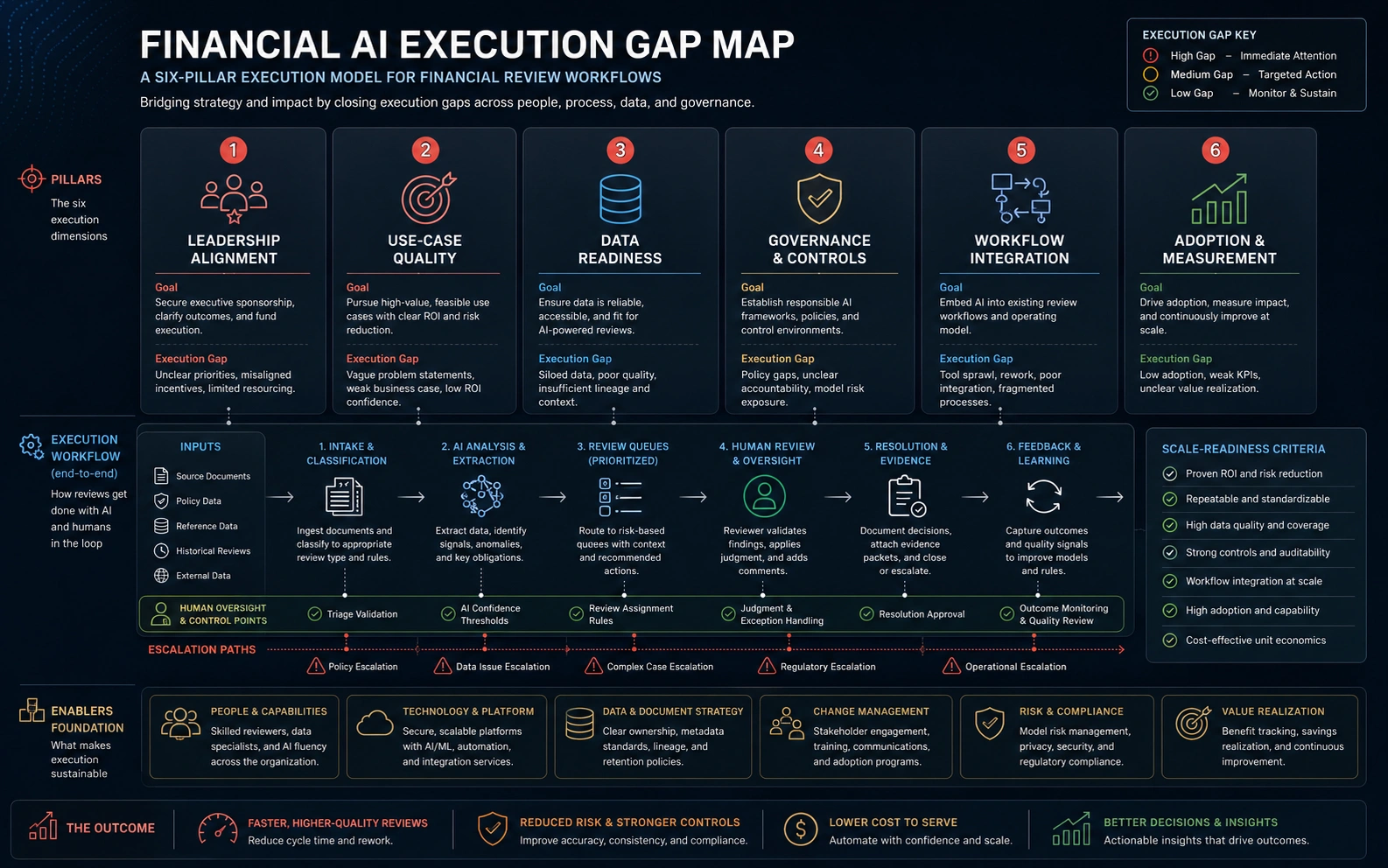
Leadership alignment
Clarified the business problem, owners, review stakeholders, and pilot decision path.
Use-case quality
Prioritized bounded workflows where AI could assist review without making final decisions.
Data readiness
Mapped source documents, policies, workflow data, access needs, and data sensitivity.
Governance
Defined human oversight, escalation paths, model/vendor questions, and data-boundary assumptions.
Workflow integration
Designed AI assistance inside review queues, evidence packets, and knowledge workflows.
Adoption and measurement
Defined reviewer feedback, quality signals, adoption metrics, and scale-readiness criteria.
GOVERNANCE MODEL
Governance was built into the workflow.
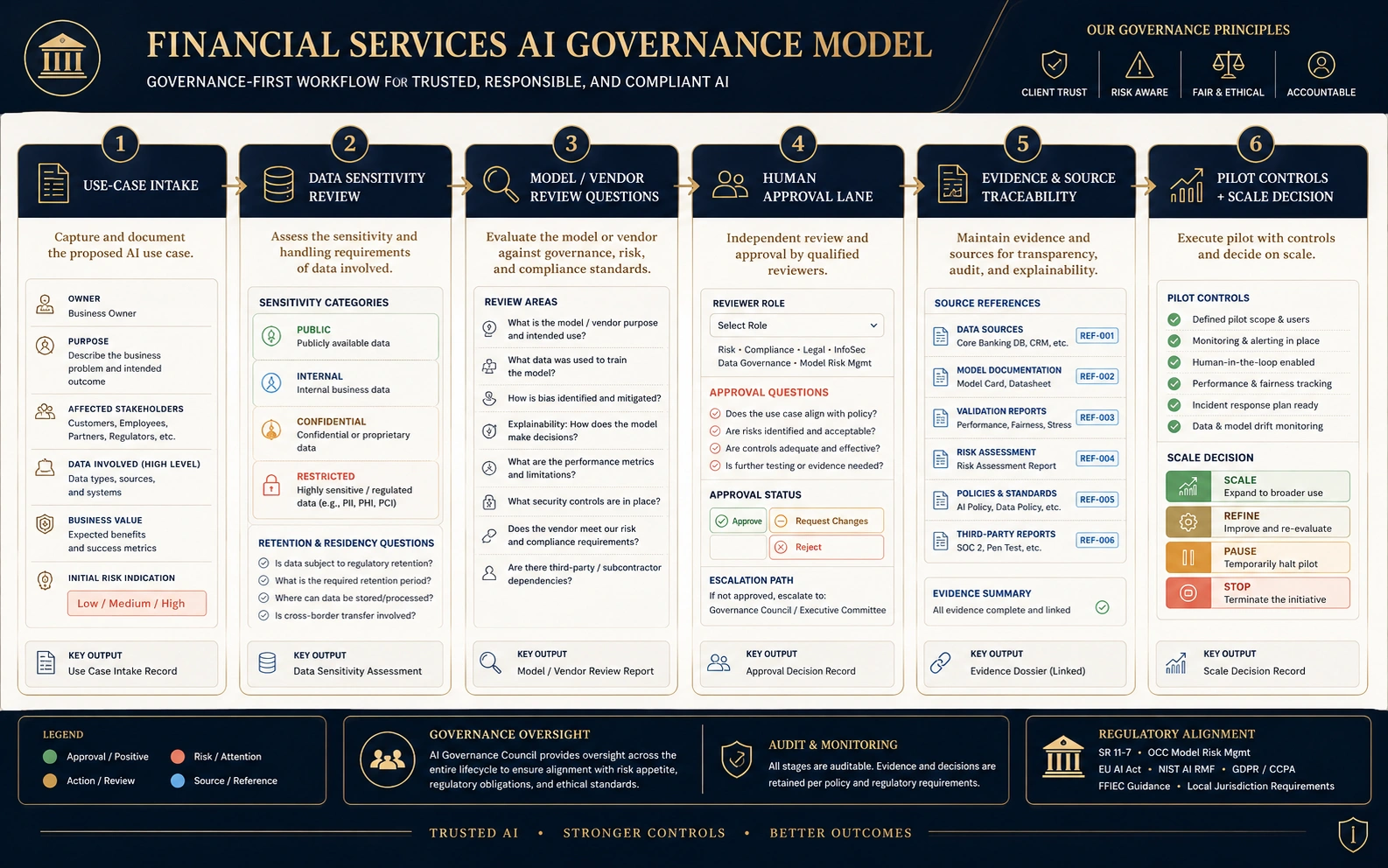
In financial services, a useful AI workflow must be reviewable, accountable, and bounded. The model focused on use-case intake, data sensitivity, model/vendor questions, human approval, source traceability, pilot controls, and scale decisions.
Use-case intake
Owner, purpose, workflow, affected stakeholders, data involved, and business objective.
Data sensitivity review
Customer, account, transaction, portfolio, claims, employee, operational, and confidential business data.
Model/vendor review questions
Model path, vendor usage, data processing assumptions, retention questions, and dependency risk.
Human approval lane
Reviewer role, approval path, escalation, corrections, and final accountability.
Evidence and source traceability
Source references, supporting documents, reviewer comments, and review status.
Pilot controls and scale decision
Quality metrics, adoption signals, risk review, feedback, and scale/refine/stop decision.
DATA AND REVIEW ARCHITECTURE
The architecture starts with the review workflow.
The design connected source materials, policy references, AI assistance, human approval, and pilot measurement into one reviewable flow.
This is presented as a pilot architecture concept, not a claim of live system integrations.
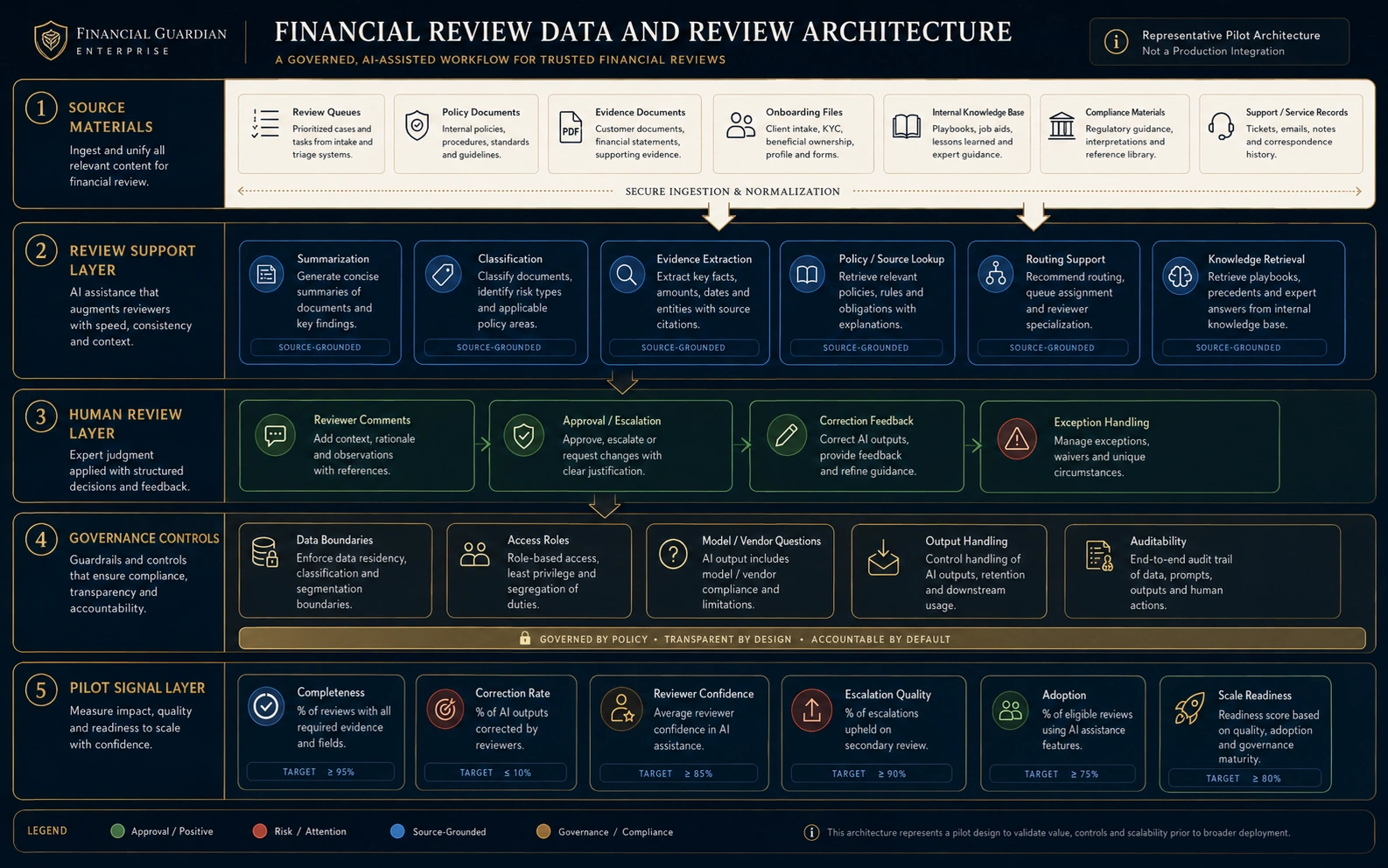
Source materials
Review queues, policy documents, evidence documents, onboarding files, internal knowledge base, compliance materials, and support/service records.
Review support layer
Summarization, classification, evidence extraction, policy/source lookup, routing support, and knowledge retrieval.
Approval and correction
Reviewer comments, approval/escalation, correction feedback, and exception handling.
Controls and boundaries
Data boundaries, access roles, model/vendor questions, output handling, and auditability considerations.
Pilot signal layer
Completeness, correction rate, reviewer confidence, escalation quality, adoption, and scale readiness.
EVIDENCE PACKET
Every assisted review needed an evidence packet.
The evidence packet became the trust layer: a structured record of sources, summaries, reviewer notes, policy references, exceptions, and approval status.
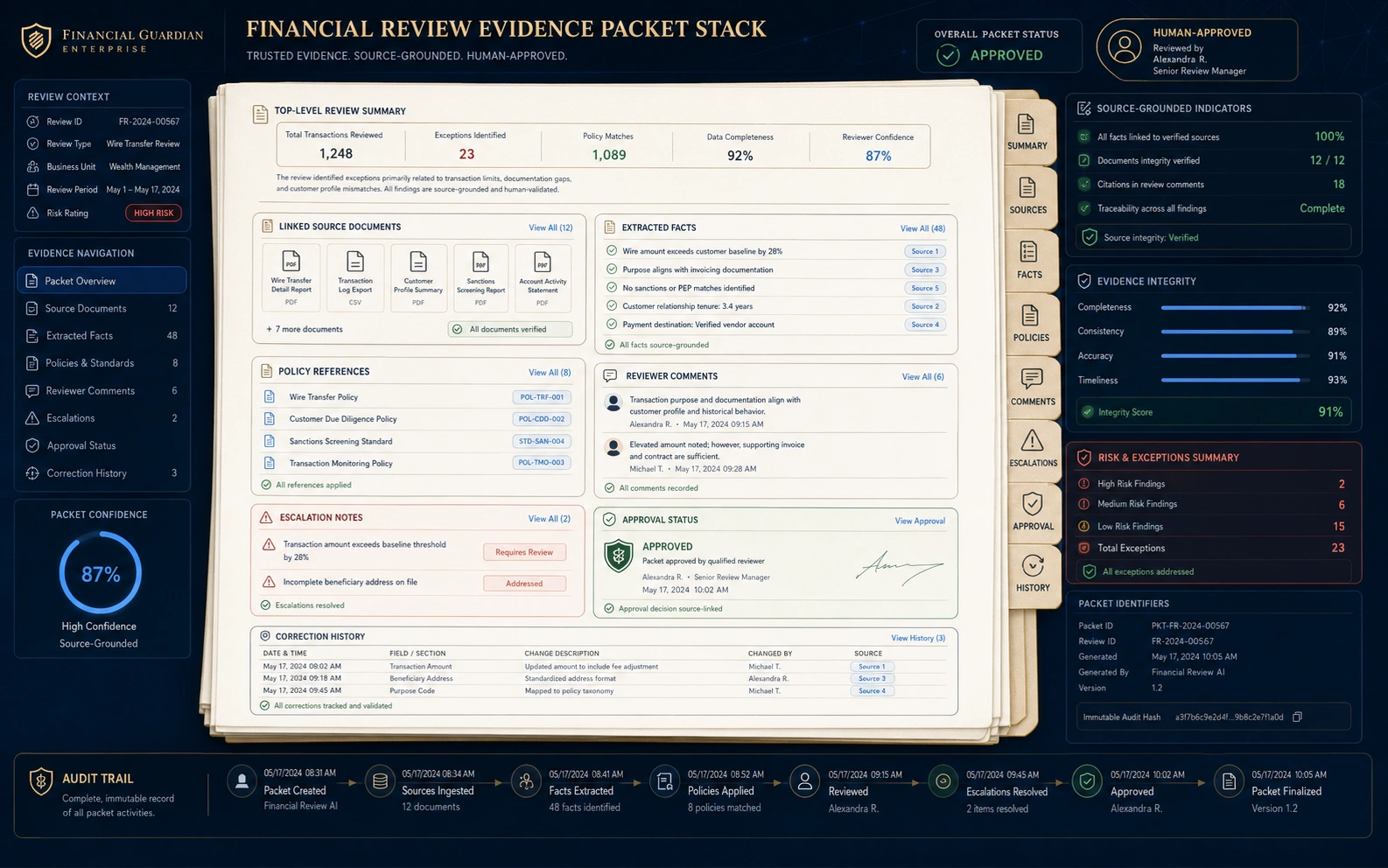
Source grounded
Reviewers can see where the answer came from.
Human approved
AI supports the review; qualified humans approve the work.
Escalation ready
Unclear, sensitive, or high-impact items can be routed for additional review.
Measurable
Each packet creates quality and adoption signals for pilot evaluation.
PILOT SCOPE
A pilot path designed for regulated workflows.
The pilot was scoped around bounded workflows, reviewer confidence, quality signals, and governance review, not broad automation.
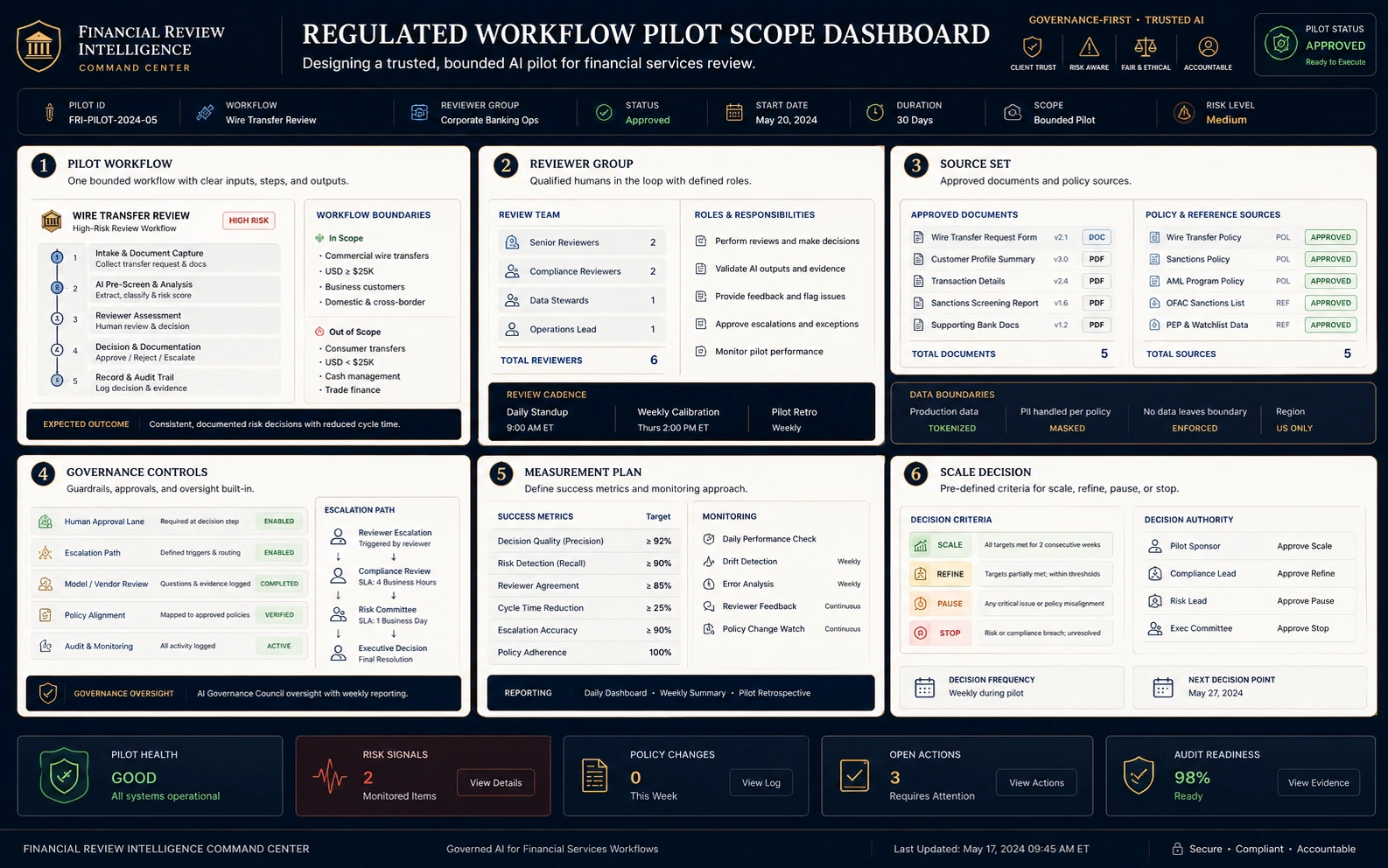
Pilot workflow
One bounded financial review workflow, such as compliance evidence review, onboarding document review, or risk signal triage.
Reviewer group
A defined review team with clear roles, feedback paths, and approval expectations.
Source set
A controlled set of approved documents, policies, evidence sources, or review records.
Governance controls
Data boundaries, human approval, escalation, source references, and model/vendor review questions.
Measurement plan
Completeness, correction rate, reviewer confidence, escalation quality, adoption, and scale readiness.
Scale decision
Evidence-based decision to scale, refine, pause, or stop.
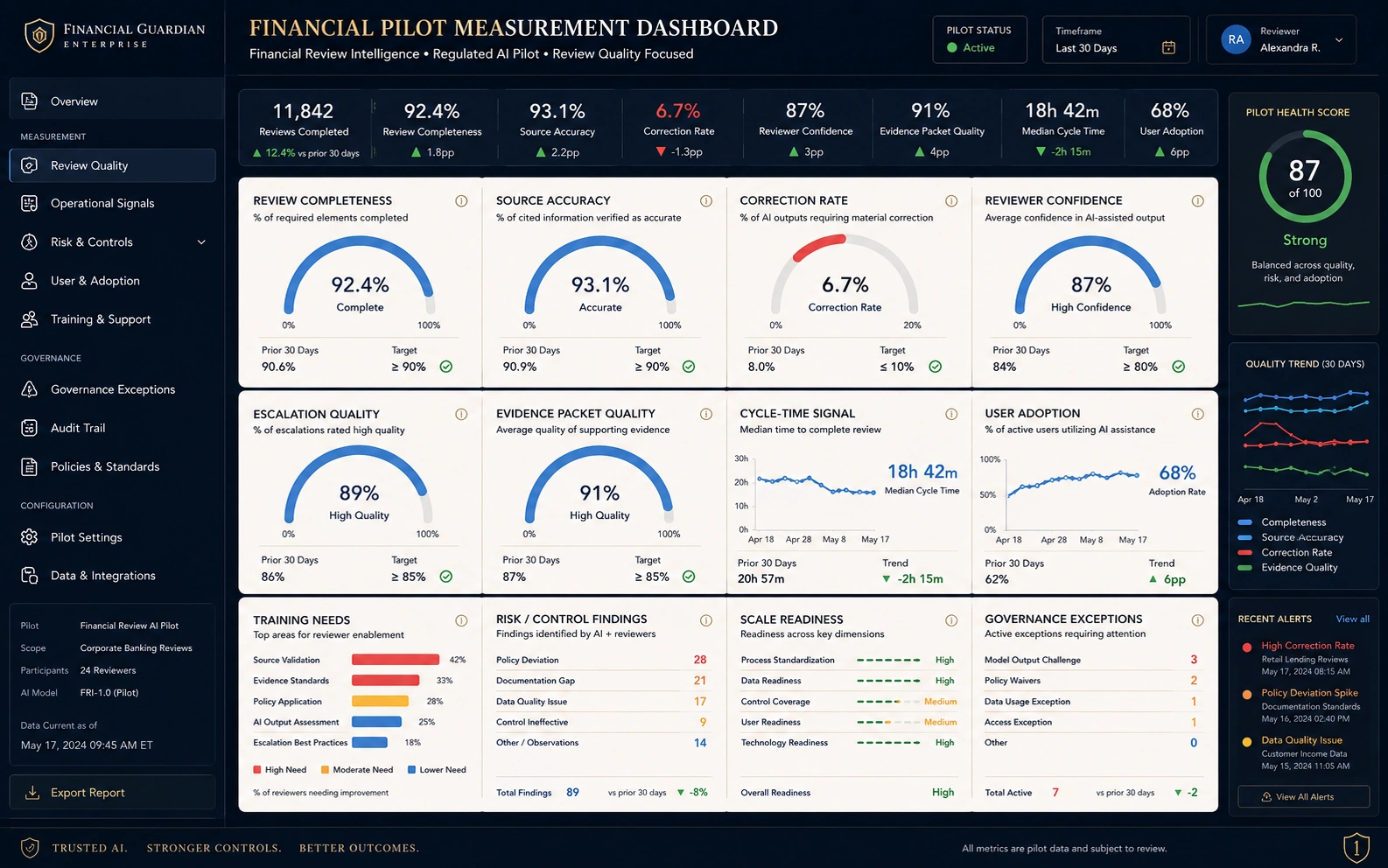
MEASUREMENT MODEL
The case study was measured by review quality, not AI novelty.
A serious financial-services AI pilot needs signals that reviewers, risk leaders, compliance teams, and executives can actually use.
No unverified outcome numbers are included. This section describes pilot measurement signals.
DELIVERED ARTIFACTS
What the engagement produced.
The most valuable output was not just an AI idea. It was a reviewable execution path.
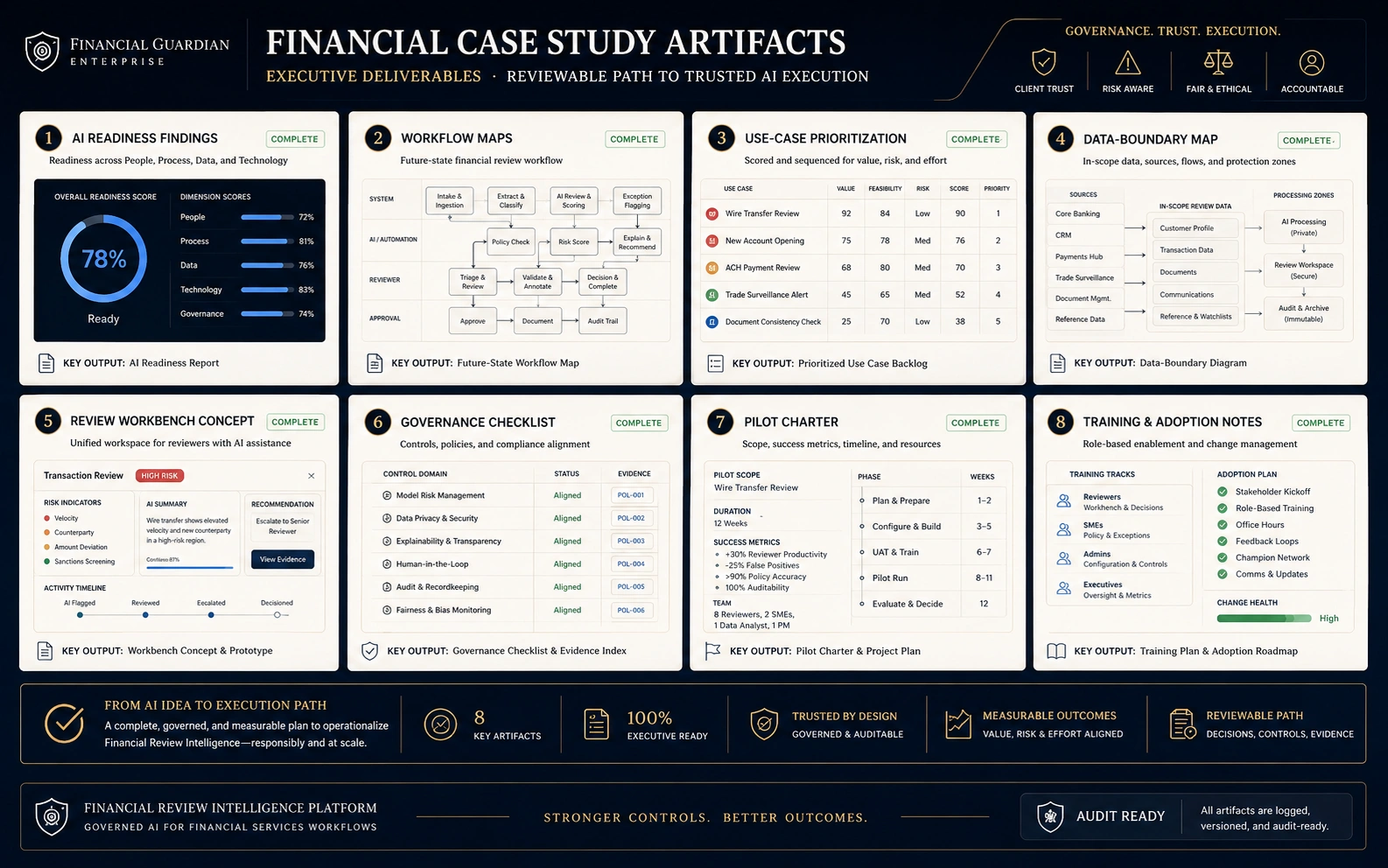
AI readiness findings
Where the organization was ready, where it needed governance, and what should happen before implementation.
Workflow maps
Review queues, handoffs, approvals, data sources, escalations, and reviewer roles.
Use-case prioritization
Pilot candidates ranked by value, feasibility, risk, data readiness, and workflow fit.
Data-boundary map
What information could be used, what required additional review, and what stayed out of scope.
Review workbench concept
Human-reviewed AI assistance across summaries, evidence packets, policy lookup, and triage.
Governance checklist
Use-case intake, model/vendor review questions, data handling, escalation, and approval paths.
Pilot charter
Scope, stakeholders, success signals, review process, and scale decision criteria.
Training and adoption notes
Reviewer enablement, responsible-use expectations, and feedback loops.
WHY THIS CASE STUDY MATTERS
It shows how financial-services AI can be practical without becoming reckless.
The case study stayed focused on review support, evidence quality, governance controls, and scale-readiness decisions.
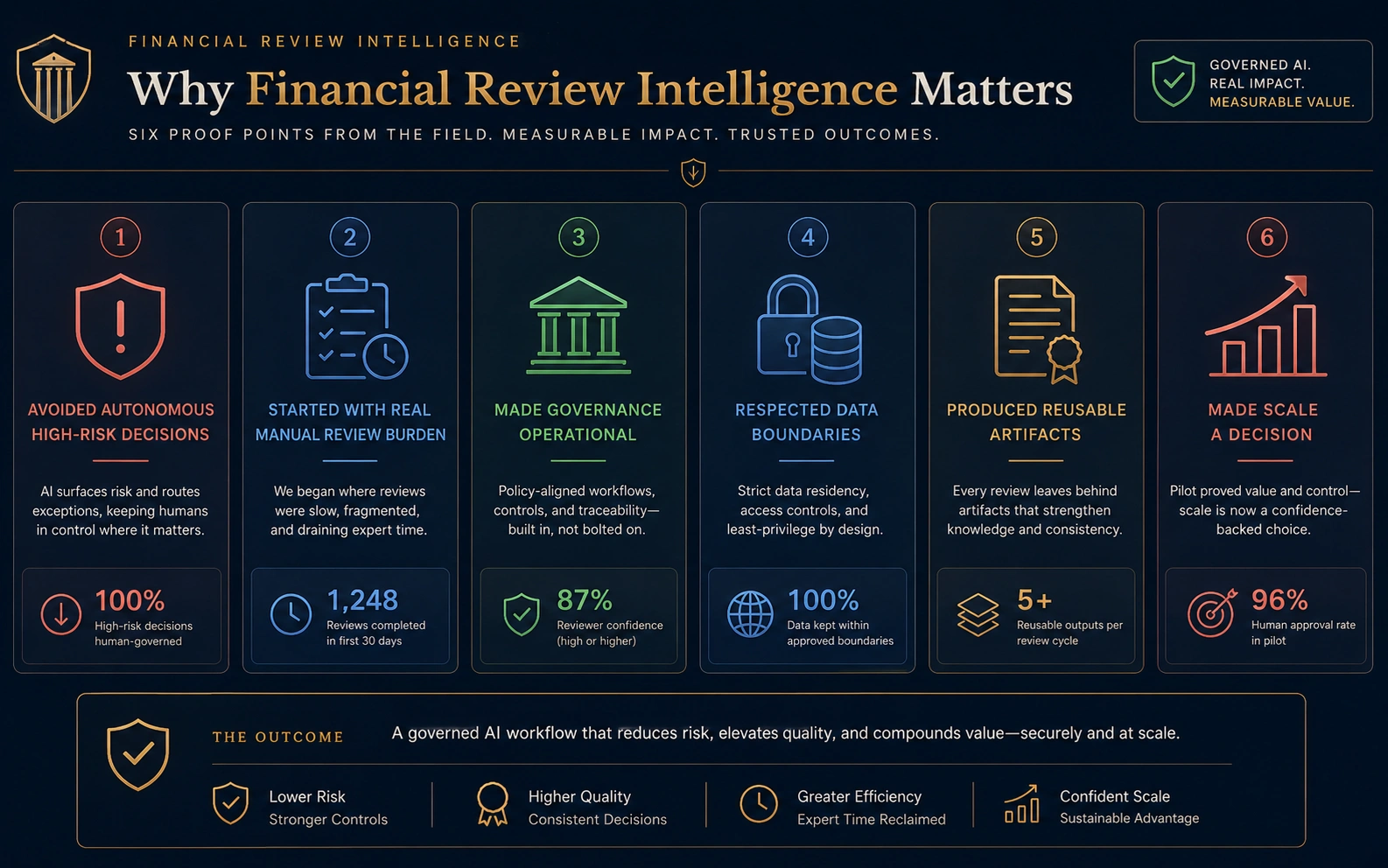
It avoided autonomous high-risk decisions
The workflow supported review, evidence, and summarization, not final credit, investment, compliance, or legal determinations.
It started with real manual review burden
The use case was rooted in high-volume review workflows that already existed.
It made governance operational
Governance became part of the intake, review, evidence, escalation, and approval process.
It respected data boundaries
The design clarified sensitive data, access rules, and review requirements before implementation.
It produced reusable artifacts
Readiness findings, maps, charters, governance checklists, and evidence-packet models created a repeatable path.
It made scale a decision
The pilot was designed to generate evidence for whether to scale, refine, pause, or stop.
HIGH-REVIEW FINANCIAL USE CASES
What the case study intentionally did not automate.
Part of responsible financial-services AI is knowing which use cases require extra review.
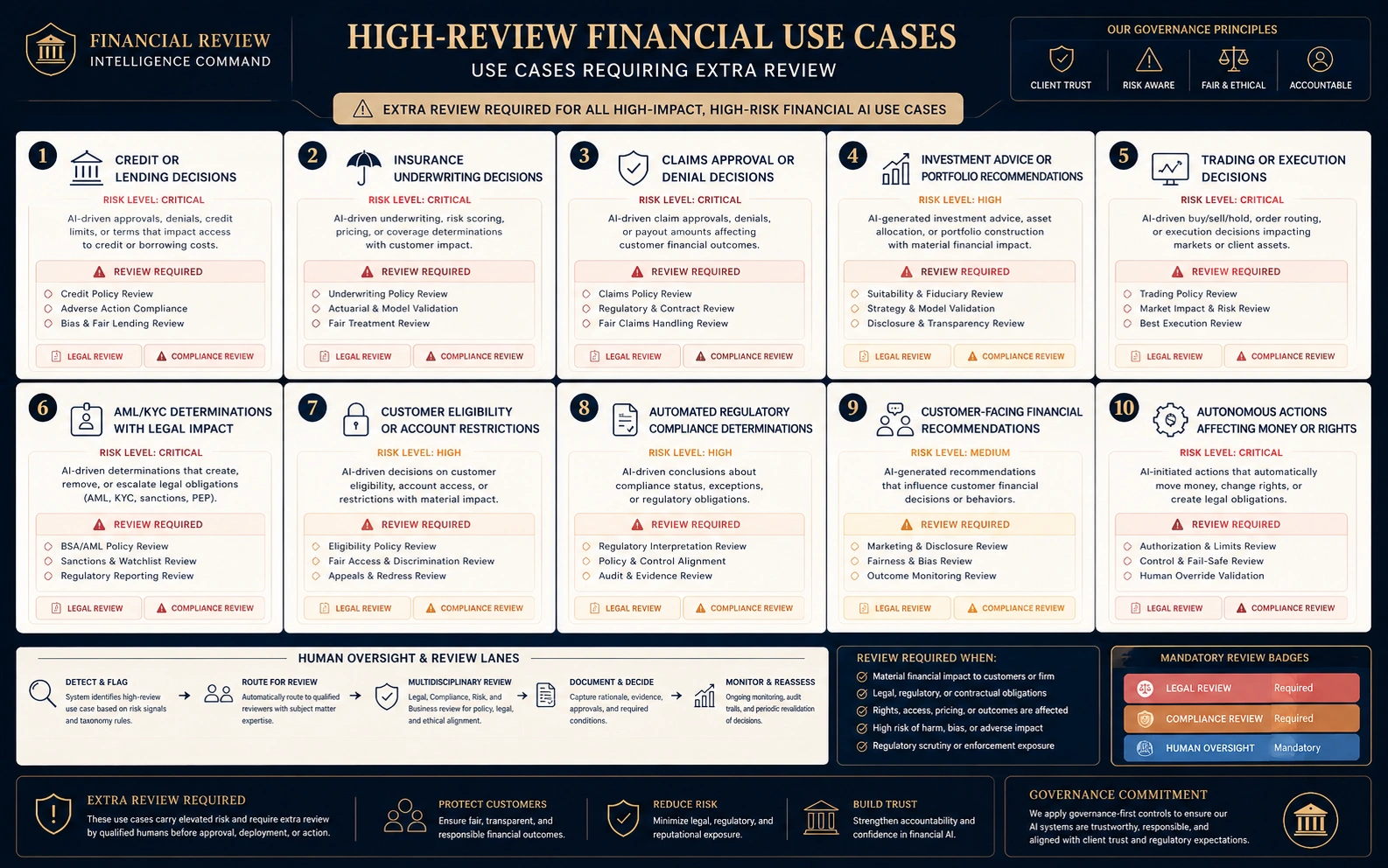
Credit or lending decisions
Decisions can affect access, pricing, obligations, and rights. Start with legal/compliance, privacy/security, model/vendor review, human oversight, and pilot-risk assessment.
Insurance underwriting decisions
Coverage, pricing, eligibility, and protected data require compliance, legal, model-risk, data access, and human oversight review.
Claims approval or denial decisions
Claims actions can affect money, benefits, obligations, and customer outcomes. Define escalation, approval, and exception paths first.
Investment advice or portfolio recommendations
Advice-related workflows need suitability, disclosure, compliance, and accountable human review before any pilot scope.
Trading or execution decisions
Market activity, authorization, monitoring, and risk controls require legal/compliance, risk, model/vendor, and security review.
AML/KYC determinations with legal impact
Determinations can affect account access, reporting obligations, and escalation decisions. Start with governance and documented human review.
Customer eligibility or account restrictions
Restrictions can affect access, service, funds, and rights. Start with privacy, security, legal, compliance, and escalation review.
Automated regulatory compliance determinations
Regulatory determinations require qualified review, source traceability, validation, documentation, and escalation before pilot design.
Customer-facing financial recommendations
Customer recommendations require review of disclosures, data use, suitability concerns, supervision, and vendor/model assumptions.
Autonomous actions affecting money or rights
Any fully autonomous action affecting money, rights, access, benefits, or obligations needs stakeholder review before implementation planning.
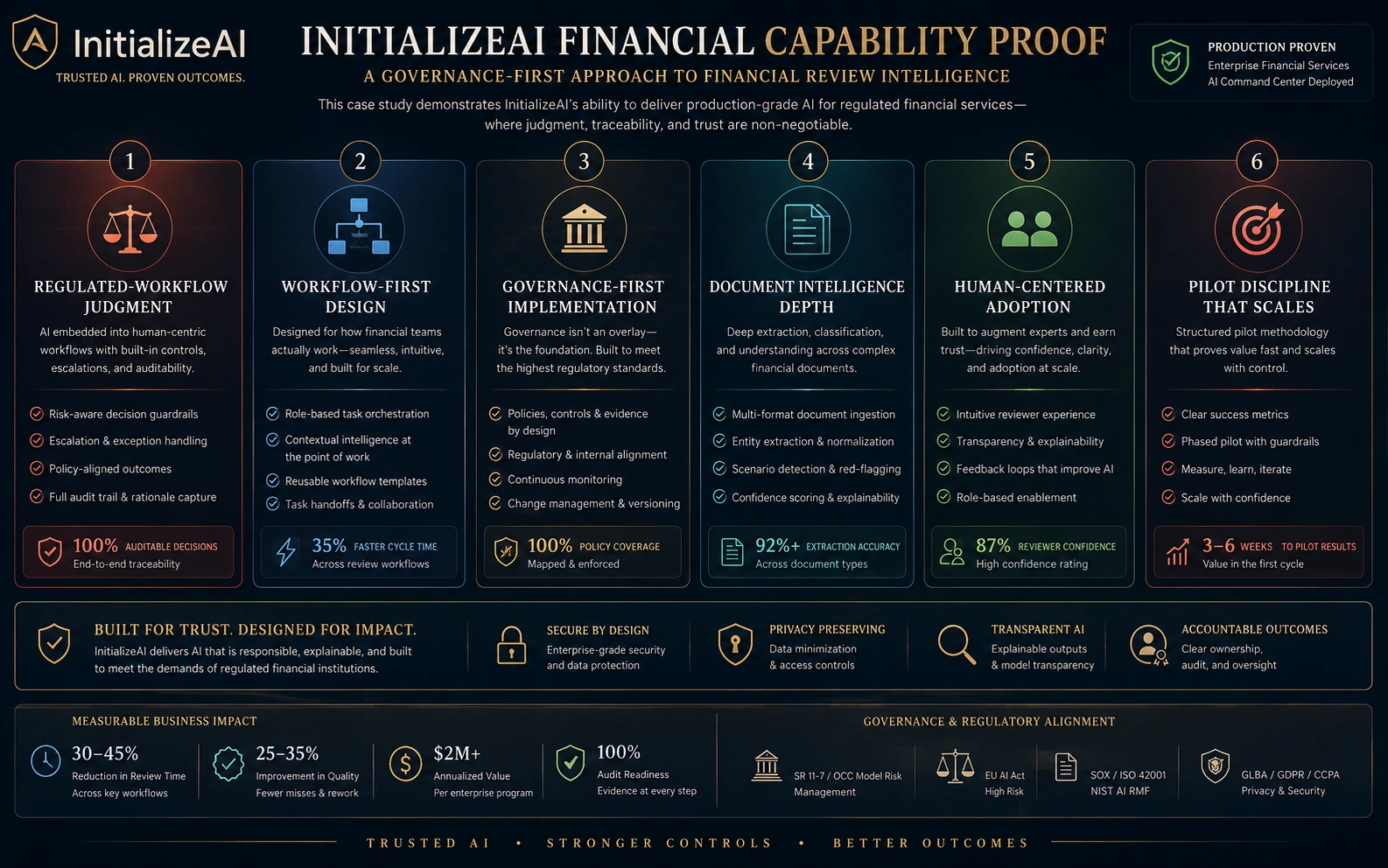
INITIALIZEAI CAPABILITY PROOF
What this proves about InitializeAI.
This case study demonstrates the kind of financial-services AI work InitializeAI is built for: workflow-first, governance-first, reviewable, measurable, and practical.
Regulated-workflow judgment
InitializeAI can help separate safe pilot candidates from high-review use cases.
Workflow-first design
InitializeAI maps the work before recommending the AI.
Governance-first implementation
Controls, review, data boundaries, and escalation are designed early.
Document intelligence depth
Document-heavy workflows become source-grounded, reviewable, and measurable.
Human-centered adoption
Reviewer confidence and staff adoption are treated as implementation requirements.
Pilot discipline
Scale decisions are based on evidence, not excitement.
FAQ
Financial Review Intelligence FAQ.
What is Financial Review Intelligence?
Financial Review Intelligence is a governed AI review-workbench concept that supports financial-services teams with document intelligence, evidence organization, risk signal triage, policy lookup, client operations support, and human-reviewed workflows.
Is this an anonymized case study?
Yes. This page is written as an anonymized financial-services case study to protect confidential project and client information.
Does the workflow automate financial decisions?
No. The case study is designed around human review. AI supports summarization, evidence organization, triage, and knowledge retrieval, while qualified humans remain responsible for review and decisions.
What workflows did the case study focus on?
The case study centers on review-heavy financial workflows such as risk signal triage, compliance evidence workflows, onboarding/client operations support, internal knowledge retrieval, and AI governance intake.
What made the project governance-first?
Governance was built into the workflow through use-case intake, data-boundary planning, model/vendor review questions, human approval lanes, source traceability, escalation, pilot controls, and scale-decision criteria.
What metrics would a pilot track?
Relevant pilot signals include review completeness, source accuracy, correction rate, reviewer confidence, escalation quality, evidence packet quality, user adoption, and scale readiness.
Can InitializeAI build a similar workflow for another financial-services team?
Yes. InitializeAI can help financial-services teams evaluate readiness, prioritize use cases, map workflows, define governance, scope pilots, automate review workflows, and plan custom AI implementation.
How does this differ from fraud detection or investment advice AI?
This case study focuses on review support, evidence organization, and human-approved workflows. Higher-impact use cases such as lending, underwriting, claims decisions, investment advice, trading, or regulatory determinations require additional legal, compliance, model-risk, privacy, security, and business review.
GOVERNED FINANCIAL AI
Need a governed AI review workflow for financial services?
InitializeAI can help your team assess readiness, prioritize use cases, map review workflows, define data boundaries, design governance controls, scope pilots, and implement practical AI around real financial-services review needs.