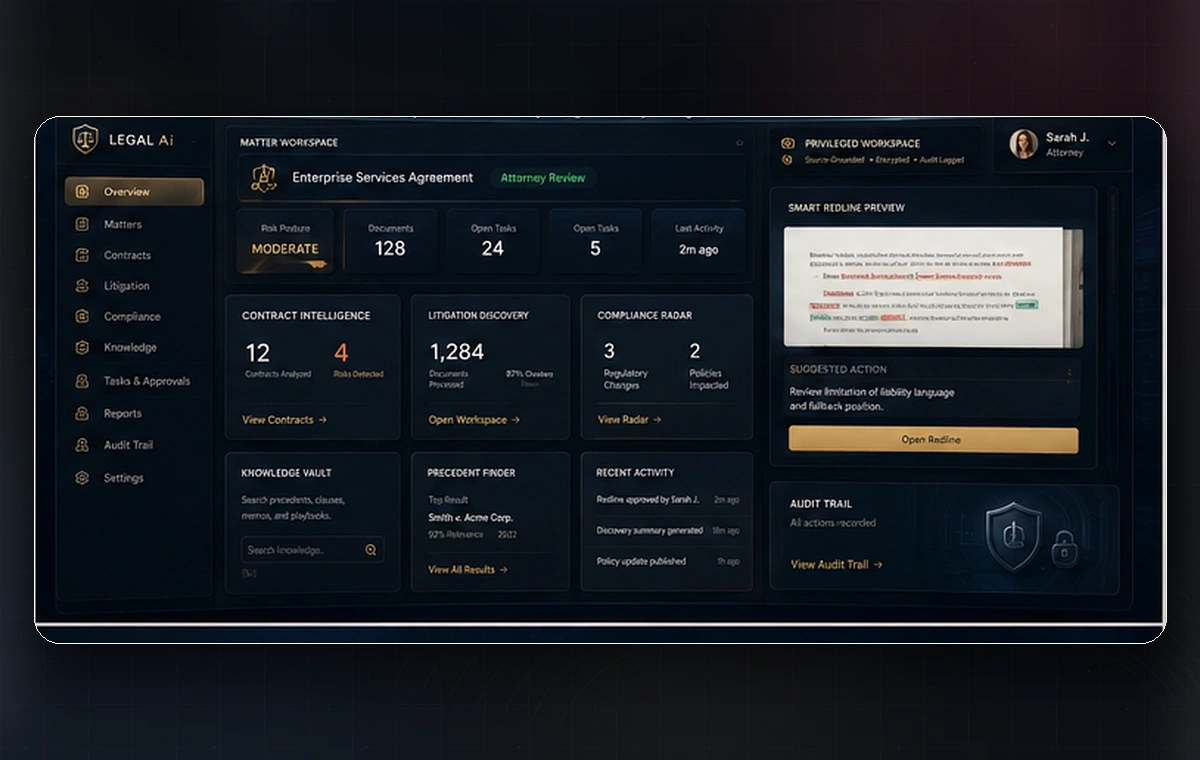
Legal teams face rising workload, cost pressure, regulatory complexity, and fragmented tools across contracts, discovery, compliance, knowledge retrieval, and drafting.
A secure, explainable legal intelligence platform that supports core legal workflows while preserving attorney review, matter context, privilege, and auditability.
Legal workflow modeling, contract intelligence, litigation support, compliance monitoring, knowledge management, retrieval, audit trails, and governance.
A trusted AI workbench that helps legal teams move faster without sacrificing control, confidentiality, or legal judgment.
Legal AI adoption will be won by platforms lawyers can trust: source-grounded, reviewable, explainable, secure, and built around real legal workflows.
TRUSTED LEGAL AI WORKBENCH
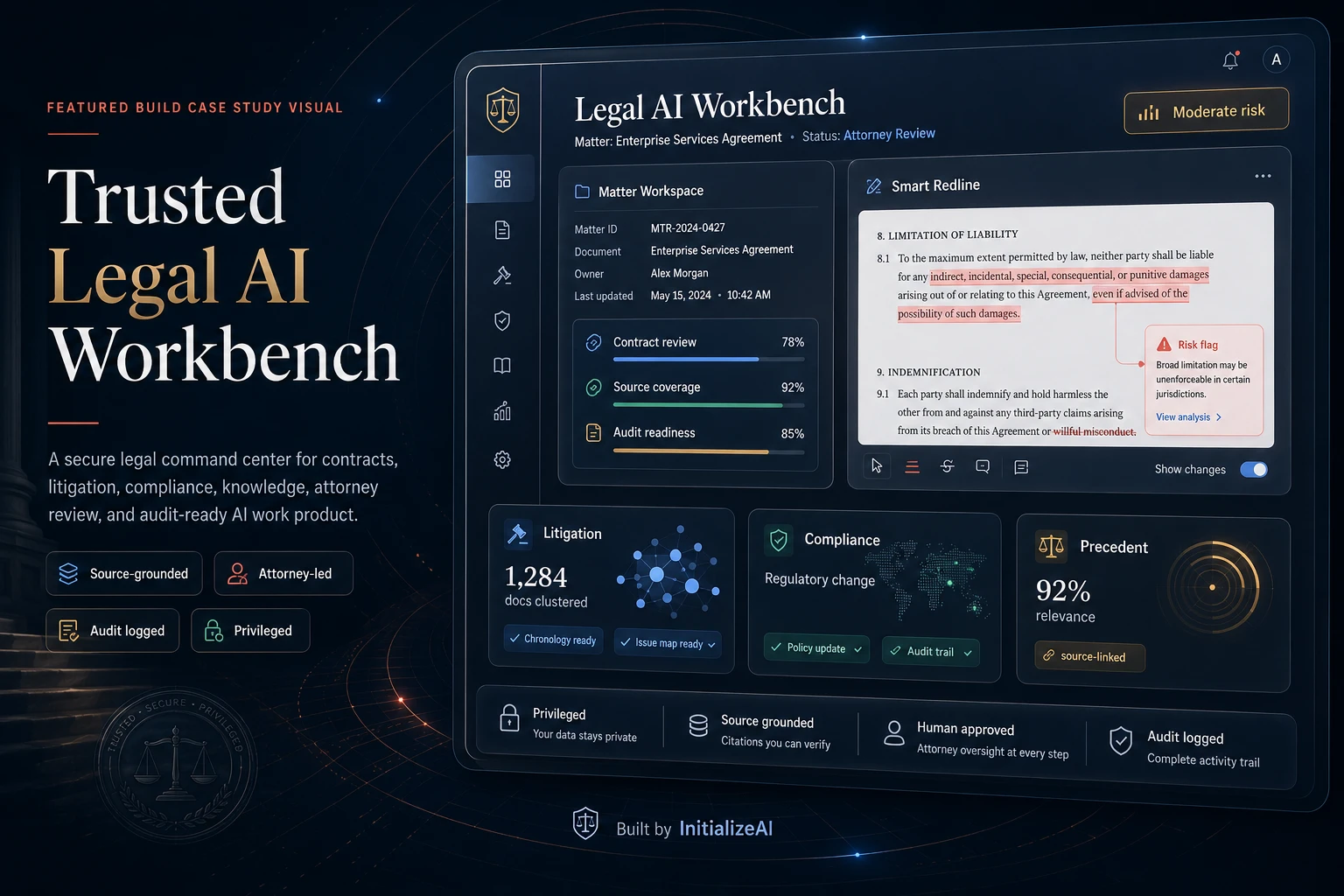
Inside the trusted Legal AI workbench.
Legal AI brings matter context, contract review, redline support, litigation intelligence, compliance monitoring, precedent retrieval, attorney review, and audit trails into one secure workbench.
MATTER INTELLIGENCE BRIEF
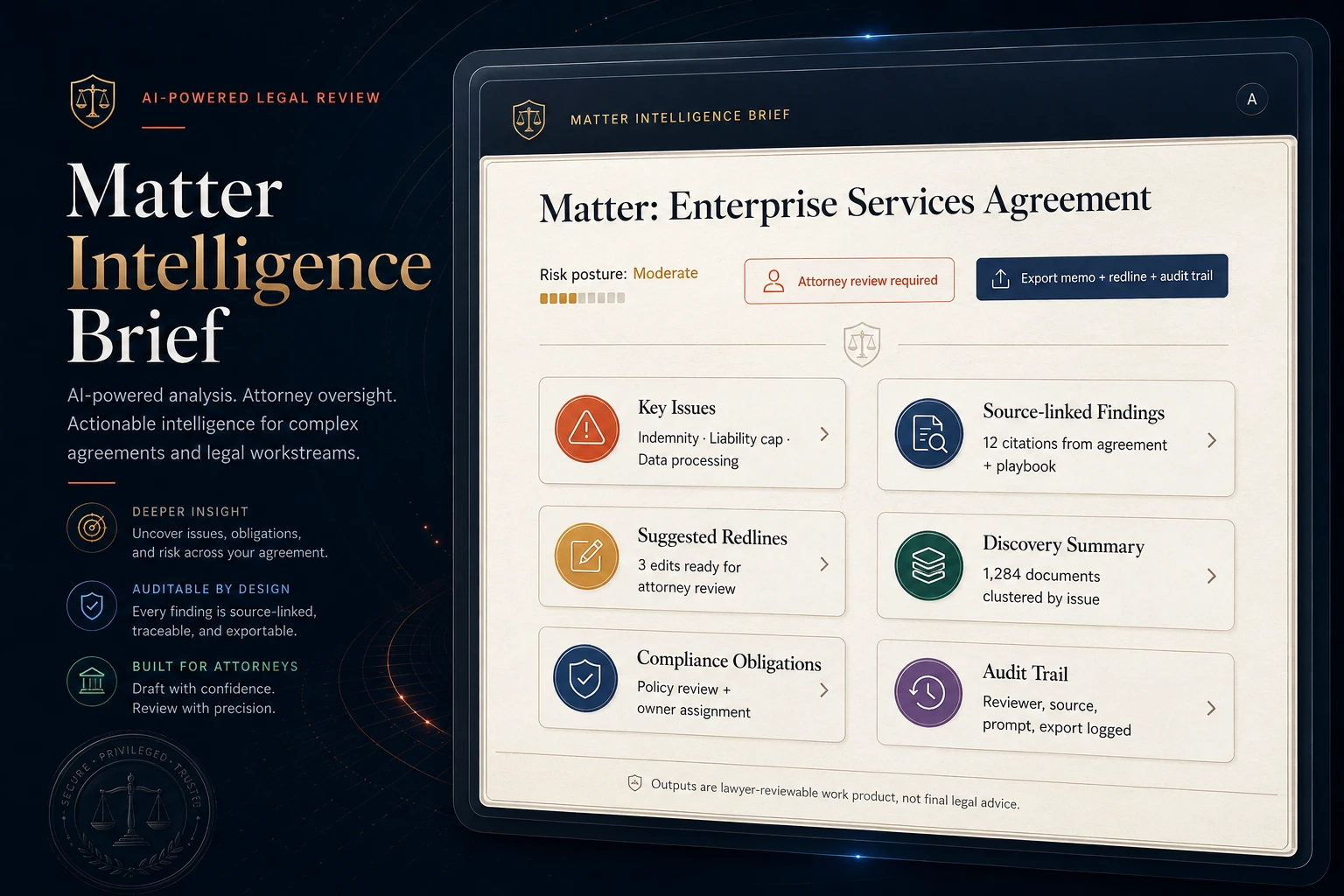
The output: a matter intelligence brief lawyers can review.
The platform creates attorney-reviewable work product: risk posture, source-linked findings, suggested redlines, discovery summaries, compliance obligations, and audit-ready export trails.
THE BUILD STORY
Legal work is knowledge work under constraint.
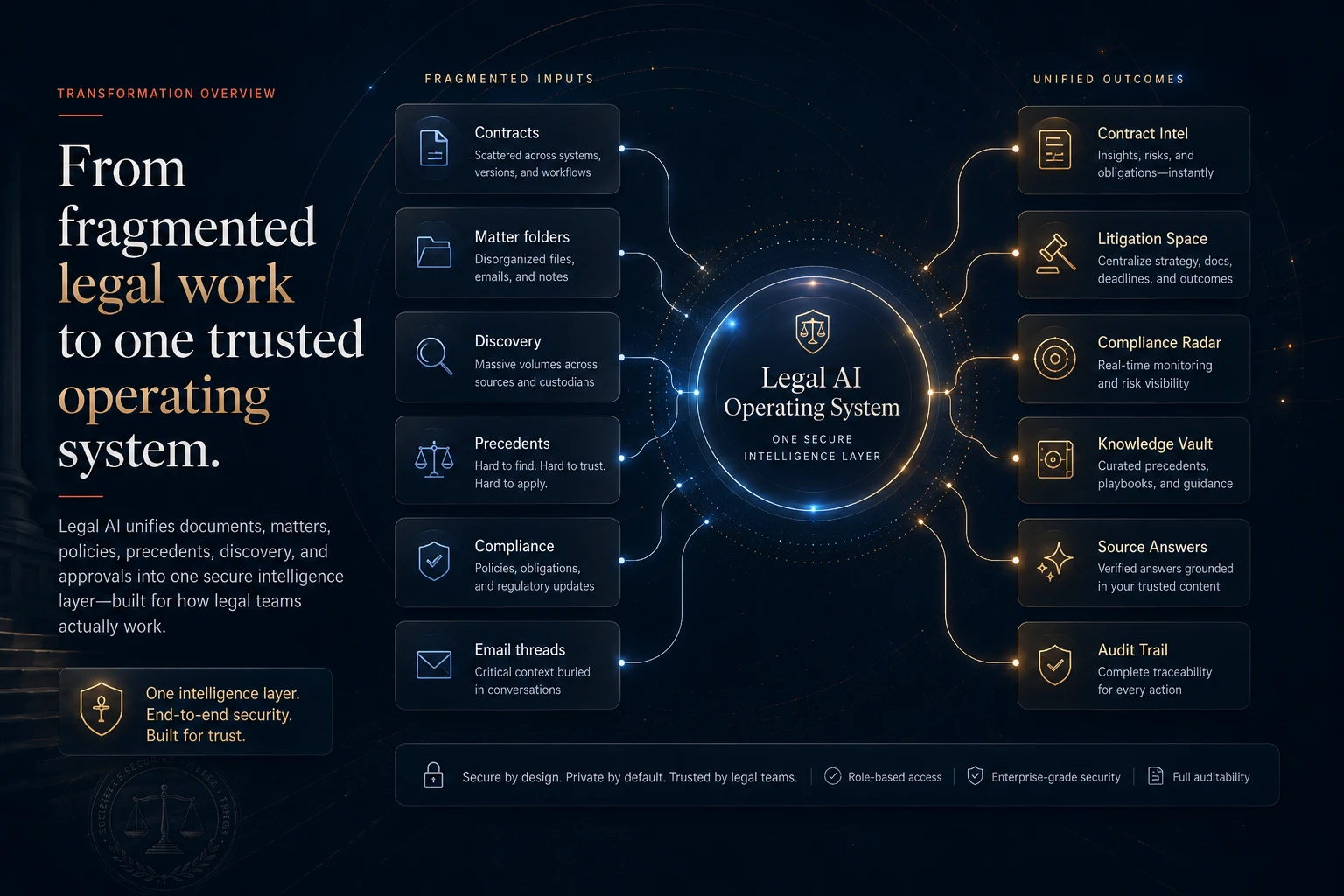
Legal teams are under pressure to move faster, lower cost, and manage increasingly complex risk. But most legal workflows still rely on disconnected documents, manual review, institutional memory, email chains, spreadsheets, matter folders, and siloed research tools.
Legal AI was designed around a different premise: lawyers do not need a generic chatbot. They need a secure legal intelligence layer that understands the matter, grounds outputs in trusted sources, explains its reasoning path, preserves audit trails, and keeps attorneys in control.
Contract review is repetitive but high stakes
Clause review, redlining, playbook alignment, and risk identification require consistency and legal judgment.
Litigation work is document-heavy
Discovery, summaries, chronologies, issue maps, and motion support depend on large volumes of information.
Compliance changes constantly
Teams must monitor changing regulations, update policies, assign obligations, and prove follow-through.
Knowledge is trapped in work product
Precedents, memos, clauses, strategies, and prior matters are often hard to find and reuse.
Legal tools are fragmented
Contract systems, repositories, research tools, email, billing, compliance trackers, and matter management rarely work as one system.
Trust is the adoption barrier
Lawyers need citations, provenance, review controls, confidentiality, explainability, and defensible process.
PRODUCT THESIS
From legal chatbot to Legal Intelligence Operating System.
Legal AI is not an AI lawyer. It is a trusted legal workbench: matter-aware, source-grounded, reviewable, permissioned, and designed around the way legal teams actually work.
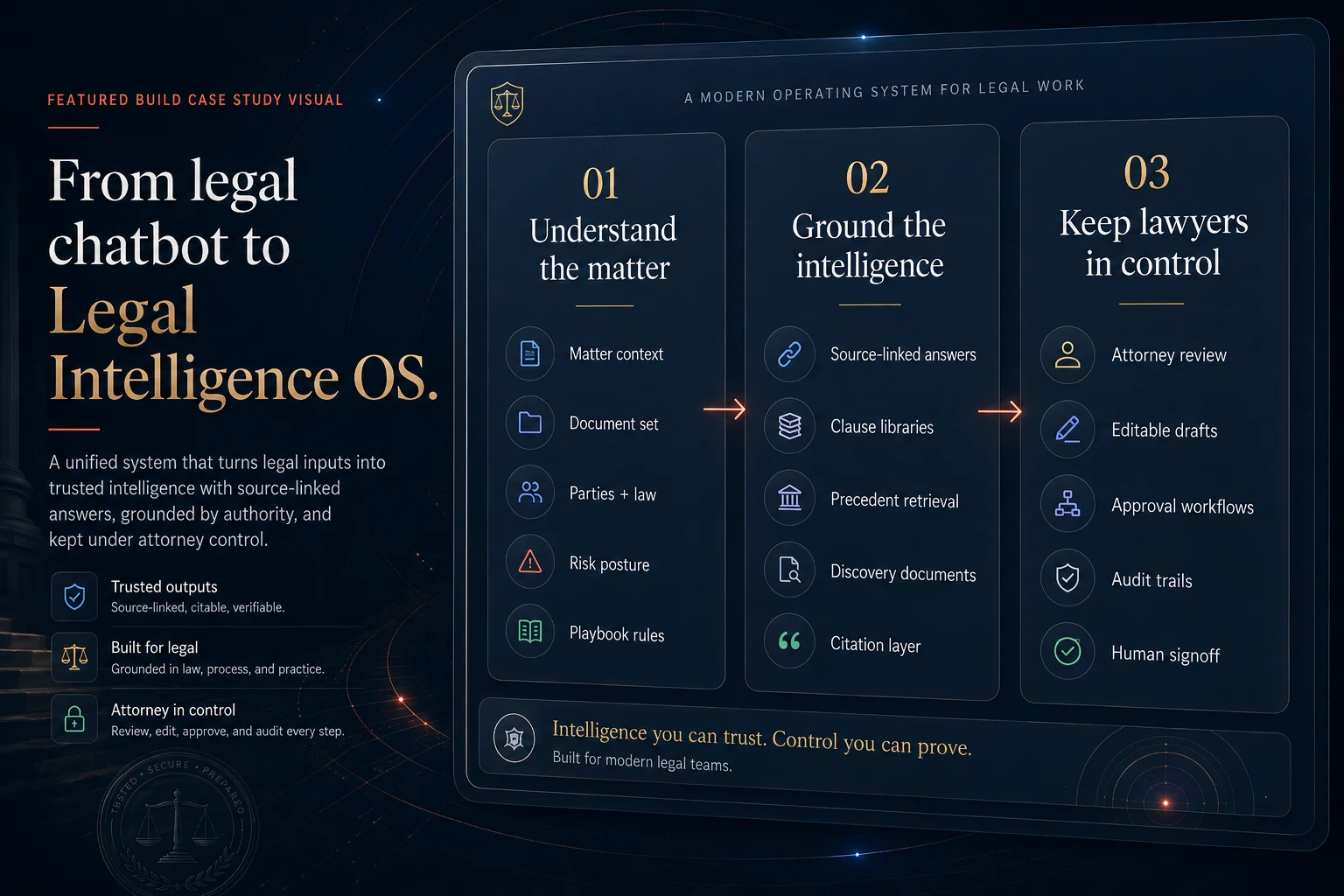
Understand the matter
- Matter context
- Document set
- Parties
- Governing law
- Risk posture
- Playbook rules
- Prior work product
- Attorney instructions
Ground the intelligence
- Source-linked answers
- Clause libraries
- Precedent retrieval
- Case law references
- Discovery documents
- Regulatory sources
- Policy repositories
- Citation layer
Keep lawyers in control
- Attorney review
- Editable drafts
- Approval workflows
- Audit trails
- Privilege-aware workspaces
- Explainable outputs
- Human signoff before use
- No final legal decision without lawyer approval
LEGAL INTELLIGENCE SYSTEM
A complete Legal Intelligence system for contracts, litigation, compliance, and knowledge.
Legal AI connects high-value legal workflows into one source-grounded, attorney-reviewable product system.
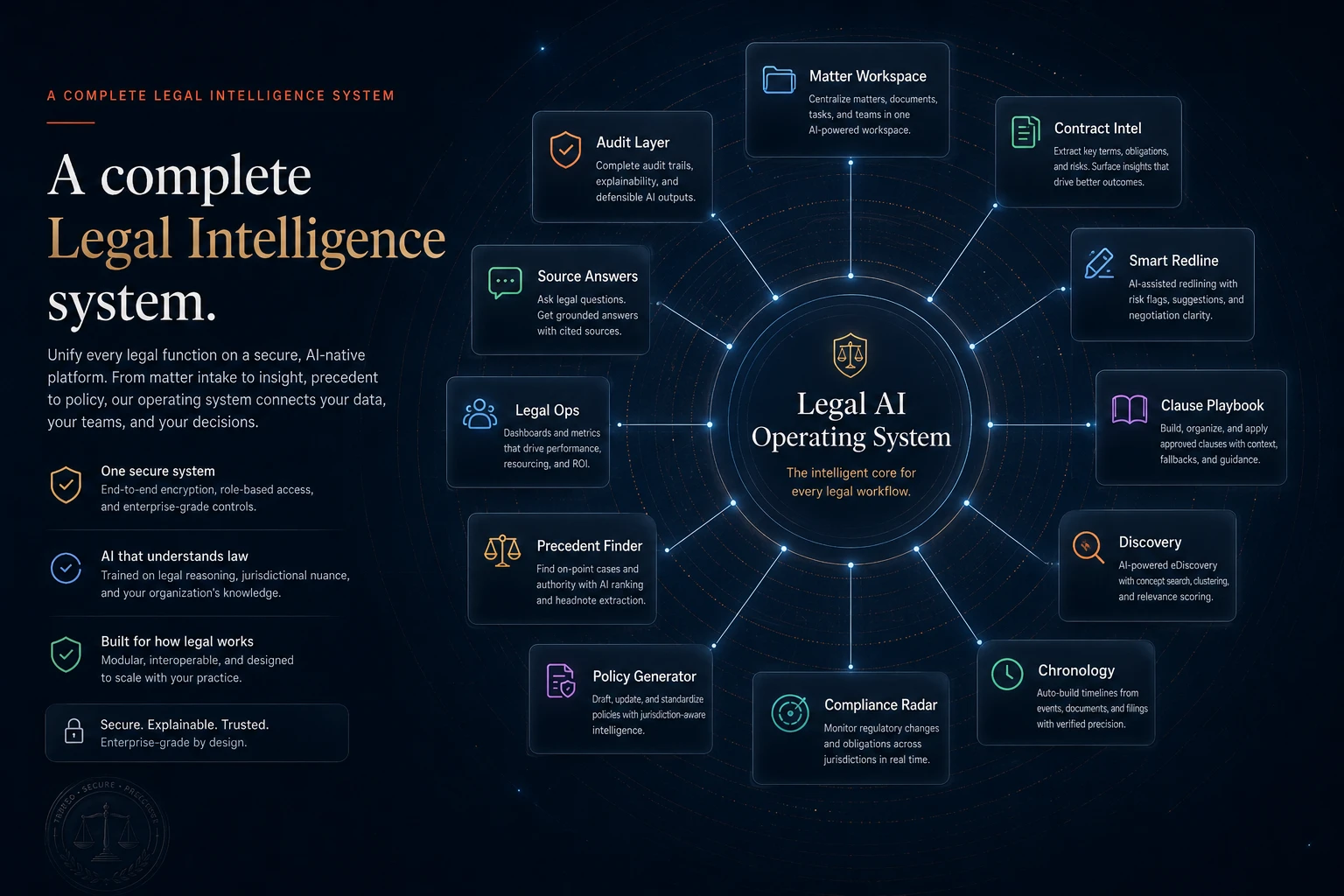
Secure Matter Workspace
A privileged workspace for documents, issues, parties, tasks, legal questions, attorney notes, and AI-generated work product.
Build elements:Matter data model, document permissions, context windows, task states, review status, audit history, secure UX.Contract Intelligence
AI-assisted review that identifies clauses, missing terms, risk areas, playbook deviations, and negotiation issues.
Build elements:Clause extraction, risk taxonomy, playbook alignment, document comparison, issue flagging, attorney review workflow.Smart Redlining
Drafting support for redlines, alternative clause language, fallback positions, and negotiation notes.
Build elements:Redline preview UI, clause rewrite logic, fallback libraries, approval states, version tracking, editable output.Clause Playbook Builder
A tool for preferred clauses, fallback language, unacceptable provisions, negotiation posture, and matter-specific rules.
Build elements:Playbook schema, clause library, rule configuration, risk scoring, approval workflow, firm and client policy controls.Litigation Discovery Navigator
A discovery intelligence layer for summaries, clusters, timelines, issue tags, and litigation team review.
Build elements:Document ingestion, summarization, entity extraction, issue tagging, chronology building, review queues, source links.Case Chronology Generator
A workflow that turns discovery records, correspondence, pleadings, and evidence into a lawyer-reviewable chronology.
Build elements:Event extraction, date normalization, source citations, confidence states, issue mapping, editable timeline UI.Motion and Brief Drafting Support
First-pass outlines, argument maps, factual summaries, and source-grounded draft sections for attorney review.
Build elements:Matter-grounded drafting, citation placeholders, issue outline workflow, review gates, human approval controls.Precedent Finder
Semantic search for relevant clauses, memos, briefs, prior matters, policies, research, and firm work product.
Build elements:Secure ingestion, vector search, metadata filters, relevance scoring, access controls, source preview.Compliance Radar
A monitoring layer that tracks regulatory changes, maps them to policies and obligations, and flags required review.
Build elements:Regulatory source model, change detection, obligation mapping, policy impact analysis, owner assignment, audit trail.Policy Generator
A workflow for generating and updating internal policies based on requirements, posture, and approved templates.
Build elements:Policy template system, regulatory grounding, review workflow, versioning, approval logs, compliance-ready export.Legal Intake and Triage
A front-door workflow for business teams to submit legal requests and for legal teams to triage and route work.
Build elements:Request intake forms, classification logic, routing rules, SLA states, matter creation, task assignment.Legal Operations Analytics
Dashboards for matter volume, review time, contract risk, compliance workload, research activity, and throughput.
Build elements:Metrics model, workflow events, dashboards, workload views, matter analytics, executive reporting.Source-Grounded Legal Answers
A retrieval-augmented answer layer linked to trusted sources, matter documents, firm work product, and approved references.
Build elements:RAG architecture, source citations, confidence indicators, source previews, answer boundaries, hallucination controls.Audit Trail and Approval Layer
A governance layer that records who reviewed, approved, edited, exported, or relied on AI-supported work product.
Build elements:Event logging, approval states, version history, reviewer identity, export records, compliance reporting.Privilege and Access Controls
A security model for confidentiality, privilege, ethical walls, matter access, permissions, and authentication.
Build elements:Permission model, access groups, matter-level controls, audit logs, secure ingestion, data boundary rules.Legal Knowledge Vault
Secure institutional memory for approved templates, research, clause positions, strategy notes, and prior work product.
Build elements:Knowledge ingestion, taxonomy, semantic retrieval, metadata, tagging, source control, content governance.LEGAL WORKFLOW JOURNEYS
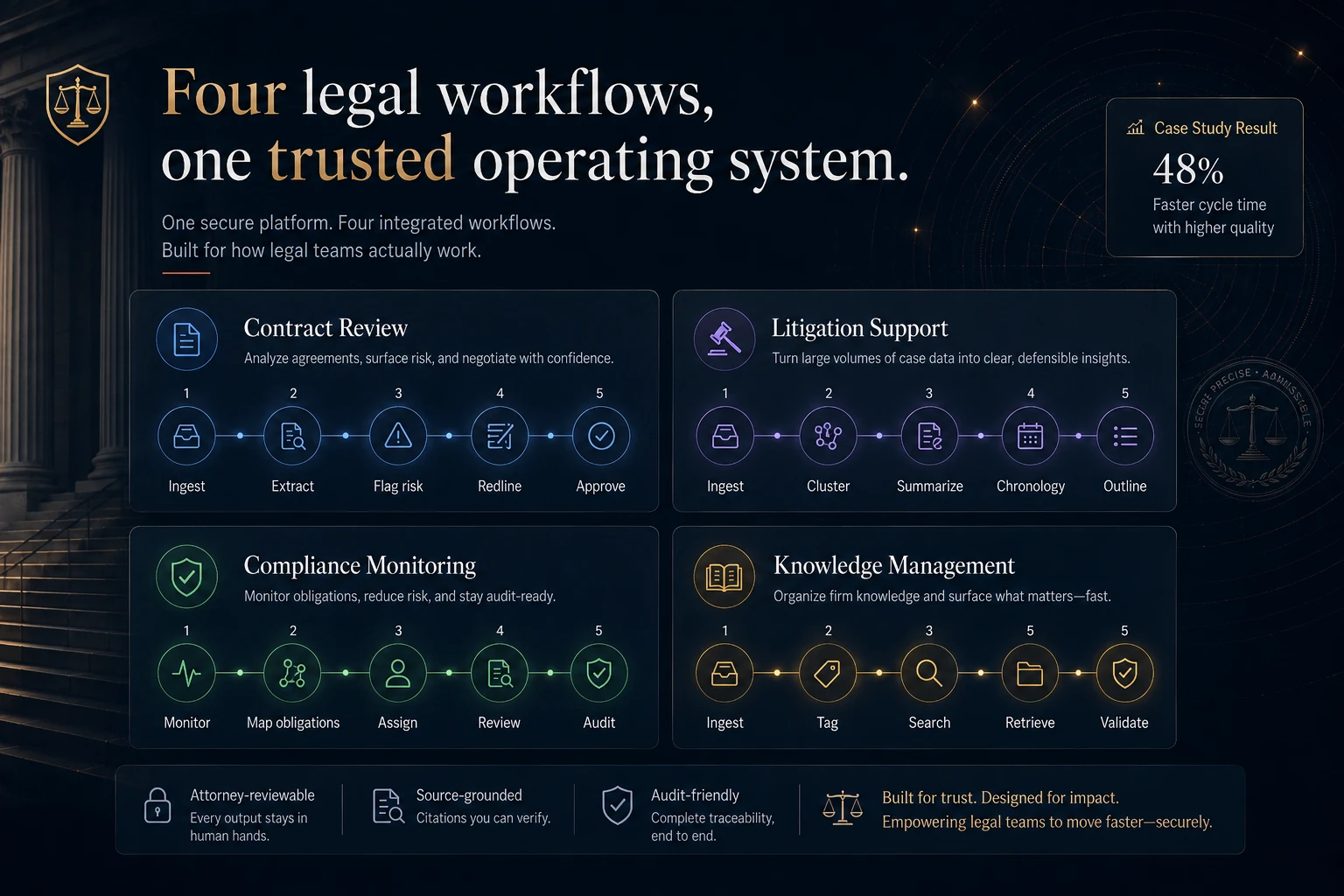
Four legal workflows, one trusted operating system.
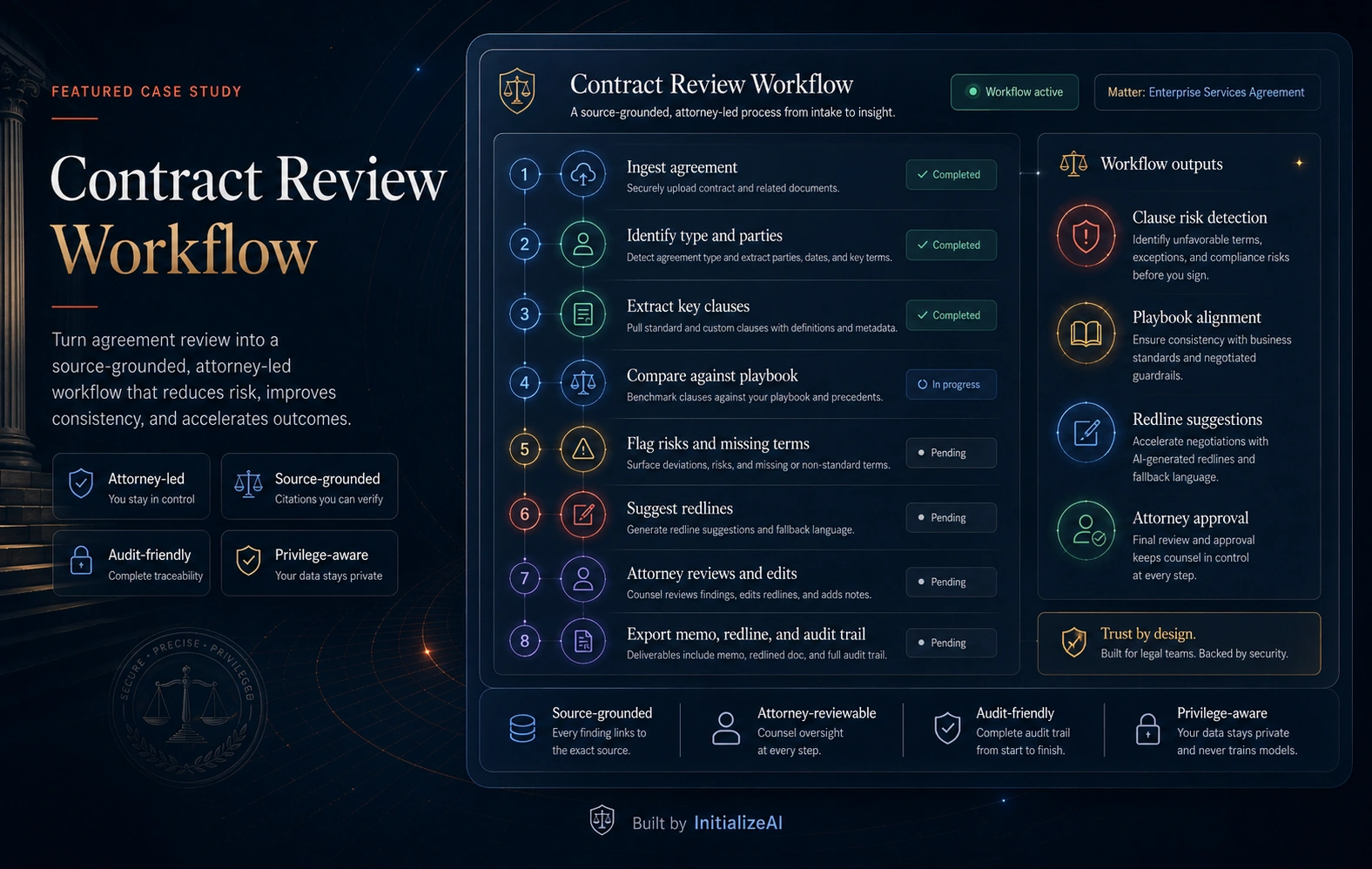
From agreement to attorney-approved redline.
- Ingest agreement
- Identify type and parties
- Extract key clauses
- Compare against playbook
- Flag risks and missing terms
- Suggest redlines
- Attorney reviews and edits
- Export memo, redline, and audit trail
From discovery volume to source-linked strategy.
- Ingest discovery set
- Cluster documents by topic
- Summarize key records
- Extract parties, dates, and events
- Generate case chronology
- Build issue map
- Draft reviewable outline
- Preserve source citations
From regulatory change to audit-ready follow-through.
- Monitor regulatory changes
- Identify affected policies
- Map obligations
- Assign owners
- Generate policy update draft
- Review with legal/compliance team
- Approve and publish
- Maintain audit trail
From firm work product to reusable legal intelligence.
- Securely ingest work product
- Tag by matter and issue
- Search semantically
- Retrieve precedents
- Compare against current matter
- Generate source-linked summary
- Attorney validates
- Save improved work product
Contract review: from agreement to attorney-approved redline.
Source-grounded review logic turns contract intake into playbook comparison, risk flags, redline suggestions, attorney edits, and exportable review records.
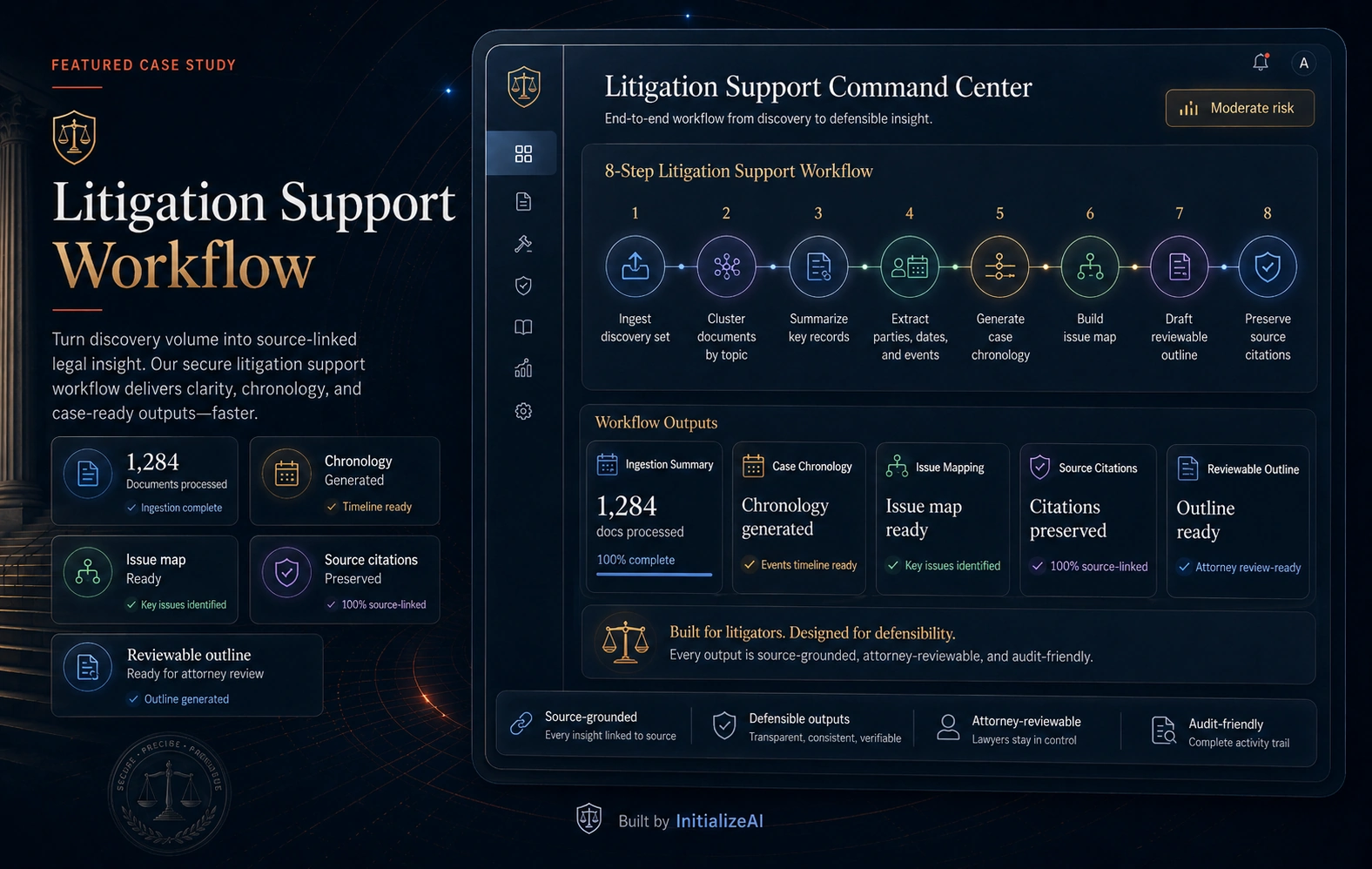
Litigation support: from discovery volume to source-linked strategy.
Discovery sets become clustered, summarized, mapped to issues, organized into chronology, and preserved with source citations for legal review.
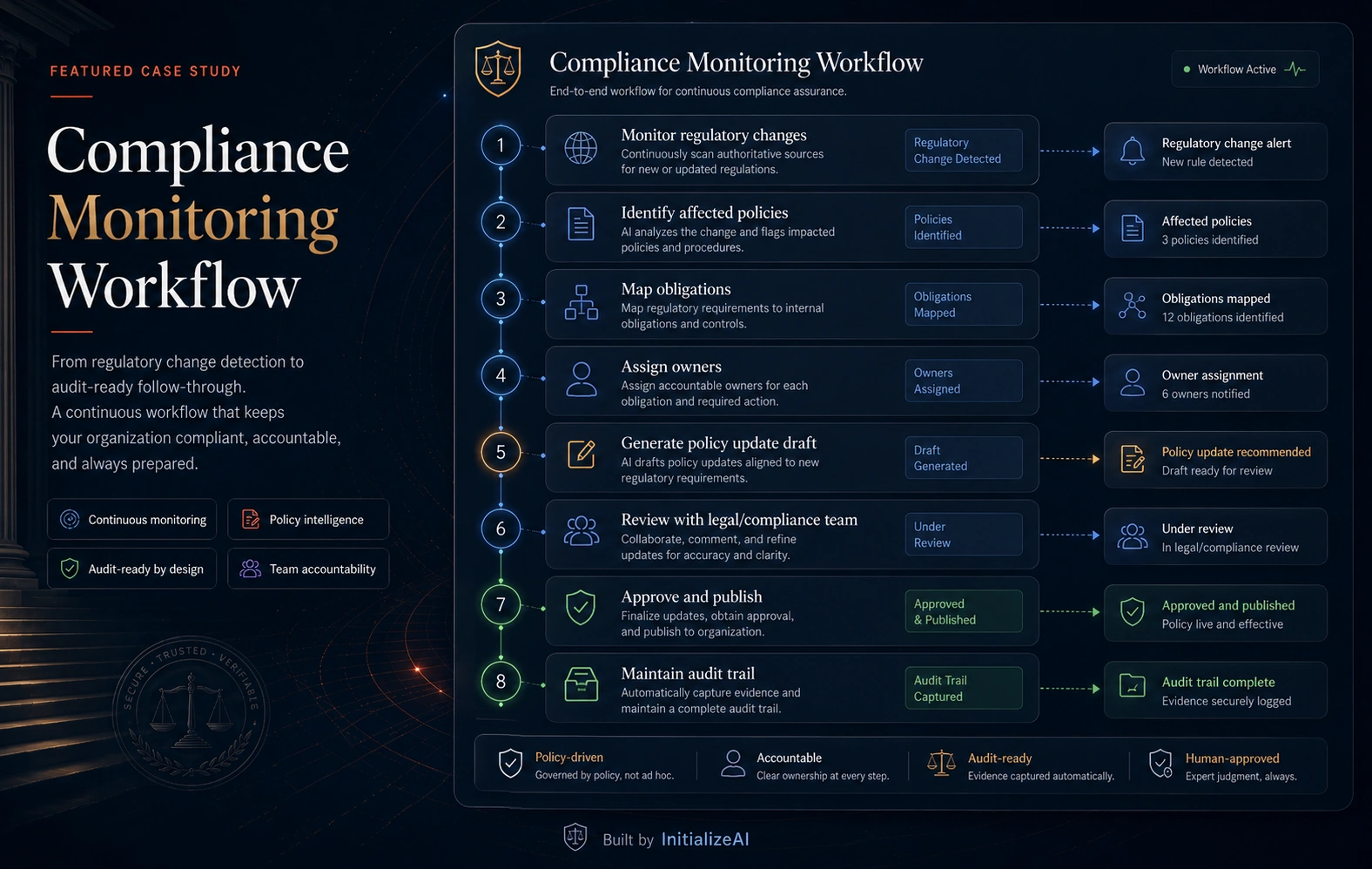
Compliance monitoring: from regulatory change to audit-ready follow-through.
Regulatory updates move through policy impact analysis, obligation mapping, owner assignment, legal review, approvals, and audit trails.
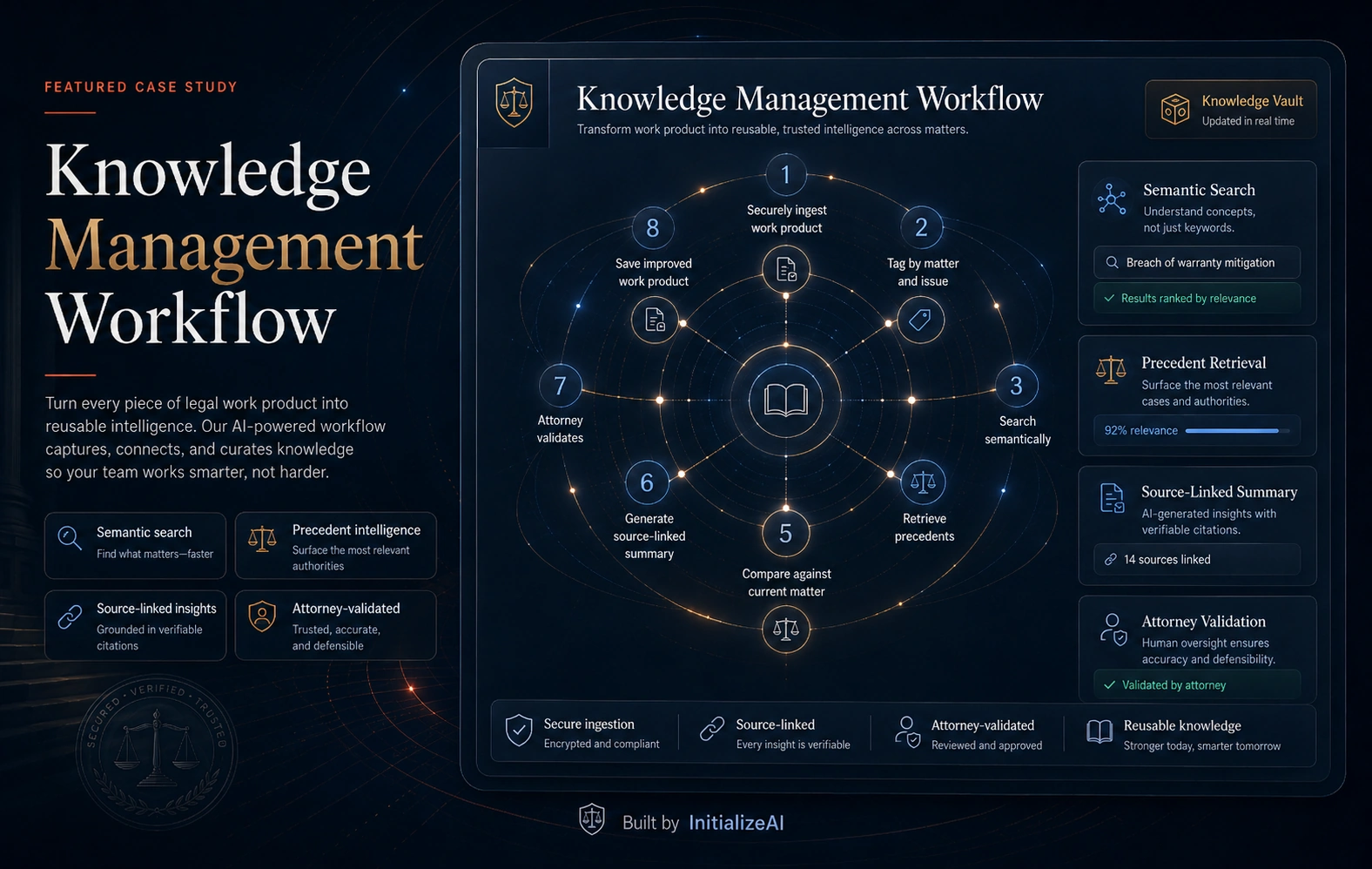
Knowledge management: from work product to reusable legal intelligence.
Prior work product, clauses, briefs, memos, and strategy notes become searchable, permissioned, source-linked legal intelligence.
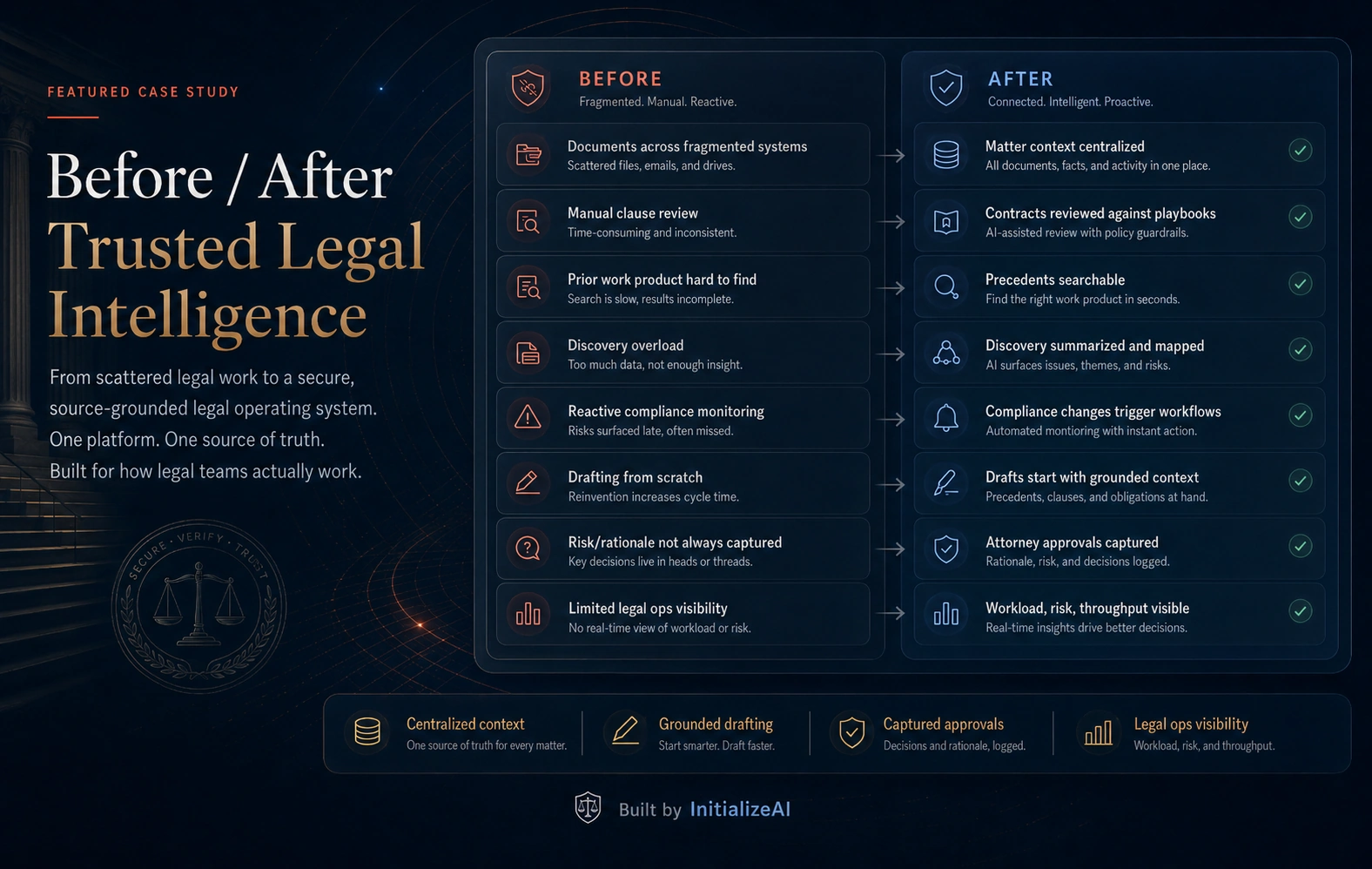
BEFORE / AFTER
From scattered legal work to trusted legal intelligence.
Before Legal AI
- Documents live across fragmented systems
- Contract review depends on manual clause-by-clause analysis
- Prior work product is hard to find
- Discovery review creates information overload
- Compliance monitoring is reactive
- Drafting starts from scratch too often
- Risk and rationale are not always captured
- Legal operations lacks workflow-level visibility
After Legal AI
- Matter context is centralized
- Contracts are reviewed against playbooks
- Precedents and work product are searchable
- Discovery becomes summarized, clustered, and mapped
- Compliance changes trigger review workflows
- Drafts start with source-grounded context
- Attorney approvals and rationale are captured
- Legal leaders can measure workload, risk, and throughput
AI EXECUTION GAP
How Legal AI closes the AI Execution Gap in legal work.
Legal AI becomes valuable when it is integrated into actual legal workflows with accountable owners, trusted data, governance, and measurement.
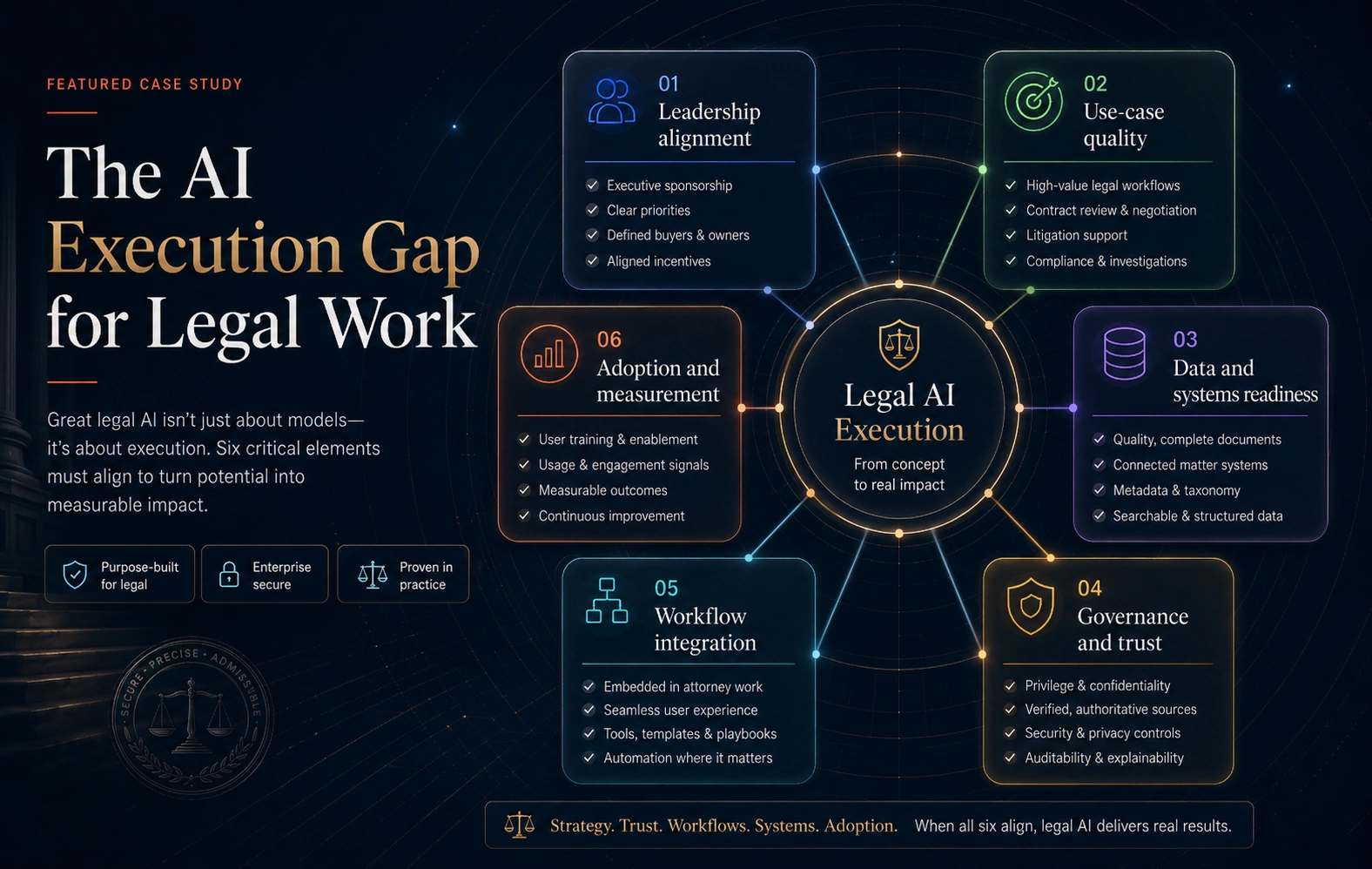
Leadership alignment
Define the legal workflow, risk tolerance, review standard, data boundaries, and accountable legal owner.
Use-case quality
Focus on contracts, discovery, compliance, knowledge retrieval, intake, and legal operations.
Data and systems readiness
Structure matter documents, templates, policies, clauses, precedents, research, regulatory sources, permissions, and events.
Governance and trust
Add source grounding, attorney review, privilege controls, audit trails, approval states, version history, and clear boundaries.
Workflow integration
Connect AI to the real legal process instead of leaving it as a standalone chatbot.
Adoption and measurement
Measure review cycle time, matter throughput, playbook alignment, source reuse, approvals, compliance response, and attorney usage.
TRUST LAYER
Legal AI adoption depends on trust by design.
Legal AI must be designed differently from ordinary automation. Attorneys need to see the source, understand the rationale, control the output, preserve privilege, and approve final work product before it leaves the system.
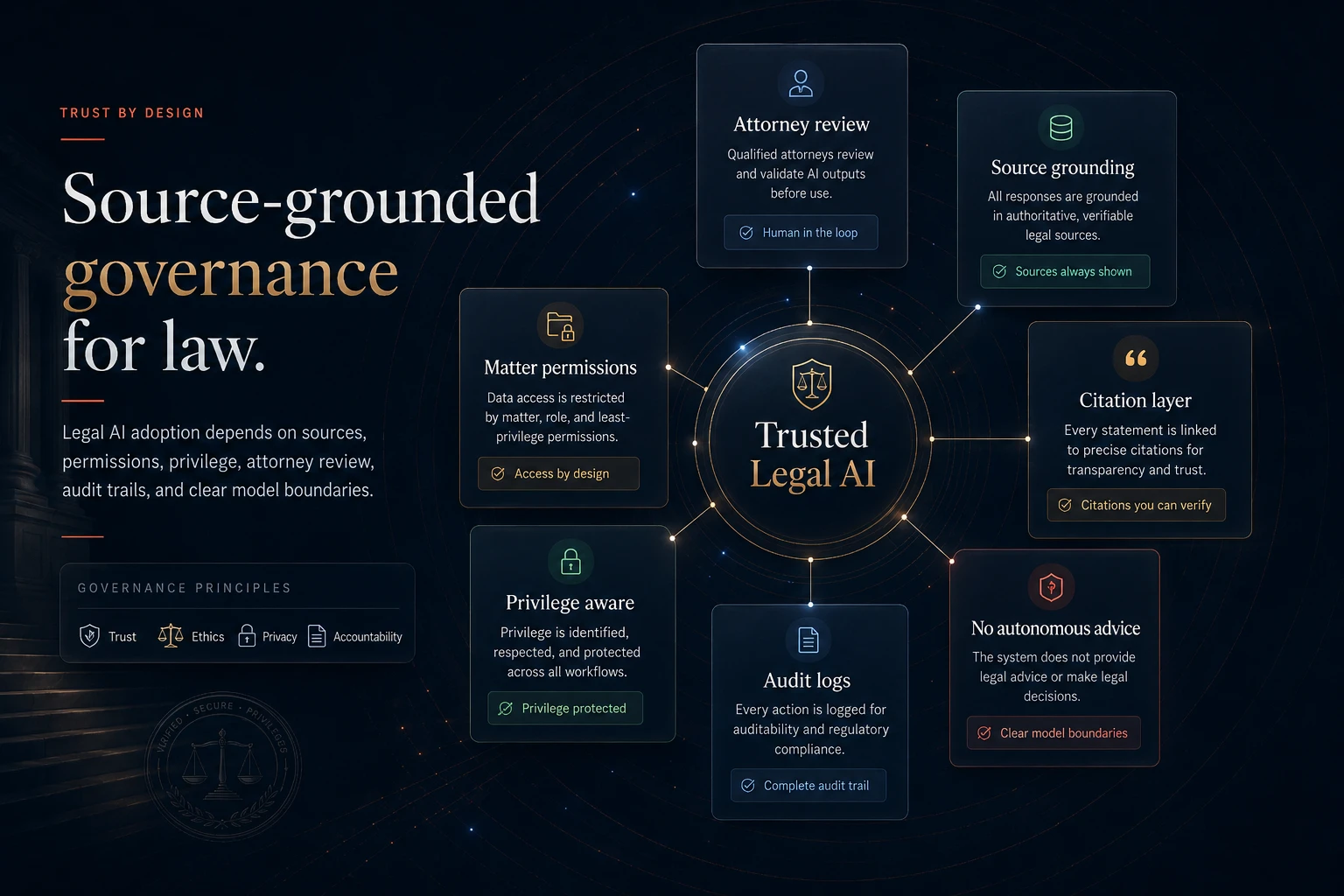
Legal AI should accelerate legal judgment, not replace it.
Outputs are attorney-reviewable work product, not final legal advice.
RESPONSIBLE LEGAL AI
Built for regulated, high-stakes professional judgment.
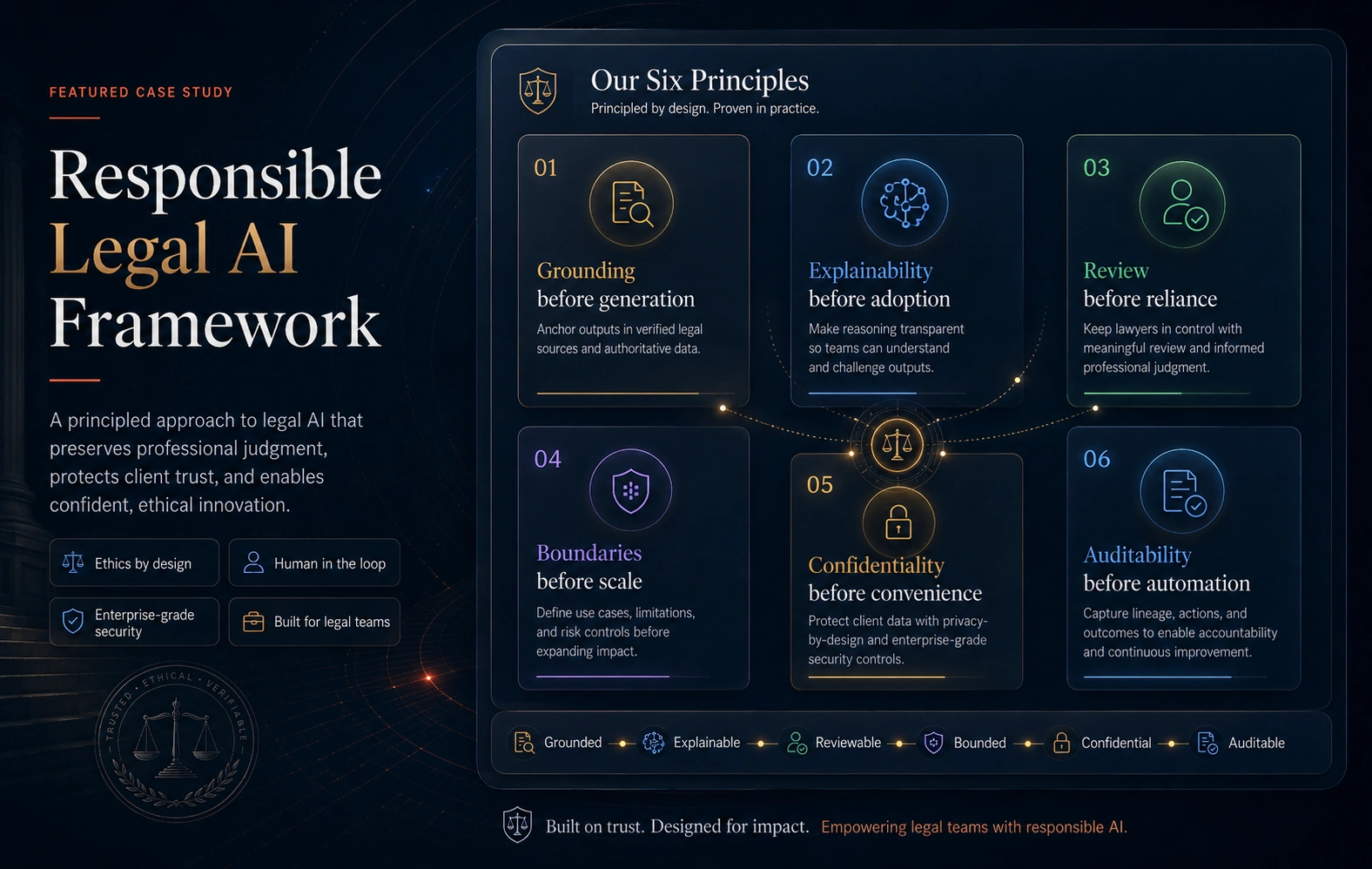
Grounding before generation
Responses should be grounded in matter documents, approved legal sources, playbooks, and firm knowledge.
Explainability before adoption
Lawyers need to see why a clause was flagged, why a precedent was suggested, or why a regulatory change matters.
Review before reliance
AI outputs must be reviewed, edited, approved, and contextualized by legal professionals.
Boundaries before scale
The system should define what it can do, what it cannot do, and when attorney review is mandatory.
Confidentiality before convenience
Legal AI systems must protect client data, firm work product, privileged material, and matter boundaries.
Auditability before automation
The system should preserve who did what, when, why, and based on which sources.
BUILD ARTIFACTS
Artifacts behind the build.
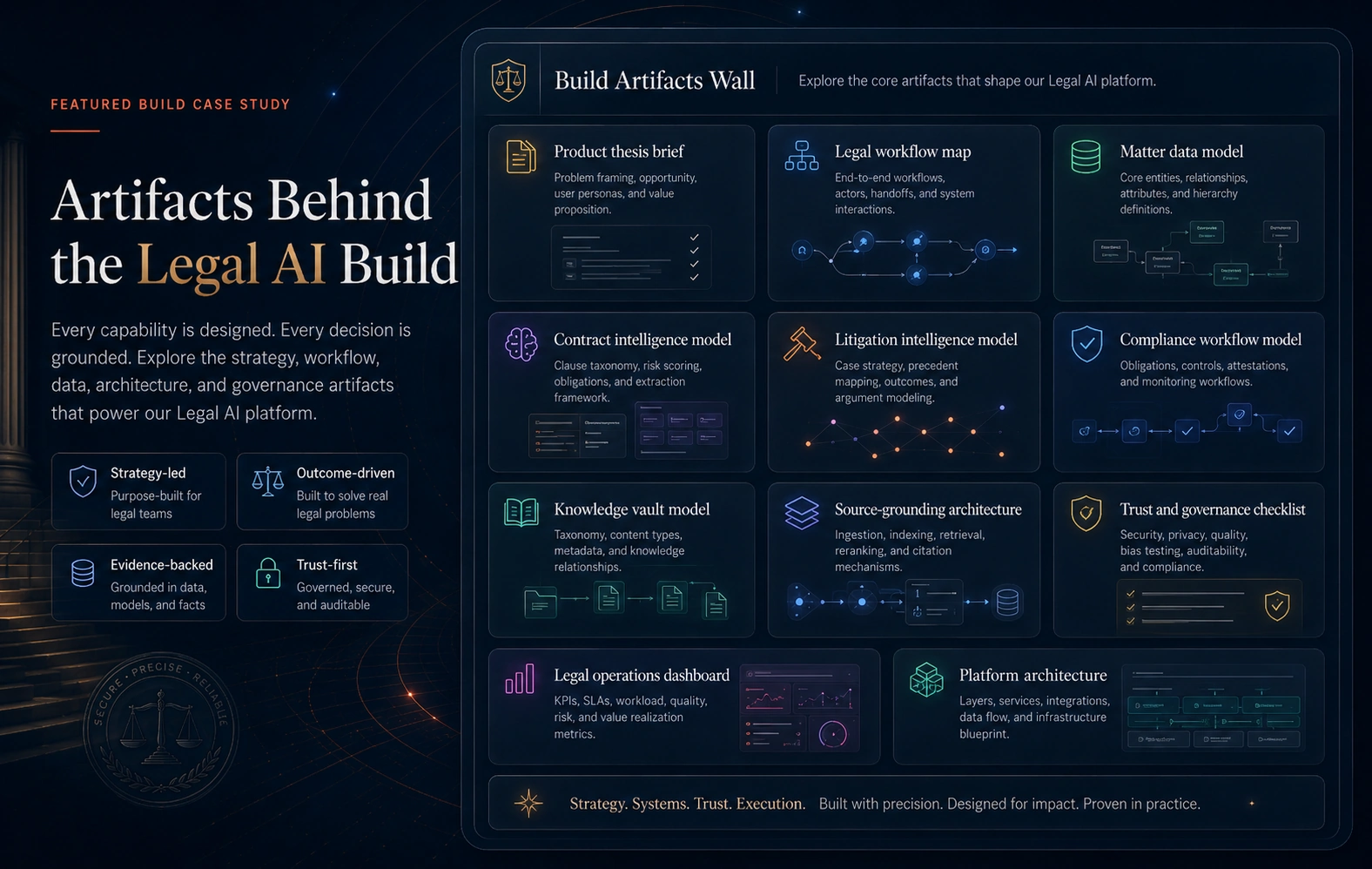
Product thesis brief
Trusted AI Operating System for legal workflows.
Legal workflow map
Contracts, litigation, compliance, knowledge, intake, and legal operations.
Matter data model
Parties, documents, issues, jurisdiction, governing law, tasks, approvals, and work product.
Contract intelligence model
Clauses, risks, playbook rules, fallback language, redlines, comments, and approval states.
Litigation intelligence model
Discovery documents, entities, dates, chronology, issue tags, summaries, source links, and notes.
Compliance workflow model
Regulations, obligations, policies, owners, review states, approvals, and audit trails.
Knowledge vault model
Precedents, briefs, memos, clauses, templates, policies, practice groups, and access rules.
Source-grounding architecture
Retrieval, citations, source previews, confidence states, and answer boundaries.
Trust and governance checklist
Privilege, confidentiality, access control, audit logs, versioning, attorney review, and export controls.
Legal operations dashboard
Matter volume, review time, risk trends, workflow status, attorney usage, and compliance activity.
Platform architecture
Frontend, backend, AI workflows, secure document ingestion, retrieval, legal data, analytics, permissions, and audit layer.
TECHNICAL ARCHITECTURE
Built as a compliance-grade AI platform, not a chatbot wrapper.
This representative architecture shows the platform thinking behind Legal AI: secure matter workflows, document understanding, retrieval and grounding, legal operations, approvals, audit trails, and governance working together.
Integration planning depends on customer systems, data permissions, security requirements, and deployment scope.
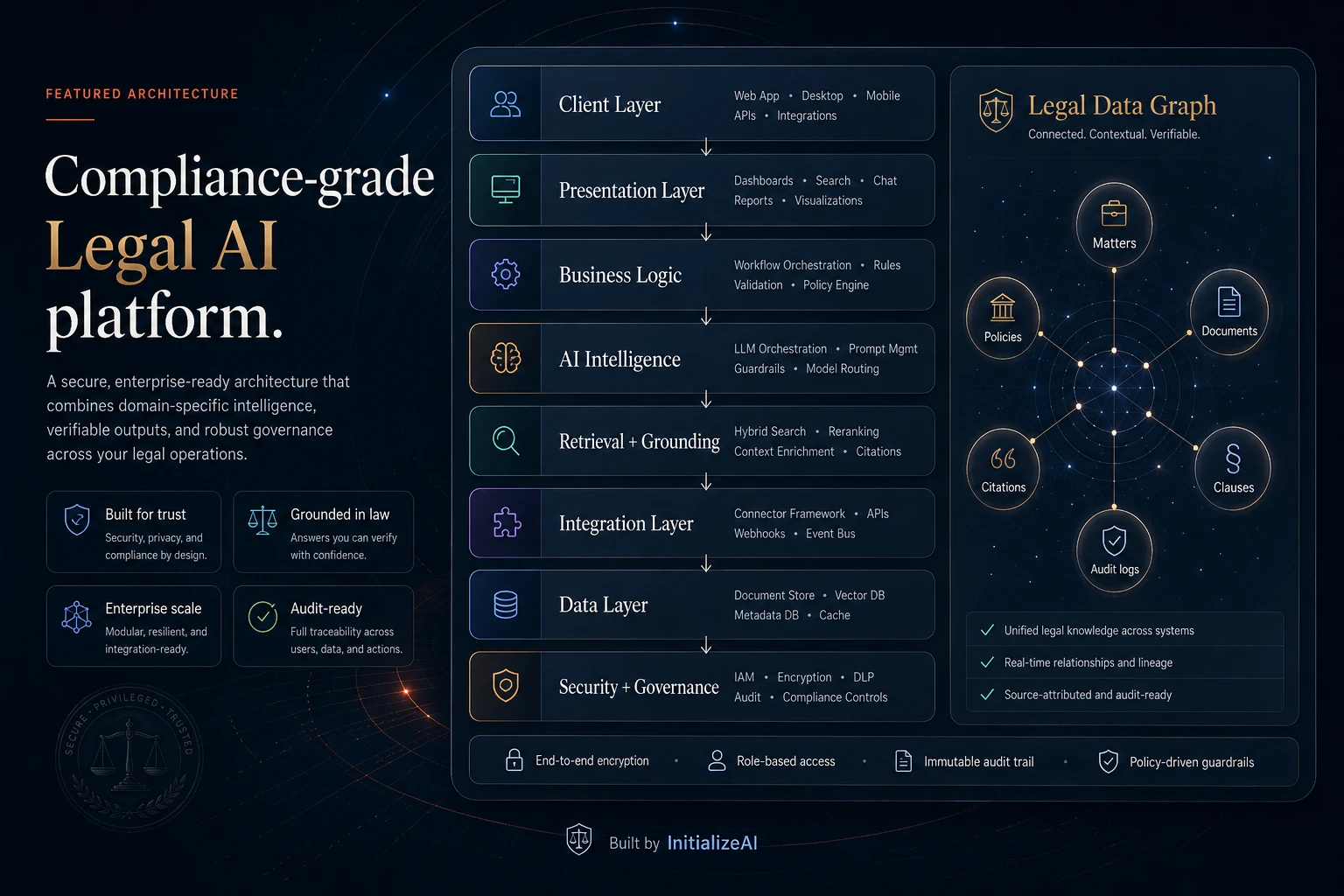
Client layer
Web app for attorneys, legal operations teams, compliance teams, contract managers, litigators, and administrators.
Presentation layer
Matter dashboards, contract review workbench, redline viewer, discovery navigator, compliance radar, search, intake, approvals, and analytics.
Business logic layer
Matter management, document workflows, review states, playbook logic, task routing, approval gates, policy workflows, audit logging, and export controls.
AI / intelligence layer
Document understanding, clause extraction, summarization, redline suggestions, source-grounded Q&A, precedent retrieval, issue mapping, and drafting support.
Retrieval and grounding layer
Matter documents, approved sources, firm knowledge, contract playbooks, policy repositories, regulatory sources, and citation/provenance logic.
Integration layer
Document management, CLM, eDiscovery, matter management, legal research, email/calendar, identity, and compliance systems where applicable.
Data layer
Matters, documents, clauses, policies, precedents, templates, annotations, tasks, approvals, users, permissions, prompts, outputs, citations, and audit logs.
Security and governance layer
Role-based access, matter permissions, ethical walls, encryption, retention settings, export controls, logging, and monitoring.
PRODUCT GALLERY
Inside the Legal AI product experience.
These product states show a serious legal AI platform without exposing private matters, clients, or legal work product.
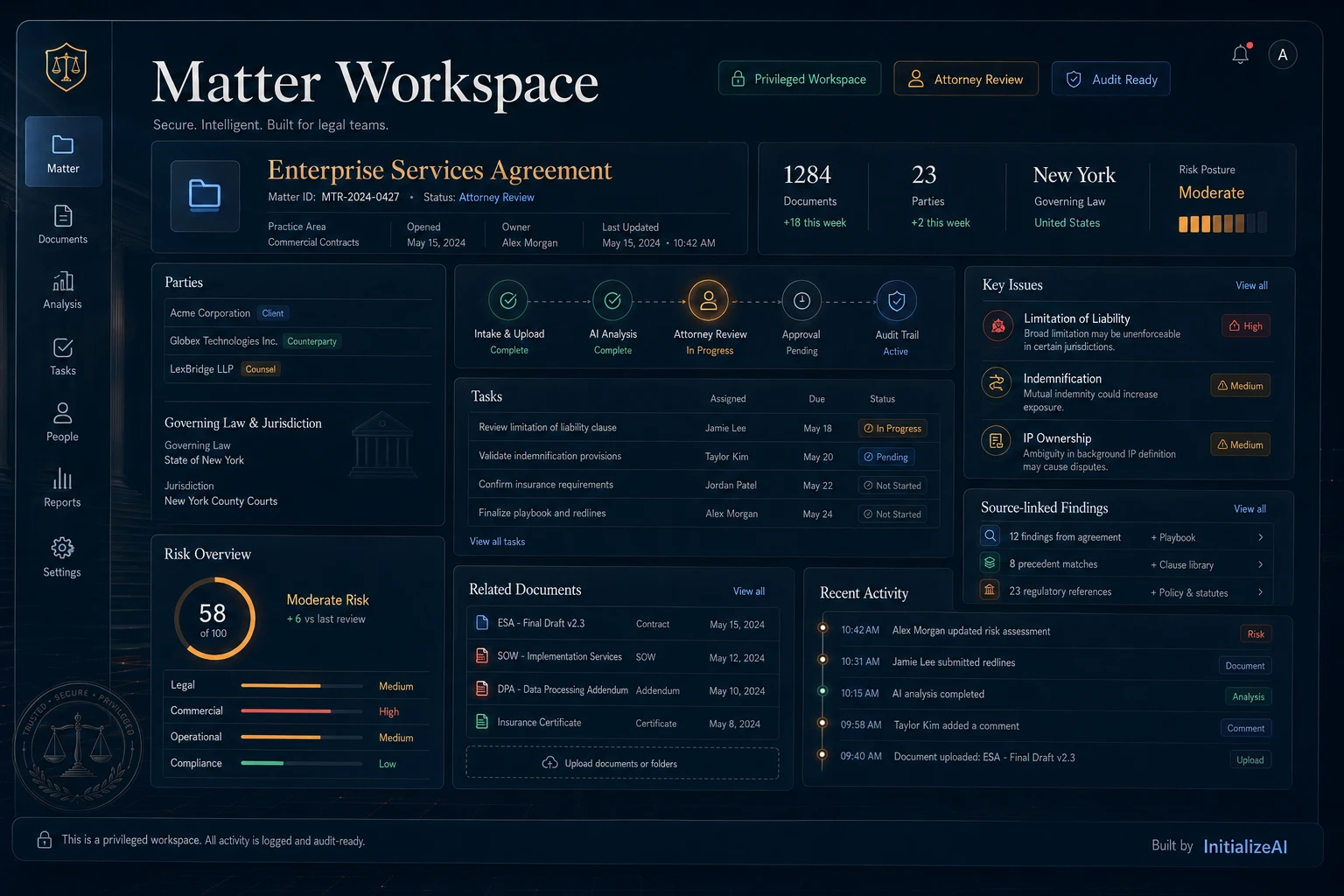
Matter Workspace
A secure matter dashboard with matter context, risk posture, tasks, documents, parties, attorney review, and audit status.
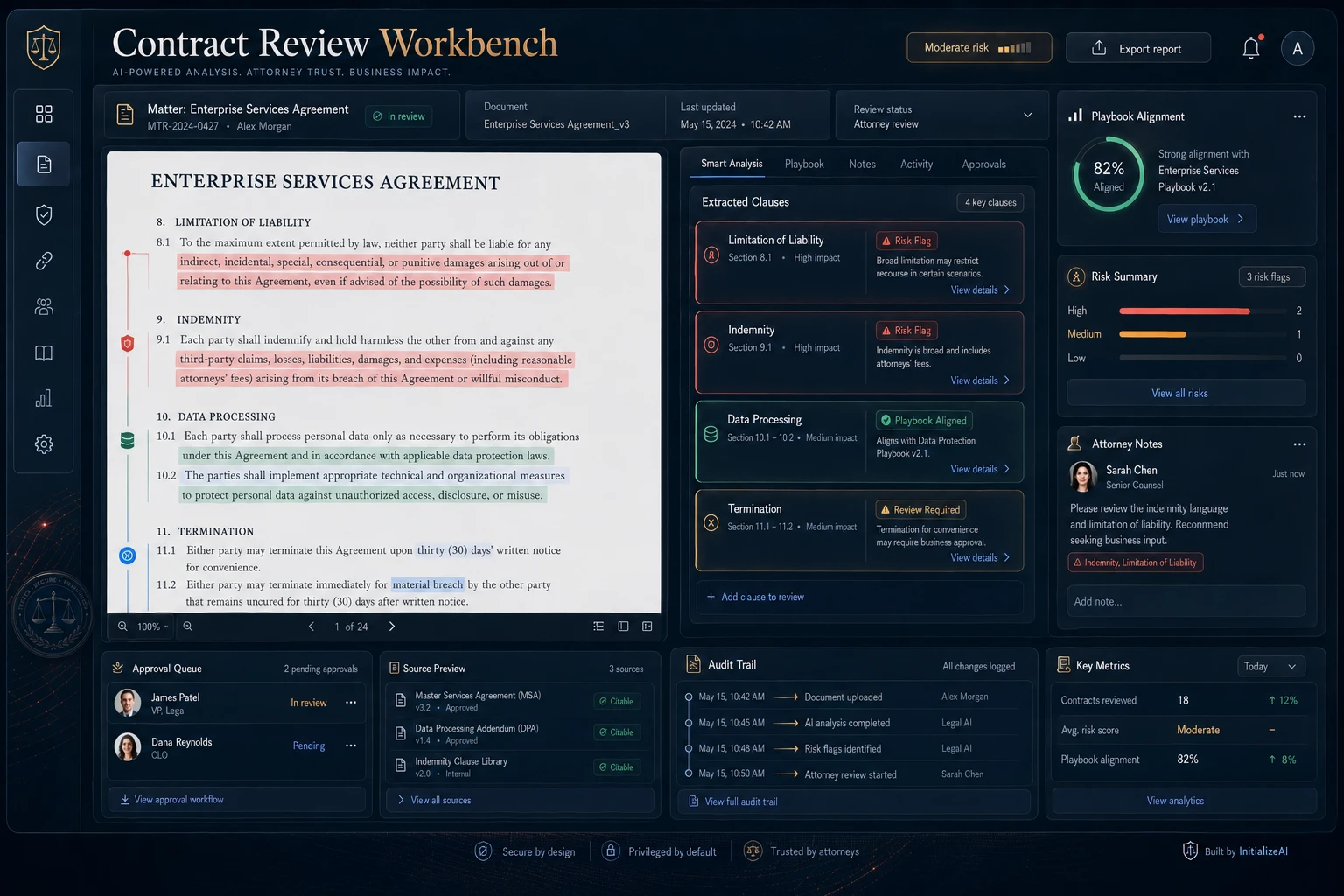
Contract Review Workbench
A contract intelligence interface for clause extraction, risk flags, playbook alignment, attorney notes, approval queues, and source previews.
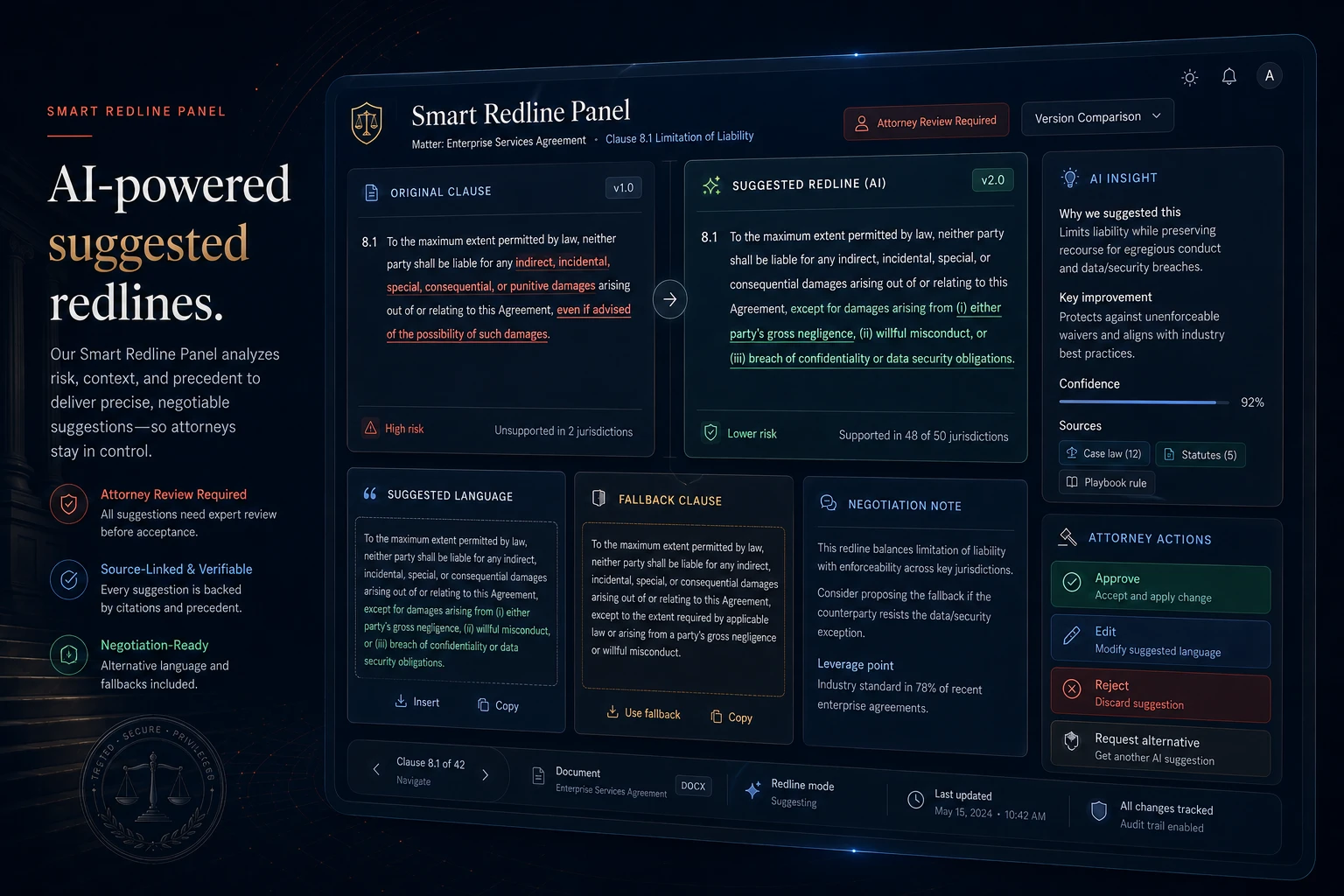
Smart Redline Panel
Suggested language, fallback clauses, negotiation notes, and approve/edit/reject controls for attorney-led redlining.
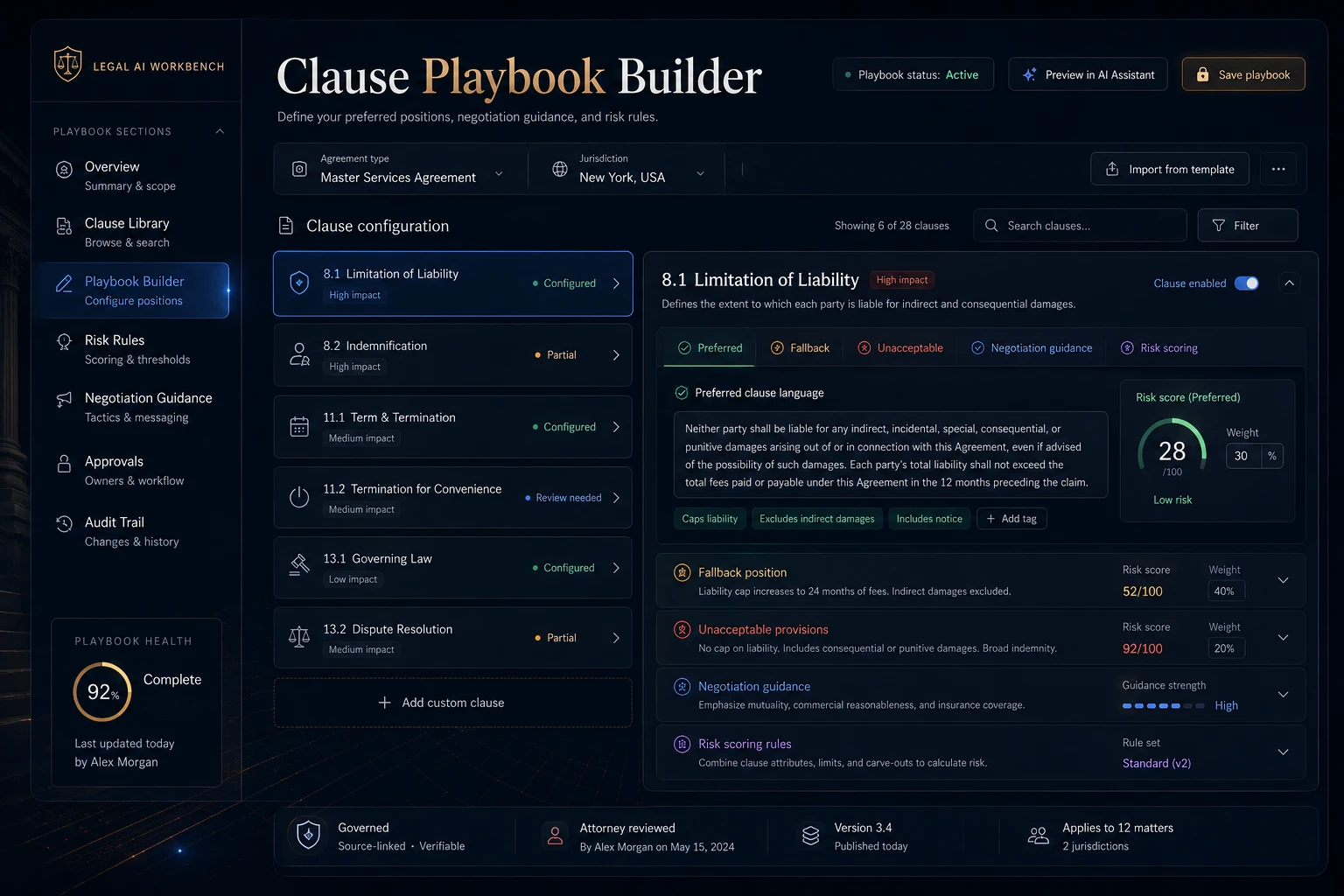
Clause Playbook Builder
A configuration system for preferred terms, fallback language, prohibited clauses, scoring rules, and matter-specific policies.
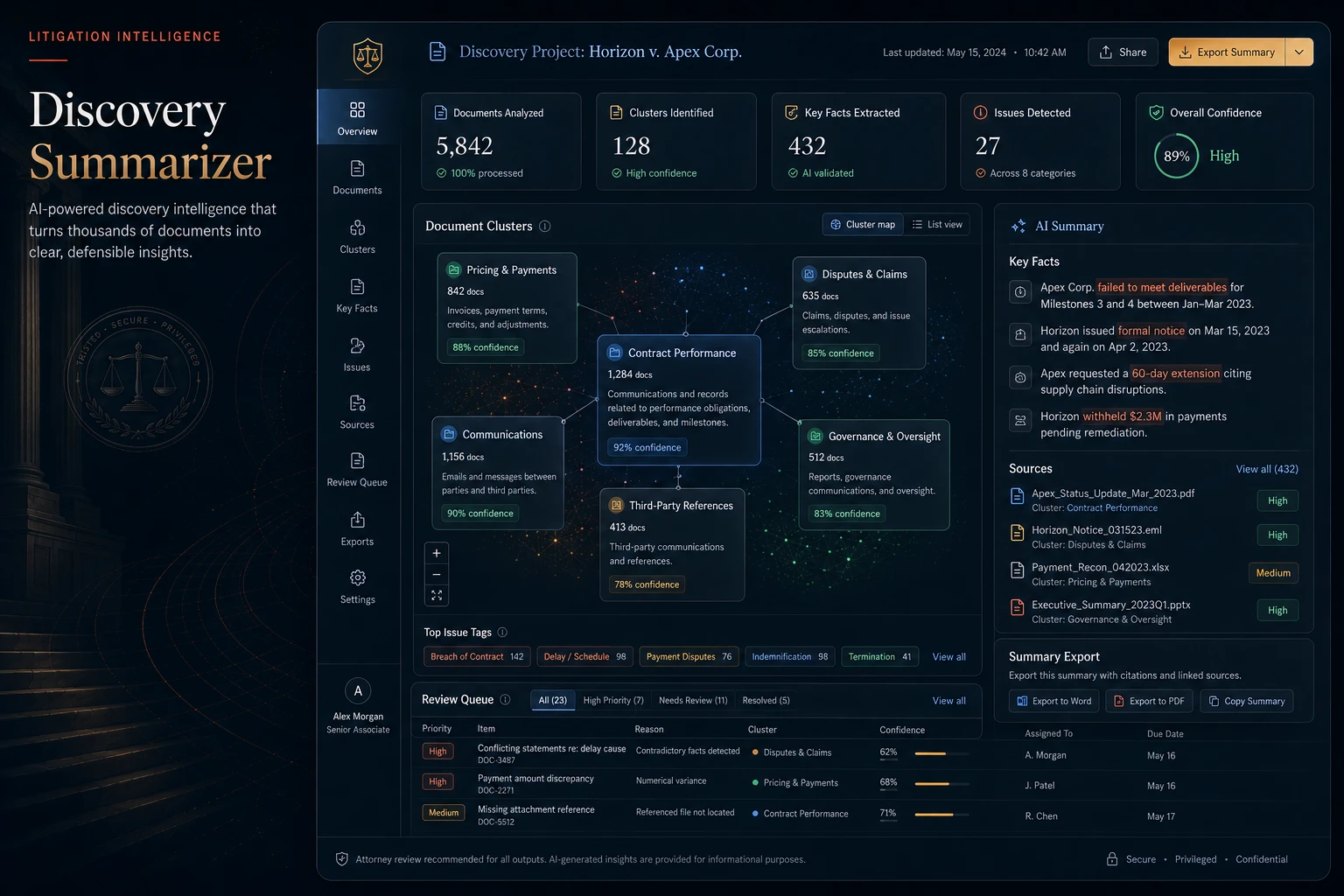
Discovery Summarizer
Litigation discovery intelligence with document clusters, key facts, source links, issue tags, reviewer queue, and summary export.
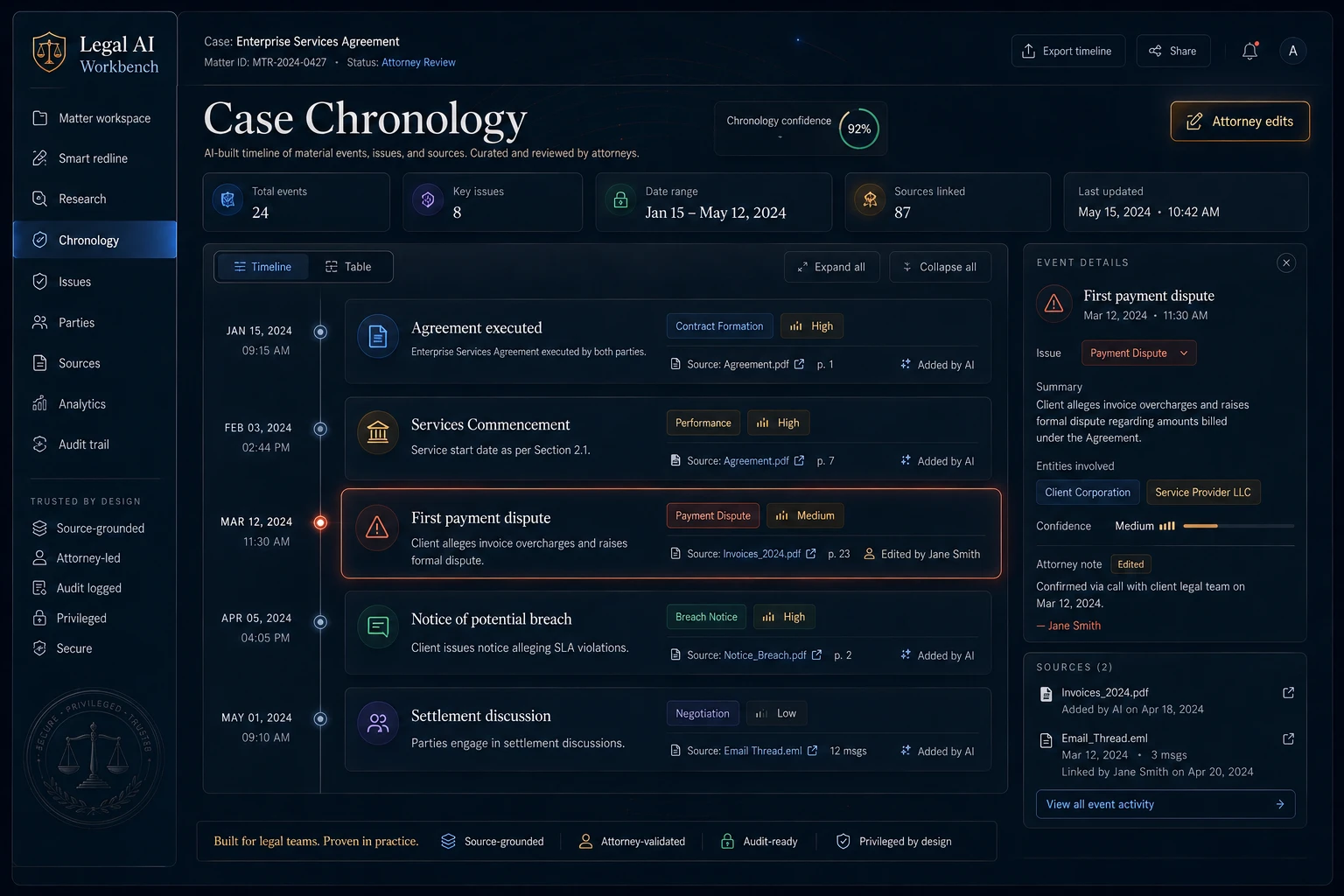
Case Chronology
A timeline builder for material events, dates, sources, entities, issue labels, confidence states, and attorney edits.
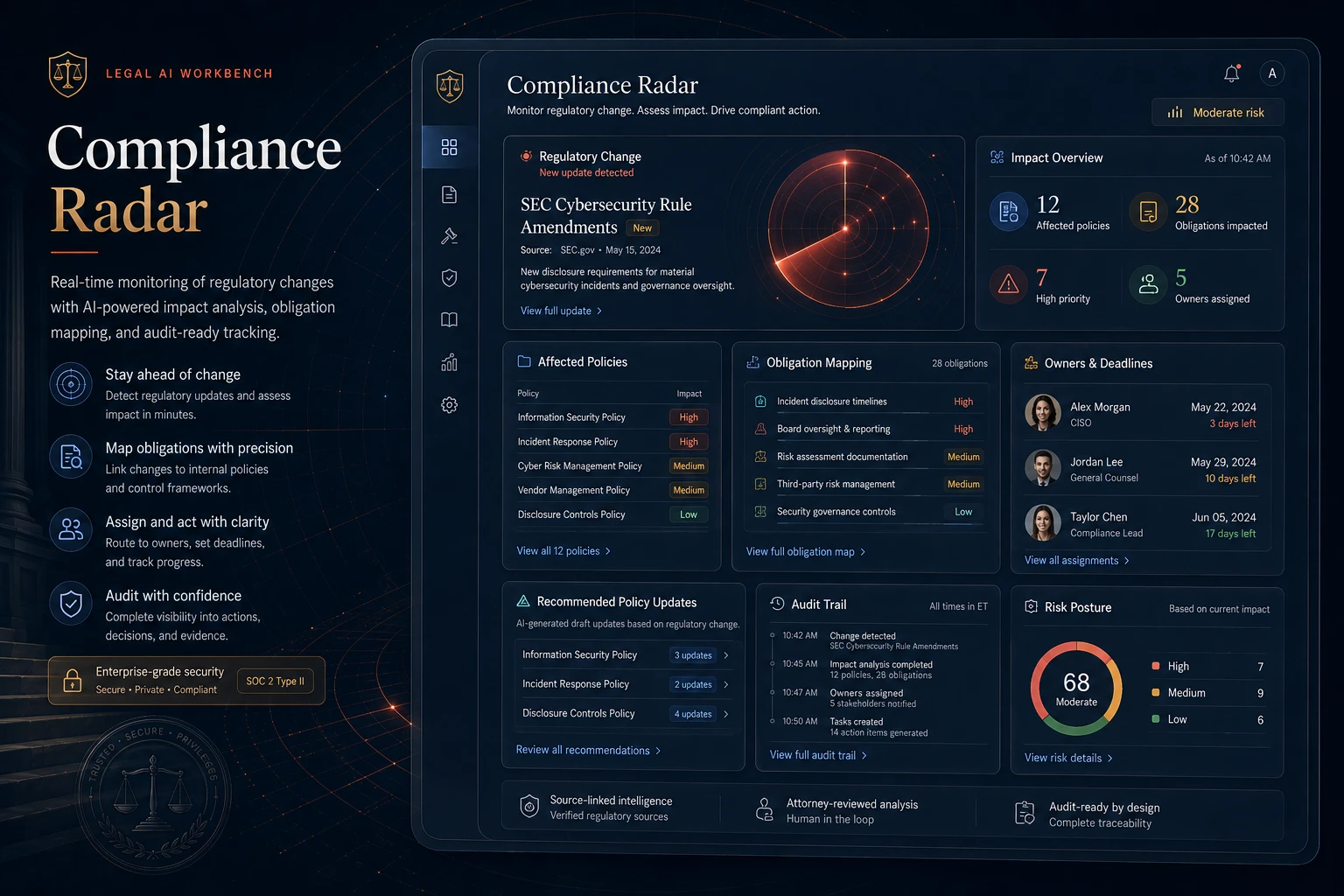
Compliance Radar
A compliance monitoring interface for regulatory alerts, policy impact, obligations, owners, deadlines, and audit trails.
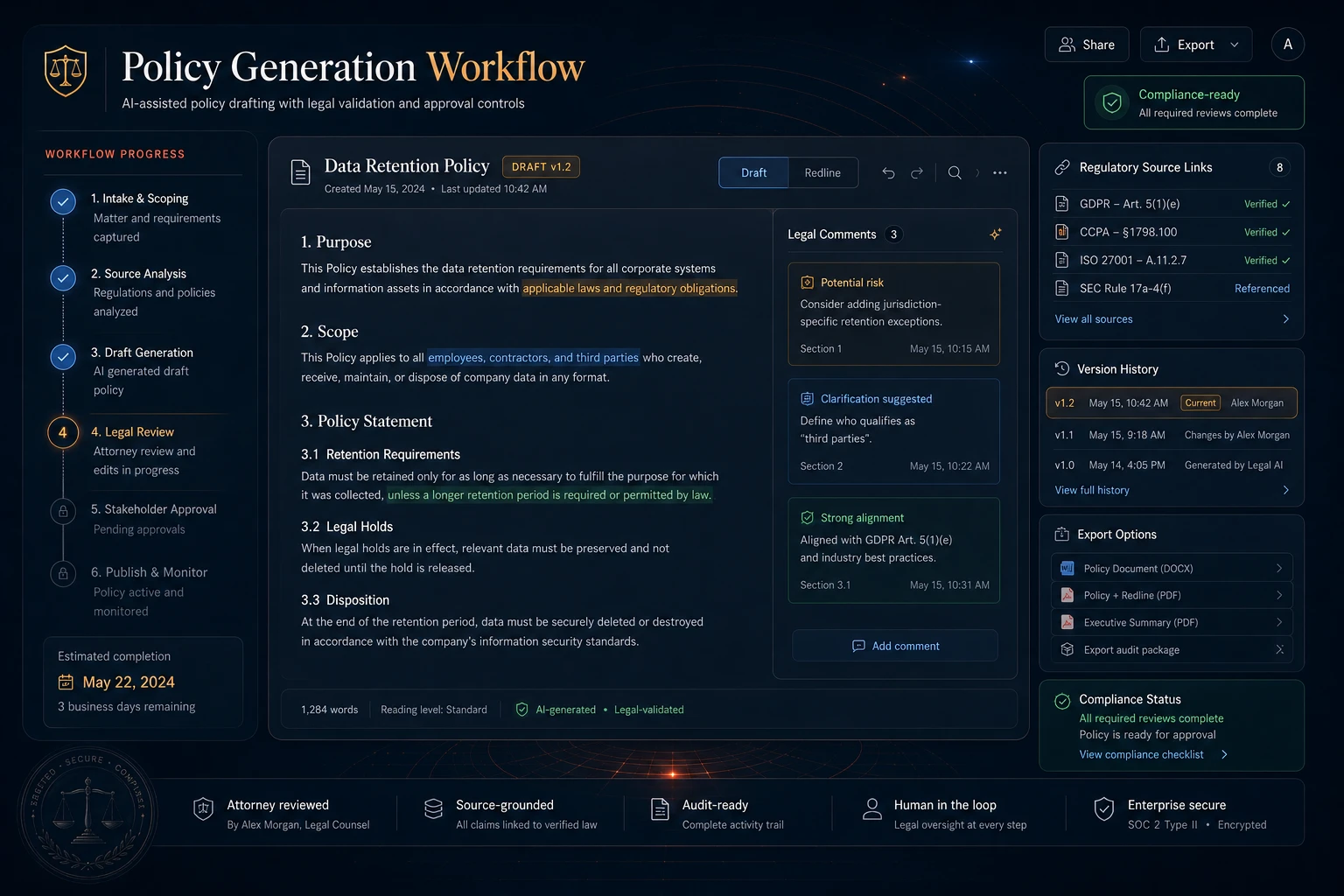
Policy Generation Workflow
AI-assisted policy drafting with regulatory source links, legal comments, approval state, version history, and export controls.
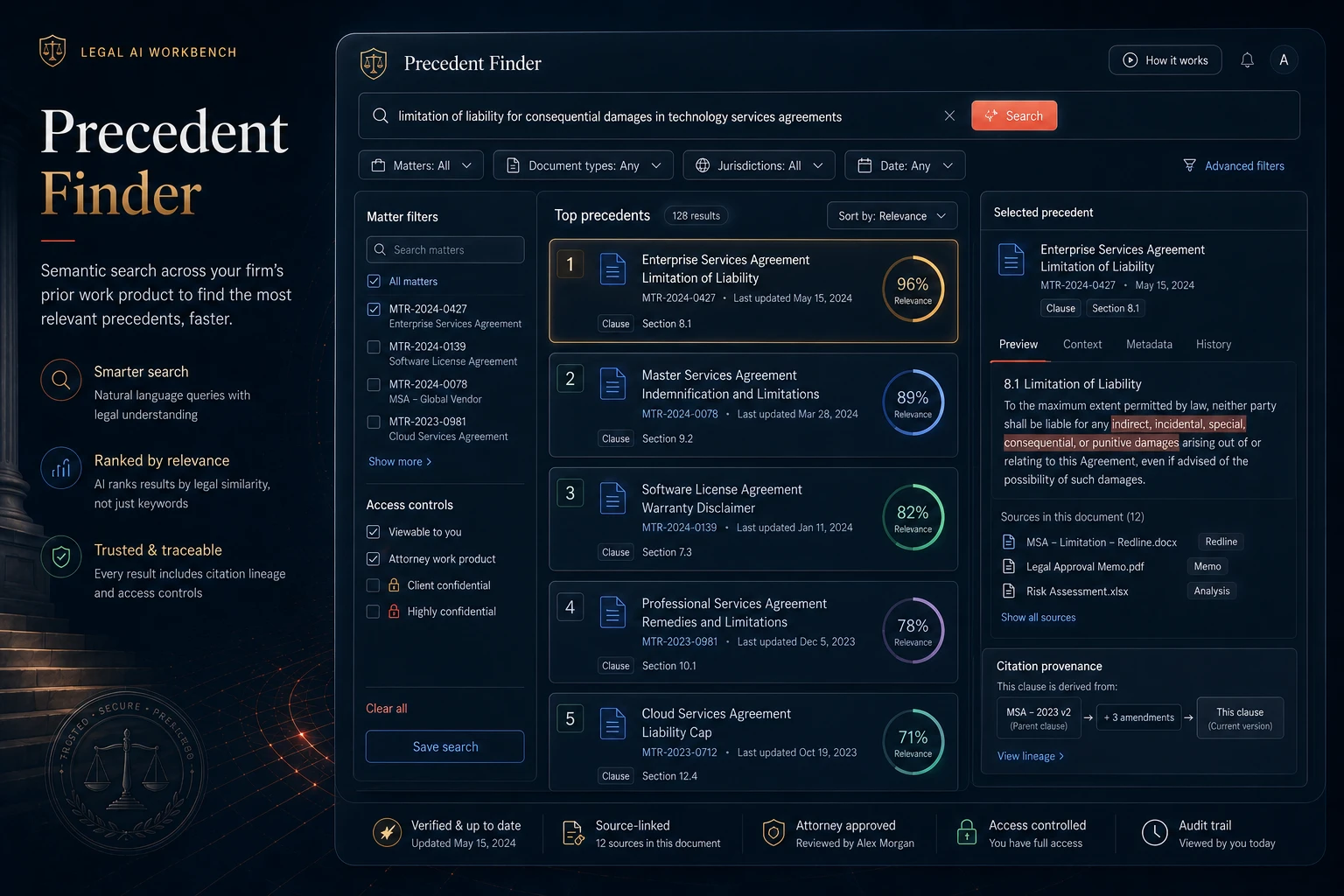
Precedent Finder
Semantic search across legal work product with relevance scoring, source previews, matter filters, access controls, and citation provenance.
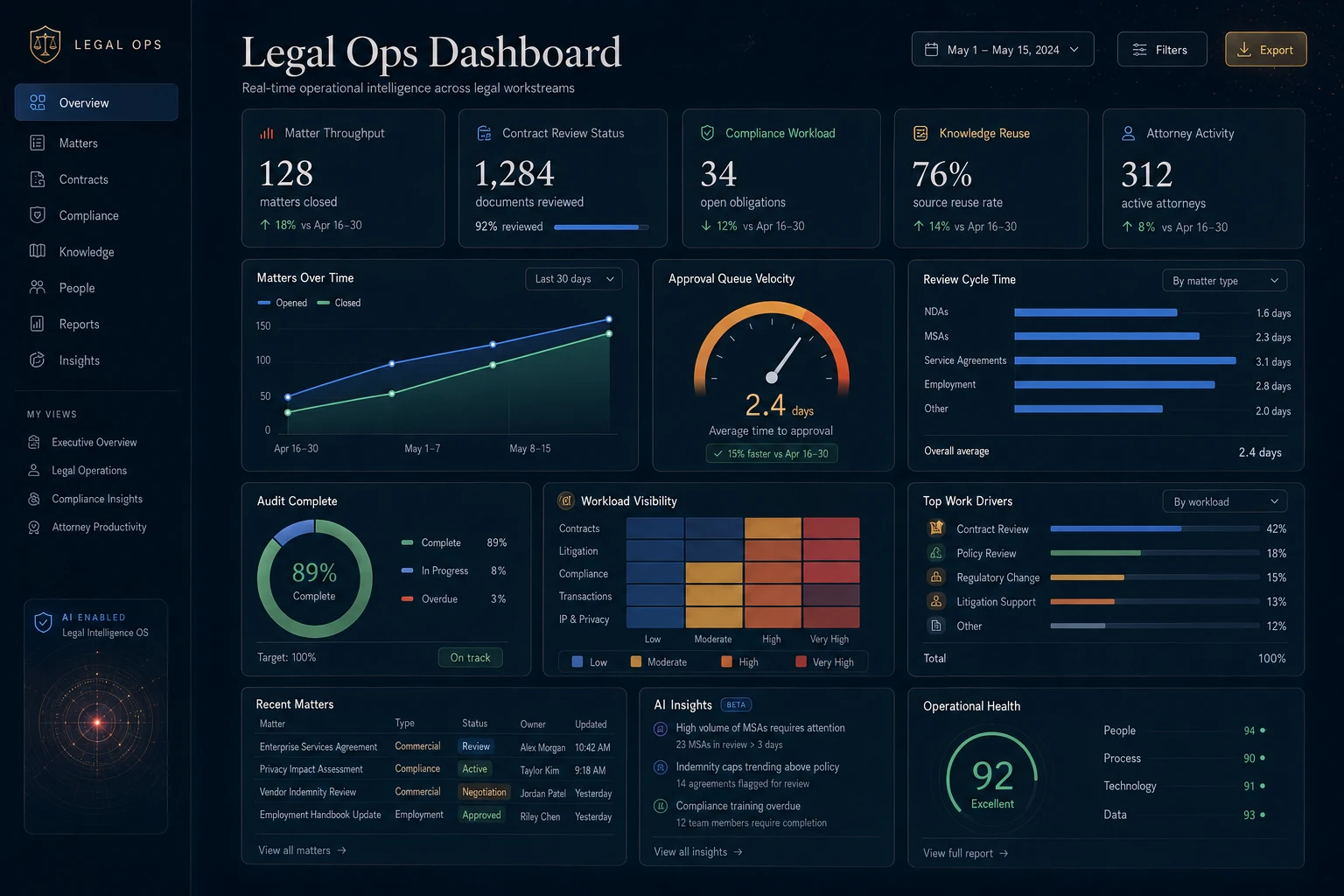
Legal Ops Dashboard
Operational analytics for matter volume, contract review status, compliance workload, knowledge reuse, approval velocity, and audit completeness.
MEASUREMENT MODEL
What a serious Legal AI platform should measure.
Because this is a public build case study, this page does not claim private customer metrics. It focuses on the measurement model and platform readiness.
Explore AI ROI Calculator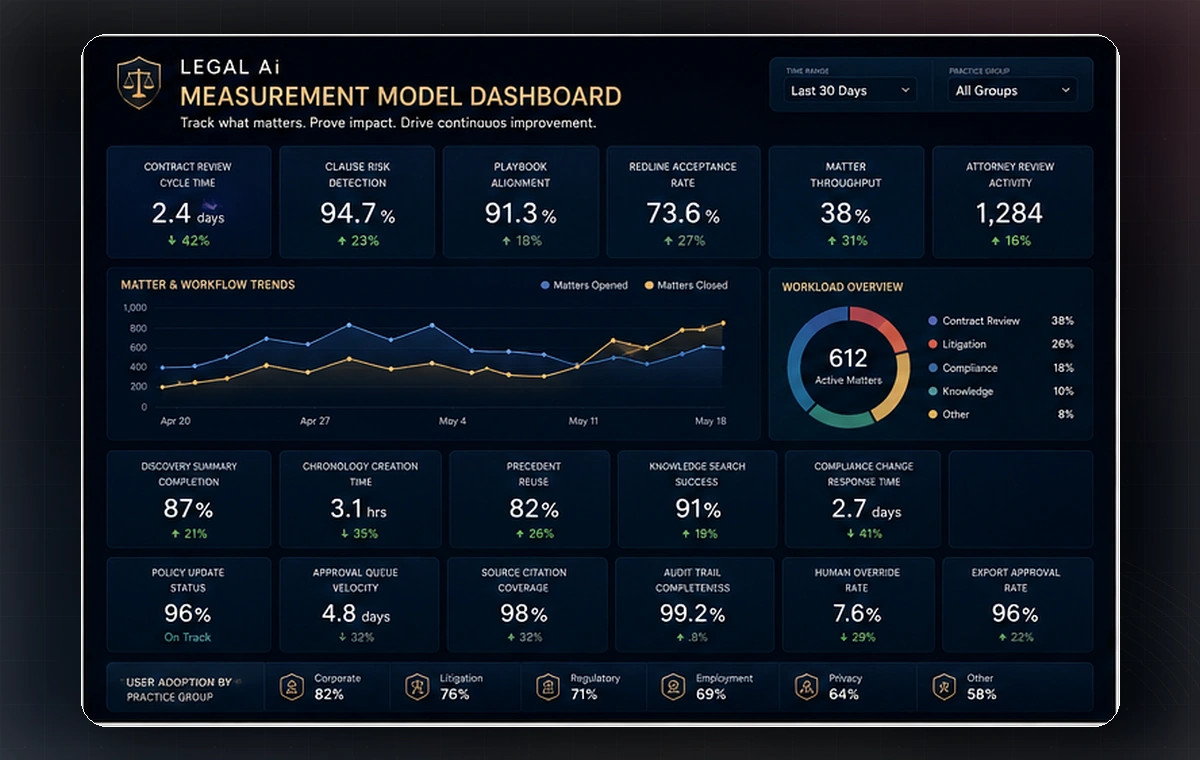
USE-CASE EXPANSION
Where the Legal AI pattern can expand.
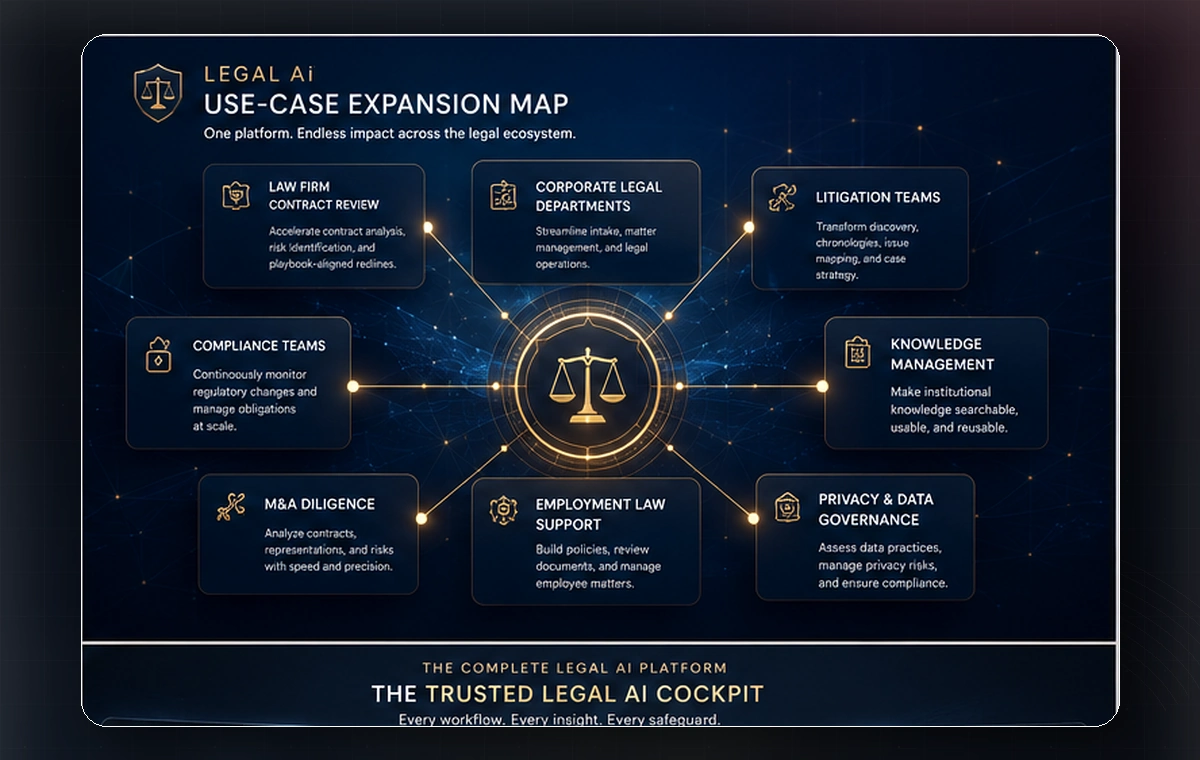
Law firm contract review
Faster first-pass review, playbook alignment, redlines, and partner-review-ready summaries.
Corporate legal departments
Intake, contract review, policy updates, business-team guidance, and legal ops visibility.
Litigation teams
Discovery summaries, issue maps, chronologies, motion outlines, and deposition prep support.
Compliance teams
Regulatory monitoring, obligation mapping, policy generation, control evidence, and audit readiness.
Knowledge management
Search and reuse firm work product, precedent, memos, templates, and approved positions.
M&A diligence
Contract summaries, risk flags, obligation extraction, change-of-control issues, and diligence trackers.
Employment law support
Policy review, handbook updates, investigation document organization, and compliance workflows.
Privacy and data governance
Data processing terms, regulatory mapping, incident response workflows, and policy updates.
WHY LEGAL AI IS IMPRESSIVE
A powerful example of InitializeAI's high-trust build capability.
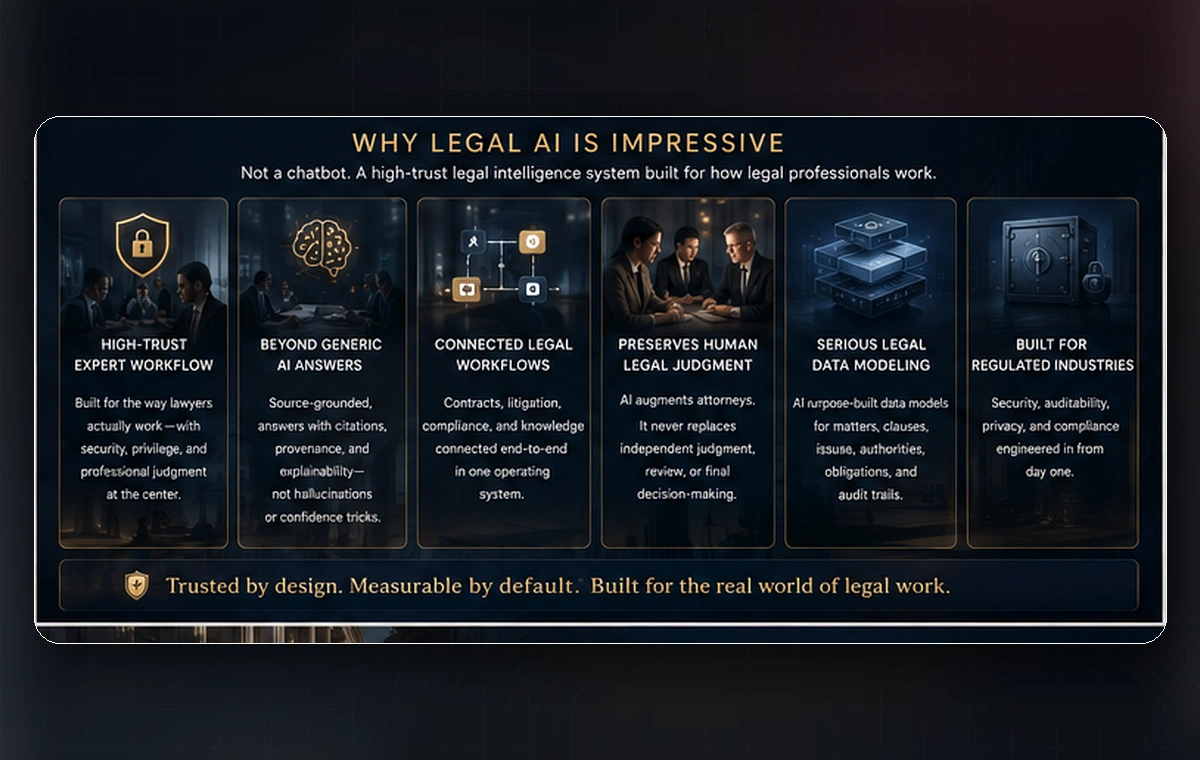
It tackles a high-trust expert workflow
Legal work requires confidentiality, judgment, provenance, and defensible process.
It goes beyond generic AI answers
The platform is designed around matters, documents, sources, playbooks, approvals, and audit trails.
It connects multiple legal workflows
Contracts, litigation, compliance, knowledge, intake, and legal operations work together.
It preserves human legal judgment
Attorney review, editable outputs, approval states, and source grounding keep lawyers in control.
It requires serious data modeling
Matters, clauses, policies, precedents, citations, permissions, and audit events all need structure.
It shows InitializeAI can build for regulated industries
The same implementation discipline applies to healthcare, finance, government, insurance, education, and other high-stakes workflows.
INITIALIZEAI BUILD LESSON
What this case study shows about InitializeAI.
Legal AI demonstrates the kind of applied AI execution InitializeAI brings to regulated, expert workflows. The work was not simply "add a chatbot to legal documents." It required mapping legal workflows, structuring matter and document data, designing retrieval and grounding, preserving attorney review, modeling risk and approvals, and building a product experience that legal professionals can actually trust.
FAQ
Legal AI case study FAQ
What is Legal AI?
Legal AI is a secure, explainable, compliance-grade legal intelligence platform concept designed to support legal workflows such as contract review, litigation support, compliance monitoring, knowledge management, legal intake, and legal operations.
Was Legal AI built by InitializeAI?
InitializeAI developed the Legal AI product concept and platform architecture as an AI-assisted legal intelligence system. The public case study focuses on the product model, trust layer, representative architecture, and legal workflow design.
Is Legal AI an AI lawyer?
No. Legal AI is AI-assisted and attorney-led. It supports legal professionals with review, retrieval, drafting support, summarization, compliance workflows, and knowledge management, but it does not replace lawyers or provide final legal advice without attorney review.
What legal workflows can Legal AI support?
Legal AI can support contract review, smart redlining, clause analysis, litigation discovery, case chronology, motion drafting support, compliance monitoring, policy generation, precedent retrieval, matter knowledge management, intake triage, and legal operations analytics.
How does Legal AI handle trust?
Legal AI is designed around source-grounded outputs, attorney review, matter-level permissions, audit trails, version history, access controls, editable drafts, citations, provenance, and clear boundaries around AI-generated work product.
What makes Legal AI different from a generic chatbot?
Legal AI is designed as a workflow platform, not a standalone chatbot. It connects matter context, documents, playbooks, precedents, compliance sources, approvals, and audit trails into a secure legal operating system.
Can Legal AI integrate with existing legal systems?
The representative architecture is designed to support integration planning for document management, contract lifecycle management, eDiscovery, matter management, legal research, identity, and compliance systems. Specific integrations depend on customer systems, data permissions, and deployment scope.
Who could use a platform like Legal AI?
The platform model can support law firms, corporate legal departments, compliance teams, litigation teams, contract management teams, legal operations leaders, and regulated enterprises with high-volume legal workflows.
What does this case study show about InitializeAI?
It shows InitializeAI's ability to design AI platforms for high-trust, regulated, expert workflows where security, governance, source grounding, workflow integration, and human review are essential.
Can InitializeAI build similar platforms for other regulated industries?
Yes. InitializeAI can help organizations design and build AI-powered platforms for legal, financial services, healthcare, insurance, government, education, professional services, and other regulated workflows.
BUILD AI EXPERTS CAN TRUST
Ready to build AI your experts can actually trust?
Legal AI shows what InitializeAI does best: take a complex expert workflow, map the documents and decisions behind it, design AI around trusted sources and human review, and build a product experience that improves speed without sacrificing control, confidentiality, or judgment.