Scattered AI Activity
- Ideas appear everywhere
- Pilots lack owners
- Vendors move ahead unevenly
- Risk review is reactive
- Funding is fragmented
- Scale decisions are unclear
Executive AI Governance Template
Define the purpose, membership, decision rights, review cadence, intake process, risk escalation, funding alignment, portfolio oversight, and accountability model your organization needs to govern AI pilots, vendors, policies, risks, and scale decisions.
Strategic Thesis
AI activity spreads through pilots, employee experimentation, vendor tools, embedded copilots, workflow automation, and executive mandates. Without a steering committee, decisions are fragmented across teams, budgets, legal reviews, security reviews, vendor conversations, and one-off pilots.
The purpose of an AI steering committee is not to discuss AI. It is to decide what AI work should move forward, under what controls, with which owners, and against which business outcomes.
Governance Gaps
Many organizations do not lack AI activity. They lack a clear executive mechanism for deciding which AI efforts matter, which ones are too risky, which ones deserve funding, which vendors can proceed, which pilots should scale, and who owns the outcomes.
AI decisions are made across IT, legal, business units, procurement, finance, and individual teams without a shared operating forum.
AI ideas compete for attention without a consistent scoring model, strategy alignment, value case, or risk review.
Teams may begin pilots without clear sponsors, decision rights, success metrics, governance gates, or scale criteria.
AI tools can be enabled, purchased, or piloted before data handling, security, privacy, contract, and model behavior questions are resolved.
High-risk use cases, sensitive data, incidents, or unresolved vendor issues may not have a defined path to executive decision.
AI investments may be spread across departments without a portfolio view, ROI model, ownership, or strategic funding discipline.
Governance policies fail when there is no committee cadence, review process, accountability model, or operating rhythm.
Teams may scale, pause, or abandon AI efforts based on enthusiasm rather than pilot results, risk posture, adoption, and value evidence.
Charter Components
The charter turns leadership intent into clear authority, intake paths, review cadence, documentation expectations, escalation rules, and accountability.
Defines why the committee exists and what outcomes it is accountable for.
Prompt: What decisions should this committee make that no single function can make alone?Clarifies which AI tools, pilots, vendors, policies, risks, data uses, and funding decisions fall under the committee.
Why it matters: Prevents invisible AI from bypassing governance.Names the executive who owns the mandate, prioritization discipline, and escalation authority.
Prompt: Who can convene leaders and remove blockers?Defines required cross-functional seats and alternate representatives.
Prompt: Which functions need standing membership?Clarifies what the committee can approve, reject, escalate, fund, pause, or require further review on.
Why it matters: Advisory-only committees rarely change execution.Defines how AI ideas, vendor requests, pilot proposals, and risk escalations enter the process.
Prompt: How does work get submitted for review?Defines how opportunities are ranked by value, feasibility, risk, readiness, sponsorship, and strategic fit.
Prompt: What determines what moves forward?Defines what must be true before an AI pilot can launch.
Why it matters: Pilot approval should require evidence, not enthusiasm.Defines when AI vendors require procurement, legal, security, privacy, data, and governance review.
Prompt: What vendor requests require committee review?Defines which risks, incidents, unresolved controls, and residual exposures must be escalated.
Prompt: What conditions require executive decision?Defines how sensitive data, personal information, regulated data, and restricted data uses are reviewed.
Why it matters: Data decisions often determine AI risk tier.Defines where human review, approval, override, escalation, and monitoring are required.
Prompt: Where must humans remain accountable?Defines how funding, staffing, budget, vendors, and implementation resources are prioritized.
Why it matters: Approved ideas still fail without capacity.Defines what leadership reviews across initiatives, pilots, vendors, risks, incidents, ROI, adoption, and scale decisions.
Prompt: What should leadership see every month or quarter?Defines how often the committee meets, what gets reviewed, and how decisions are documented.
Prompt: What is the operating rhythm?Defines how committee effectiveness, AI value, risk posture, and execution progress are measured.
Why it matters: Governance should improve execution, not just create meetings.Defines how minutes, approvals, risk decisions, exceptions, and action items are recorded.
Prompt: What evidence should be retained?Defines how the charter, policy, cadence, membership, and governance model evolve over time.
Prompt: When should the operating model improve?Committee Charter Preview
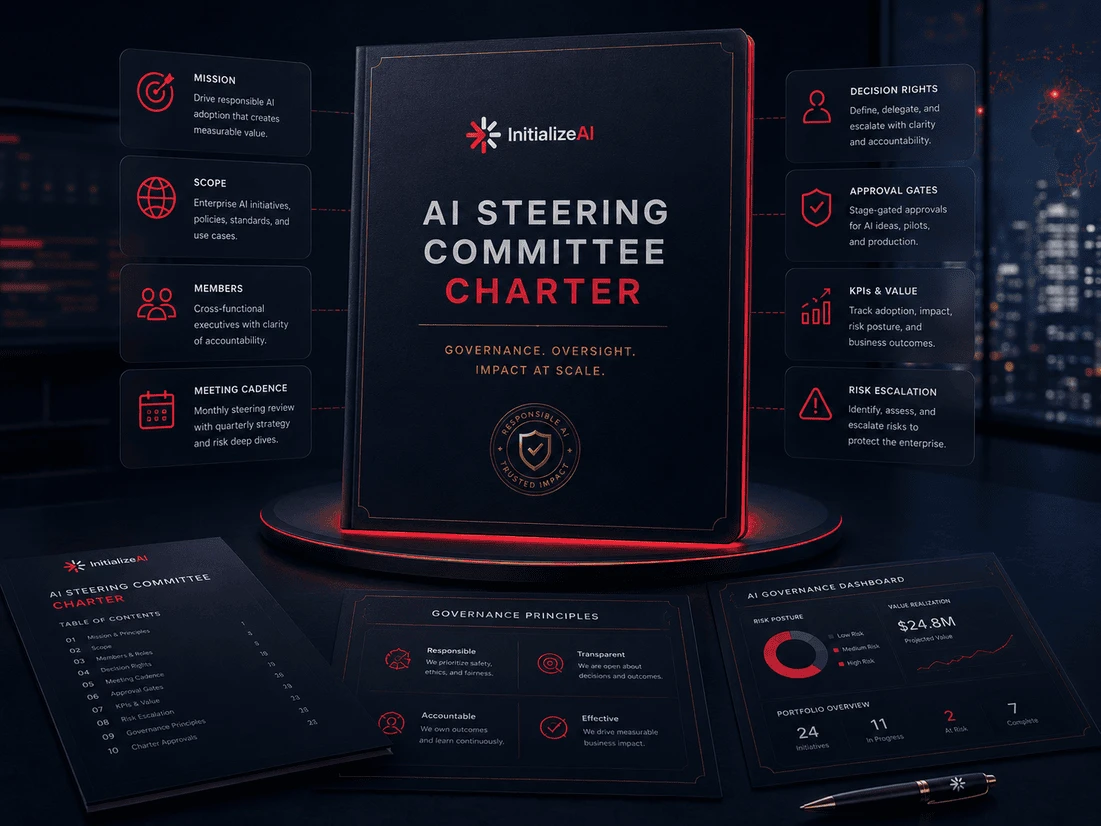
A strong charter gives executives one operating document for mandate, membership, decision rights, intake, cadence, escalation, portfolio visibility, and evidence-based AI decisions.
AI Steering Committee Charter Preview
Committee Mandate
The AI Steering Committee exists to ensure AI initiatives are strategically aligned, responsibly governed, measurable, funded appropriately, and reviewed through consistent decision processes.
Membership Table
Scrollable worksheet| Function | Representative | Primary responsibility | Decision role |
|---|---|---|---|
| Executive Sponsor | COO / CIO / CEO delegate | Sets mandate, resolves conflicts, approves priorities. | Accountable |
| Business Operations | COO or business-unit leader | Owns workflow impact, adoption, value, and operating outcomes. | Responsible |
| Technology / IT | CIO, CTO, architecture lead | Reviews systems, integrations, reliability, and support model. | Consulted |
| Data / Analytics | CDO or analytics lead | Reviews data quality, access, lineage, and measurement readiness. | Consulted |
| Legal / Compliance | General Counsel or compliance lead | Reviews legal, contractual, regulatory, and policy exposure. | Consulted |
| Security / Privacy | CISO, privacy officer, security lead | Reviews access, data protection, privacy, and incident response. | Consulted |
Decision Rights Matrix
Approval evidence| Decision area | Committee owns | Committee recommends | Escalates to | Required evidence |
|---|---|---|---|---|
| AI pilot approval | Pilots above defined risk/value threshold | Resource sequencing | Executive sponsor | Pilot charter, workflow map, ROI model, risk register entry |
| Vendor approval | Review path and conditions by risk tier | Purchase readiness | Executive sponsor / legal | Vendor checklist, security/privacy review, contract review |
| Risk acceptance | Escalation and condition setting | Mitigation owner and review cadence | Legal, security, executive sponsor | Risk register entry, residual risk, control plan |
| Scale/revise/stop | Recommendation or decision by threshold | Stage rollout and funding path | Executive leadership | Pilot results, adoption metrics, ROI, risk posture |
Executive sponsor, business owner, technology, data, legal, compliance, security, privacy, procurement, finance, HR, risk, and rotating business-unit representatives.
Clarifies when the committee approves, conditions, defers, escalates, pauses, stops, or recommends a scale decision.
Evidence reviewed: pilot charter, vendor checklist, risk register, and ROI estimate. Conditions: security review, DPA approval, human review, and output sampling.
Sample charter shown for illustration. Organizations should adapt membership, authority, cadence, decision rights, thresholds, and escalation paths to their operating model, regulatory context, and risk tolerance.
This charter is a practical AI governance operating-model starting point, not legal advice, compliance advice, board governance advice, or a formal risk determination.
Membership Model
AI steering committees fail when they are too technical, too legalistic, too advisory, or too far removed from operating teams. The right committee combines executive sponsorship, business ownership, technical feasibility, risk oversight, procurement discipline, data governance, and finance/ROI perspective.
Sets mandate, resolves conflicts, approves priorities, and ensures authority.
Typical seat: CEO, COO, CIO, CTO, or delegated executive.Runs operating rhythm, intake, agenda, decision log, and follow-up.
Typical seat: AI transformation lead or responsible AI lead.Represents workflow impact, operational adoption, value realization, and process ownership.
Typical seat: COO, VP Operations, business unit leader.Reviews architecture, integrations, support, reliability, and feasibility.
Typical seat: CIO, CTO, IT leader, architecture lead.Reviews data availability, quality, access, governance, lineage, and measurement readiness.
Typical seat: CDO, data governance lead, analytics leader.Reviews access, data protection, vendor security, privacy, and incident response.
Typical seat: CISO, privacy officer, security lead.Reviews legal, regulatory, contractual, disclosure, employment, public-sector, healthcare, financial, or compliance implications.
Typical seat: General Counsel or compliance leader.Reviews AI vendors, contracting, procurement path, renewals, and vendor risk.
Typical seat: Procurement leader or vendor management lead.Reviews budget, ROI assumptions, cost exposure, funding allocation, and value realization.
Typical seat: CFO delegate or finance business partner.Reviews workforce impact, training, employee policy, adoption, and change management.
Typical seat: CHRO delegate or HR transformation lead.Reviews customer-facing use, experience impact, product implications, and service consistency.
Typical seat: Product leader or customer experience leader.Reviews risk framework alignment, controls, evidence, monitoring, and auditability.
Typical seat: Enterprise risk, internal audit, control owner.Bring context for specific pilots, workflows, vendors, and departmental use cases.
Membership should be right-sized with standing governance seats and rotating participants.Decision Rights
Steering committees become ineffective when authority is vague. The charter should define ownership, recommendations, escalation thresholds, and required evidence.
AI portfolio prioritization, pilot approval above threshold, vendor review path, policy exception decisions, risk escalation review, scale/revise/stop recommendations, roadmap governance, and reporting cadence.
Funding allocation, enterprise rollout decisions, strategic platform decisions, cross-functional resource tradeoffs, policy updates, and high-cost vendor commitments.
Critical residual risk, high-cost investment, regulated or high-impact AI use, customer/public-facing decisions, material legal exposure, incidents, and strategy shifts.
| Decision | Business owner | AI program lead | Governance reviewers | Steering committee | Executive sponsor | Board / agency leadership |
|---|---|---|---|---|---|---|
| New AI idea | Owns | Reviews | Informed | Informed | Informed | - |
| Low-risk productivity tool | Owns | Reviews | Reviews | Informed | - | - |
| AI pilot proposal | Owns | Responsible | Reviews | Approves | Informed | - |
| AI vendor purchase | Recommends | Reviews | Reviews | Approves / escalates | Approves by threshold | - |
| High-risk use case | Responsible | Responsible | Reviews | Escalates | Approves / escalates | Informed or approves |
| Policy exception | Requests | Reviews | Reviews | Approves / escalates | Approves by threshold | - |
| Incident / escalation | Responsible | Responsible | Reviews | Escalates | Approves response | Informed |
| Scale decision | Recommends | Reviews | Reviews | Approves / recommends | Approves by threshold | Informed or approves |
Intake and Portfolio Governance
The committee needs a portfolio intake model that can handle use-case ideas, workflow automation opportunities, vendor requests, pilot charters, risk escalations, policy exceptions, and scale decisions.
Source: business units, operations teams, strategy workshops, executives, frontline users.
Required artifact: AI Use Case Prioritization MatrixSource: operations reviews, process mapping, support, finance, HR, legal, and field services.
Required artifact: AI Workflow Automation Opportunity MapSource: prioritized use case or vendor opportunity.
Required artifact: AI Pilot Charter TemplateSource: procurement, IT, business units, embedded AI features, SaaS renewal.
Required artifact: AI Vendor Evaluation ChecklistSource: AI Risk Register, governance reviewer, security, privacy, legal, or incident report.
Required artifact: AI Risk Register entrySource: business owner or governance reviewer.
Required artifact: exception request and risk analysisSource: pilot results or portfolio review.
Required artifact: pilot results, ROI model, risk register, owner recommendationOperating Cadence
A predictable cadence separates urgent escalations from regular portfolio governance and prevents AI oversight from becoming a loose update meeting.
Purpose: Active pilot issues, risk escalations, vendor evidence gaps, urgent decisions.
Outputs: Action items, mitigation updates, evidence requests, escalation recommendations.
Purpose: Intake, pilot approvals, vendor reviews, risk escalations, policy exceptions, active pilot progress, funding tradeoffs.
Outputs: Decision log, owner assignments, approved/conditioned/deferred decisions.
Purpose: Portfolio value, risk posture, vendor landscape, roadmap, funding, scale decisions, governance maturity.
Outputs: Portfolio priorities, funding shifts, scale/revise/stop decisions.
Purpose: Update mandate, membership, thresholds, policies, risk framework, and operating model.
Outputs: Updated charter, policy, and operating cadence.
Committee Dashboard
The committee dashboard connects AI initiatives to value, risk, status, resource needs, and decisions.
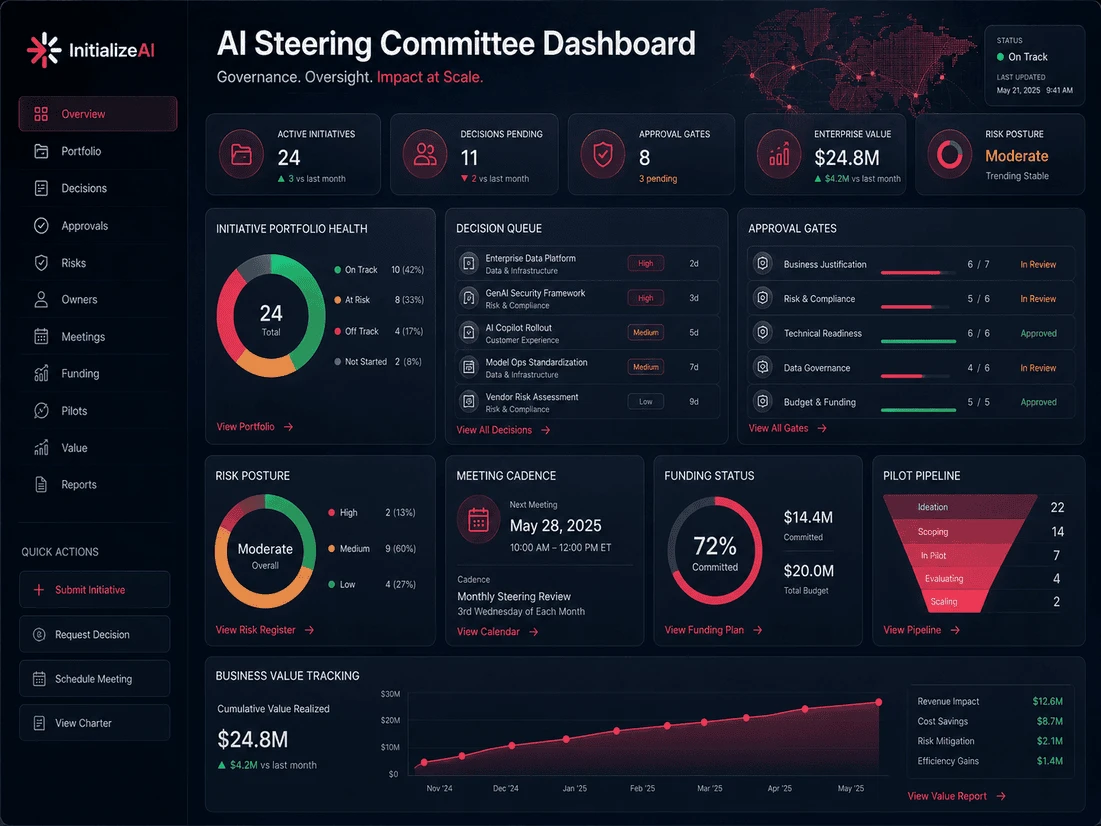
Decision pressure is concentrated in review, pilot, and scale gates.
Escalation and Exceptions
Unresolved risk, policy exceptions, data concerns, vendor terms, and incidents should not rely on informal escalation.
Evidence: Risk register entry, owner, controls, residual risk, recommendation.
Evidence: Vendor checklist, legal/security/privacy notes, procurement recommendation.
Evidence: Pilot charter, metrics, issue log, decision request.
Evidence: Exception rationale, risk analysis, owner, controls, review date.
Evidence: Incident summary, impact, containment, owner, corrective action.
Funding and Resources
Steering committees should help sequence investment based on value, readiness, capacity, risk, and implementation needs.
Is funding available for pilot, vendor, data work, integration, training, and support?
Do IT, data, security, legal, procurement, and business teams have capacity?
Is there a clear ROI model, savings estimate, revenue impact, risk reduction, or service improvement case?
What does this initiative displace, and is it more important than other AI opportunities?
Who owns the workstreams, and are they committed?
What will production rollout, support, licensing, and maintenance require?
Are usage limits, overages, renewals, support, and termination costs understood?
Is the organization balancing quick wins, strategic bets, governance investments, and foundational data work?
Decision: Fund pilot / fund conditionally / defer / reject / request more evidence
Evidence: ROI model, pilot charter, vendor checklist, risk register entry, implementation estimate
Owner: Executive sponsor / finance / business owner
Committee Artifacts
Committee Decisions
Decision: Approve pilot, request vendor review, or defer.
Evidence: Use case matrix, workflow map, vendor checklist, pilot charter.
Relevant artifactDecision: Escalate, reject, or require formal governance review.
Evidence: Risk register, legal/compliance review, bias review, oversight model.
Relevant artifactDecision: Block purchase until terms are resolved.
Evidence: Vendor checklist, DPA review, procurement/legal notes.
Relevant artifactDecision: Approve with conditions, pause, or escalate.
Evidence: Pilot metrics, risk register, security mitigation plan.
Relevant artifactDecision: Require governance review and pilot charter before launch.
Evidence: Risk tier, content review, escalation path, transparency plan.
Relevant serviceDecision: Consolidate platform review or allow departmental pilots.
Evidence: Portfolio dashboard, vendor comparison, cost model, architecture review.
Relevant artifactDecision: Revise pilot or stop.
Evidence: Pilot metrics, user feedback, adoption plan, owner recommendation.
Relevant artifactDecision: Approve exception, deny, or escalate.
Evidence: Risk register entry, legal/privacy/security review, control plan.
Relevant artifactDecision: Renew, renegotiate, exit, or consolidate.
Evidence: Usage dashboard, ROI model, vendor performance, exit plan.
Relevant artifactDecision: Scale, revise, stop, or stage rollout.
Evidence: Pilot results, ROI model, risk posture, support model, funding plan.
Relevant briefingMaturity Model
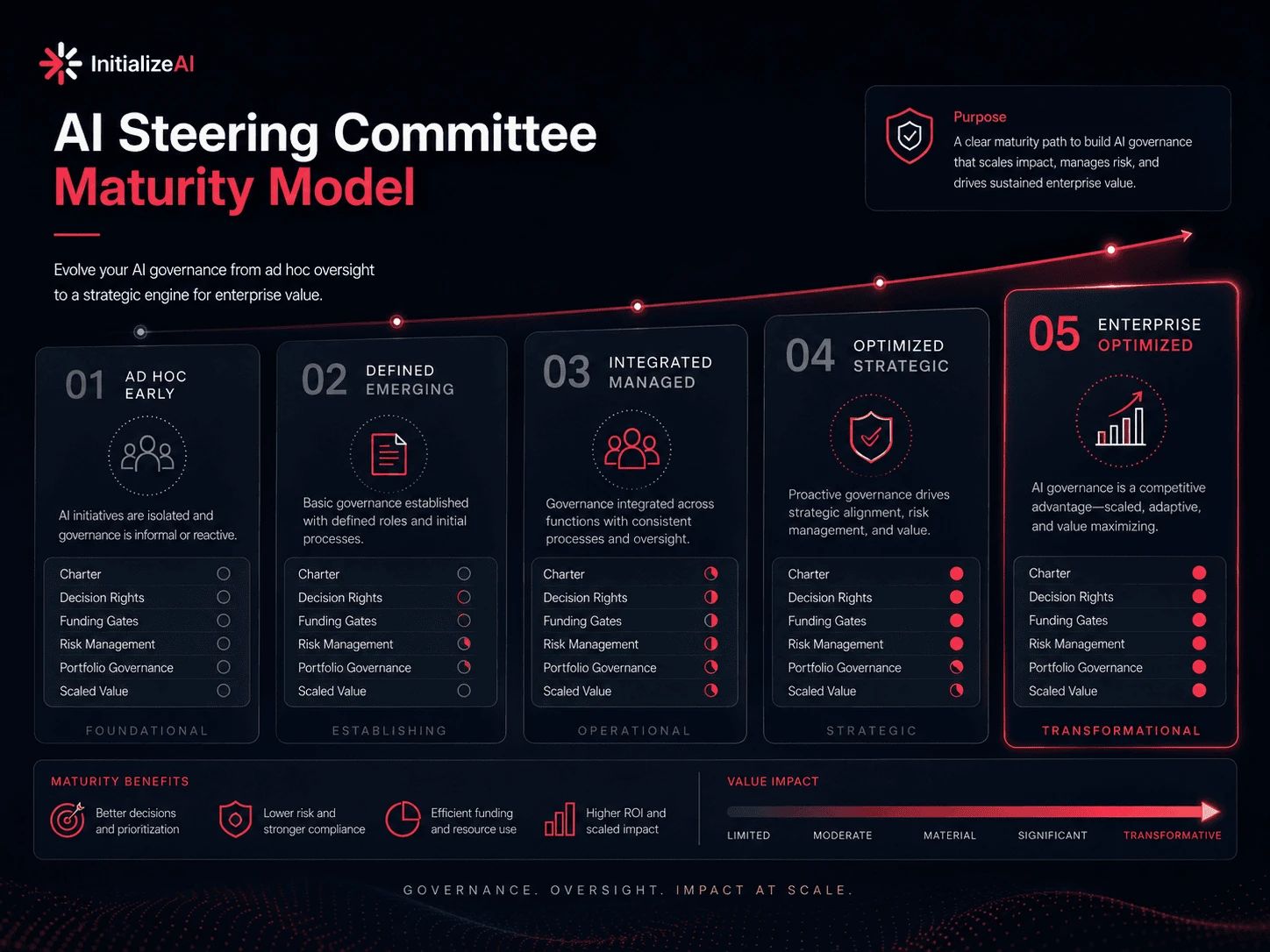
Teams experiment independently. There is no formal intake, policy, risk register, vendor review, or committee cadence.
Next step: inventory active AI use.Leaders discuss AI activity, but decision rights, evidence requirements, and escalation paths remain unclear.
Next step: define intake and decision owners.Committee charter exists. Membership, cadence, intake, prioritization, and decision records are established.
Next step: connect to risk, vendor, and pilot artifacts.Committee manages AI initiatives as a portfolio with risk, value, funding, vendor, and adoption visibility.
Next step: use dashboard evidence for scale decisions.Governance is embedded into strategy, pilots, vendor review, risk management, funding, adoption, monitoring, and continuous improvement.
Next step: refresh cadence, thresholds, and operating model.Common Mistakes
Why it hurts: The group can discuss AI but cannot make decisions.
How the charter helps: It defines authority, decision rights, and escalation paths.
Why it hurts: Meetings become informational instead of decision-oriented.
How the charter helps: It separates dashboard reporting from decision requests.
Why it hurts: AI becomes a technology program instead of an operating-value program.
How the charter helps: It requires business owners and executive sponsors.
Why it hurts: AI tools enter the organization without consistent review.
How the charter helps: It defines vendor review pathways and required evidence.
Why it hurts: Governance becomes separate from pilot design.
How the charter helps: It connects risk register review to pilot and scale decisions.
Why it hurts: Teams forget why something was approved, paused, escalated, or rejected.
How the charter helps: It requires decision records and follow-up owners.
Why it hurts: Requests arrive informally and politically.
How the charter helps: It creates a common path for ideas, vendors, pilots, risks, and exceptions.
Why it hurts: AI priorities do not match capacity, budget, or implementation reality.
How the charter helps: It includes finance and resource review.
Why it hurts: Pilots end without an executive decision.
How the charter helps: It requires scale/revise/stop decision gates.
Why it hurts: The governance model fails to adapt as tools, laws, vendors, risks, and AI maturity evolve.
How the charter helps: It defines review cadence and continuous improvement.
Interactive Planning Tool
Directionally assess whether your organization is ready to operate an AI steering committee or needs to clarify mandate, membership, decision rights, intake, or governance artifacts first.
This directional tool is for planning support only. It is not legal advice, compliance advice, board governance advice, or a formal maturity assessment.
InitializeAI Execution System
The steering committee charter turns governance artifacts into a practical operating model for AI decisions, funding, escalation, and scaling.
Editable Committee Charter
Use the on-page preview to understand the framework, or request the editable version and we will help you adapt the charter to your executive structure, risk tolerance, AI portfolio, vendor landscape, decision rights, funding model, and governance cadence.
No AI governance theater. A practical committee charter designed to help leaders make accountable AI decisions and move from scattered activity to governed execution.
FAQ
An AI Steering Committee Charter is a governance document that defines the purpose, authority, membership, decision rights, review cadence, intake process, escalation rules, reporting expectations, and accountability model for an organization's AI steering committee.
Organizations need an AI steering committee when AI activity spans multiple departments, vendors, data sources, policies, risks, pilots, and budgets. The committee creates a repeatable executive mechanism for prioritizing, approving, governing, funding, monitoring, and scaling AI initiatives.
A strong committee usually includes executive sponsorship, business operations, technology, data, security, privacy, legal, compliance, procurement, finance, HR, risk, and rotating business-unit representatives depending on the AI use cases being reviewed.
The committee may review or decide AI use-case prioritization, pilot approvals, vendor approvals, risk escalations, policy exceptions, funding alignment, high-risk AI use, and scale/revise/stop decisions after pilots.
Many organizations use a monthly steering committee cadence, with more frequent working reviews for active pilots, urgent risk escalations, or vendor decisions, plus quarterly executive portfolio reviews.
The AI governance policy defines rules and review expectations. The steering committee charter defines the executive body, decision rights, membership, cadence, and operating model that helps apply those rules to real use cases, vendors, pilots, risks, and investments.
Useful artifacts include an AI use case intake form, AI use case prioritization matrix, workflow automation opportunity map, AI pilot charter, AI governance policy, AI risk register, AI vendor evaluation checklist, AI decision log, AI portfolio dashboard, and AI roadmap.
Escalations may include high-risk AI use cases, unresolved residual risk, sensitive data use, customer-facing or public-facing AI, vendor concerns, policy exceptions, pilot incidents, funding conflicts, and scale decisions.
No. This charter is a practical AI governance operating-model starting point, not legal advice, compliance advice, board governance advice, or a formal risk determination. Organizations should adapt it with executive leadership, legal, compliance, security, privacy, procurement, data, HR, finance, and business stakeholders.
Yes. InitializeAI can help organizations define the committee mandate, membership, decision rights, intake process, governance artifacts, risk escalation paths, portfolio dashboard, meeting cadence, and operating model for responsible AI execution.